


Major US allies in Asia yesterday welcomed the UN Security Council’s unanimous vote to step up sanctions on North Korea, with its profitable textile exports now banned and fuel supplies to the reclusive North capped after its sixth nuclear test.
Japan and South Korea said after the passage of the US-drafted Security Council resolution that they were prepared to apply more pressure if Pyongyang refused to end its aggressive development of nuclear weapons and ballistic missiles.
Monday’s decision was the ninth sanctions resolution unanimously adopted by the 15-member Security Council since 2006 over North Korea’s ballistic missile and nuclear programs.
A tougher initial US draft was weakened to win the support of China, Pyongyang’s main ally and trading partner, and Russia, both of which hold veto power in the council.
“We don’t take pleasure in further strengthening sanctions today. We are not looking for war,” US Ambassador to the UN Nikki Haley told the council after the vote. “The North Korean regime has not yet passed the point of no return.”
“If it agrees to stop its nuclear program, it can reclaim its future ... if North Korea continues its dangerous path, we will continue with further pressure,” said Haley, who credited a “strong relationship” between US President Donald Trump and Chinese President Xi Jinping (習近平) for the successful negotiations.
UN member states are now required to halt imports of textiles from North Korea, its second-largest export after coal and other minerals last year that totaled US$752 million and accounted for a quarter of its income from trade, South Korean data showed.
Nearly 80 percent went to China.
“This resolution also puts an end to the regime making money from the 93,000 North Korean citizens it sends overseas to work and heavily taxes,” Haley said.
“This ban will eventually starve the regime of an additional [US]$500 million or more in annual revenues,” she said.
The South Korean Blue House yesterday said the only way for Pyongyang to end diplomatic isolation and become free of economic pressure was to end its nuclear program and resume dialogue.
“North Korea needs to realize that a reckless challenge against international peace will only bring about even stronger international sanctions against it,” the Blue House said.
However, China’s official Xinhua news agency said in a commentary that the Trump administration was making a mistake by rejecting diplomatic engagement with the North.
“The US needs to switch from isolation to communication in order to end an ‘endless loop’ on the Korean Peninsula where nuclear and missile tests trigger tougher sanctions and tougher sanctions invite further tests,” Xinhua said.
Japanese Prime Minister Shinzo Abe quickly welcomed the resolution and said after the vote it was important to change North Korea’s policy by imposing a higher level of pressure.
The resolution imposes a ban on condensates and natural gas liquids, a cap of 2 million barrels a year on refined petroleum products, and a cap on crude oil exports to North Korea at current levels. China supplies most of North Korea’s crude.

SILENCING CRITICS: In addition to blocking Taiwan, China aimed to prevent rights activists from speaking out against authoritarian states, a Cabinet department said The Ministry of Foreign Affairs (MOFA) yesterday condemned transnational repression by Beijing after RightsCon, a major digital human rights conference scheduled to be held in Zambia this week, was abruptly canceled due to Chinese pressure over Taiwanese participation. This year’s RightsCon, the world’s largest conference discussing issues “at the intersection of human rights and technology,” was scheduled to take place from tomorrow to Friday in Lusaka, and expected to draw 2,600 in-person attendees from 150 countries, along with 1,100 online participants. However, organizers were forced to cancel the event due to behind-the-scenes pressure from China, the ministry said, expressing its “strongest condemnation”
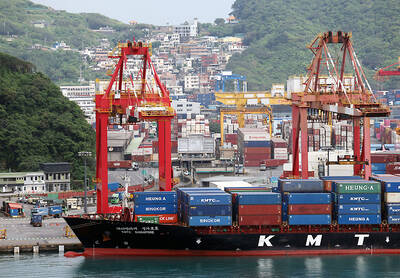
Taiwan’s economy grew far faster than expected in the first quarter, as booming demand for artificial intelligence (AI) applications drove a surge in exports, spilling over into investment and consumption, the Directorate-General of Budget, Accounting and Statistics (DGBAS) said yesterday. GDP growth was 13.69 percent year-on-year during the January-to-March period, beating the DGBAS’ February forecast by 2.23 percentage points and marking the most robust growth in nearly four decades, DGBAS senior official Chiang Hsin-yi (江心怡) told a news conference in Taipei. The result was powered by exports, which remain the backbone of Taiwan’s economy, Chiang said. Outbound shipments jumped 51.12 percent year-on-year to
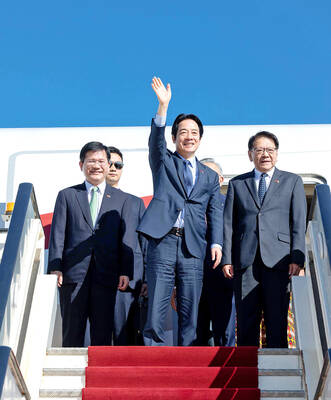
DELAYED BUT DETERMINED: The president’s visit highlights Taiwan’s right to international engagement amid regional pressure from China President Willaim Lai (賴清德) yesterday arrived in Eswatini, more than a week after his planned visit to Taiwan’s sole African ally was suspended because of revoked overflight permits. “The visit, originally scheduled for April 22, was postponed due to unforeseen external factors,” Lai wrote on social media. “After several days of careful arrangements by our diplomatic and national security teams, we successfully arrived today.” Lai said he looked forward to further deepening Taiwan-Eswatini relations through closer cooperation in the economy, agriculture, culture and education, as well as advancing the nation’s international partnerships. The president was initially scheduled to arrive in time to celebrate
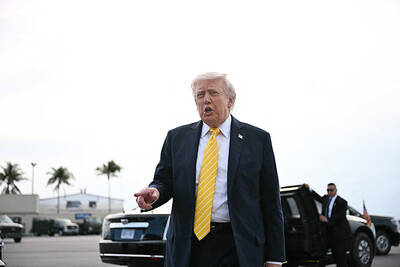
Iran’s Islamic Revolutionary Guard Corp (IRGC) yesterday said the US faced a choice between an “impossible” military operation or a “bad deal” with Tehran, after US President Donald Trump disparaged Iran’s latest peace proposal. Negotiations between the two countries have been deadlocked since a ceasefire came into effect on April 8, with only one round of direct peace talks held so far. Iran’s Tasnim and Fars news agencies reported that Tehran had submitted a 14-point proposal to mediator Pakistan, but Trump was quick to cast doubt on it. “I will soon be reviewing the plan that Iran has just sent to us, but


 RSS
RSS