


Taiwan’s medal tally at the Taipei Summer Universiade yesterday surged to 26 gold medals, 34 silvers and 30 bronzes following extraordinary performances by the nation’s badminton, table tennis and tennis teams on the final day of competition in most sports.
As of press time last night, the nation was third on the medal stable, with Japan first and South Korea second.
In badminton, Wang Chi-ling (王齊麟) and Lee Chia-hsin (李佳馨) won gold in the mixed doubles final. Although they lost the first game 21-12 to Malaysia’s Nur Mohd Azyriyn Ayub and Goh Yea Ching, Wang and Lee secured first place by winning the remaining games 21-16, 21-14.
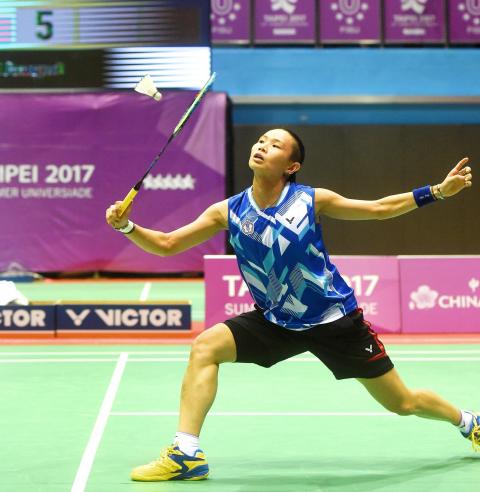
Photo: Fang Pin-chao, Taipei Times
The winning momentum continued as world No. 1 Tai Tzu-ying (戴資穎) clinched another gold medal by toppling South Korea’s Lee Jangmi in straight sets 21-9, 21-13 in 22 minutes.
Tai dominated the gold-medal match, confounding her opponent with various strategies.
Lee Jangmi had lost to Tai in the semi-finals of this year’s Badminton Asia Championships and at the 2012 BWF World Junior Championships.
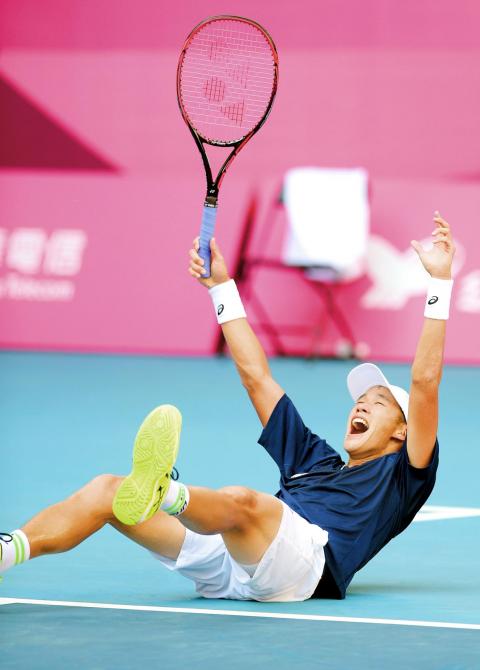
Photo: Chang Chia-ming, Taipei Times
Tai, who won bronze and silver in previous Universiades, did not drop a game on her way to gold in Taipei.
Wang Tzu-wei (王子維) extended the “gold rush” by delivering the nation’s third badminton gold, crushing Japan’s Kenta Nishimoto 21-15, 21-16 in 36 minutes.
Late last night, Hsu Ya-ching (許雅晴) and Wu Ti-jung (吳玓蓉) won the fourth badminton gold of the day in the women’s doubles final against Thailand’s Chayanit Chaladchalam and Phataimas Muenwong.
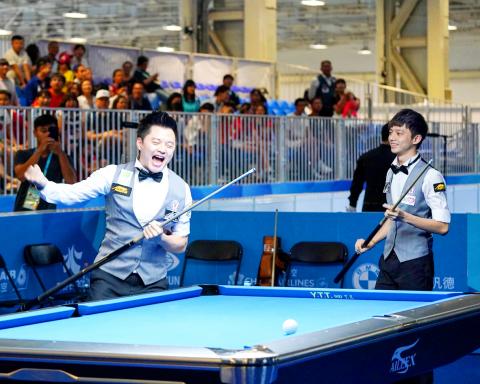
Photo: CNA
Taiwan’s Lee Yang (李洋) and Hsu Ya-ching (許雅晴), and Russia’s Rodion Alimov and Alina Davletova shared bronze in mixed doubles, while Chiang Mei-hui (江美惠) and Malaysia’s Yang Li-lian shared bronze in women’s singles.
In tennis, Jason Jung (莊吉生) reached his goal of winning men’s singles gold at his first Universiade, by beating South Korea’s Hong Seongchan in straight sets. Like Tai, Jung did not drop a set on his way to securing gold.
In the women’s singles, Lee Ya-hsuan (李亞軒) took silver after losing 6-7 (5/7), 6-4, 1-6 to Thailand’s Varatchaya Wongteanchai in a three-hour uphill battle.
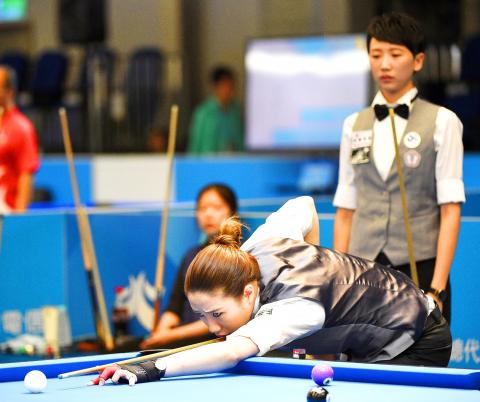
Photo: Chen Chih-chu, Taipei Times
After the loss, Lee Ya-hsuan buried her face in a towel and broke into tears, later saying that she was sorry for letting her supporters down.
“I would be lying if I said I never thought about quitting, but people came and cheered for me. My coach supported me,” she said. “I really had no reason to quit. I would fight until the end, unless I fell on the ground and could not get up.”
In table tennis, Cheng I-ching (鄭怡靜) made history as the nation’s first women’s singles finalist at a Universiade. She took silver after losing to South Korea’s Jeon Jihee 11-5, 5-11, 10-12, 11-7, 9-11, 8-11
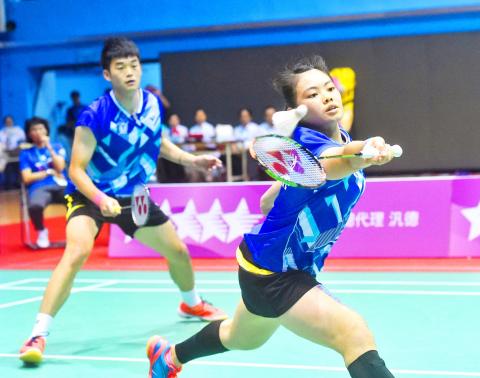
Photo: Fang Pin-chao, Taipei Times
Before Cheng’s feat, the nation’s best record was set by Huang Yi-hua (黃怡樺), who reached the semi-finals in 2009.
Chen Chien-an (陳建安) also had a personal best at a Universiade by reaching the men’s singles final. He took silver after losing to Japan’s Masataka Morizono 6-11, 11-6, 7-11, 8-11, 8-11.
Taiwan yesterday swept the team titles in billiards to add two gold medals.
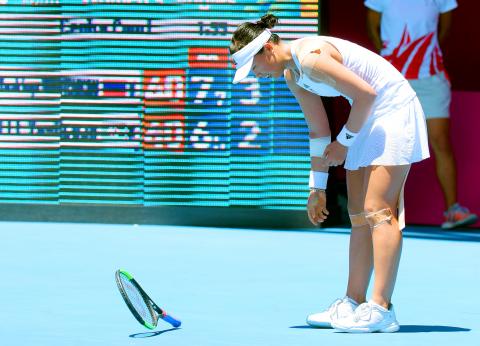
Photo: Chang Chia-ming, Taipei Times
In women’s 9-ball doubles, Wei Tzu-chien (魏子茜) and Kuo Szu-ting (郭思廷) faced off against South Korea’s Jang Yoon-hye and Jeong Eun-su at the Taipei Flora Expo Dome.
Wei, a student at Min Chuan University, and Kuo, who is enrolled at the University of Taipei, have over the past few years competed at the Amway Cup and other international competitions. They racked up a 9-3 win against the Jang and Jeong for the gold.
In wushu, Taiwan’s Hsu Kai-kuei (許凱貴) won gold in men’s combined taolu.
He scored 9.56 for his nanquan routine, which, when added to his 9.62 in nangun on Sunday, secured him first place overall.
In men’s 9-ball doubles, rising stars Ko Ping-yi (柯秉逸) and Ko Ping-chung (柯秉中) took on Japan’s Kengo Suzuki and Takayuki Shishido in the final.
The Ko brothers of coastal Shengang Township (伸港) in Changhua County, who are students at Taipei University of Marine Technology, overpowered their opponents to take a 10-4 victory for gold.
“We are elated to have won the gold medal and hope to build upon this success for good results in future international competitions,” Ko Ping-chung said. “We would like to see more support for the nation’s cue sports players to shine in big events.”
In other billiards finals yesterday, Mongolia’s Narantuya Bayarsaikhan and Uyanga Battulga took home bronze with a 9-3 triumph over Singapore’s Ong Rui-yi and Sarah Wong in women’s 9-ball doubles.
Norway’s Eirik Riisnaes and Matias Saetre prevailed over Singapore’s Leong Jun-jie and Hwang Mo-chi for bronze in men’s 9-ball doubles.
In rounds on Sunday, Taiwan’s Hsu Jui-an (許睿安) beat compatriot Liu Cheng-chieh (劉政杰) 11-3 for gold in the men’s 9-ball singles, while Ku Cheng-chin (古正晴) defeated Mongolia’s Narantuya Bayarsaikhan 9-6 for first place in women’s 9-ball singles.
Lin Shang-yi (林上義), head coach of the nation’s billiards team, said he was satisfied with the results, as Taiwanese athletes pocketed four golds, one silver and one bronze.
“We have proved to everyone at the Universiade that Taiwan is very strong in this event, and we want to improved government policies and public support to help develop cue sports,” Lin said. “Today we have shown that Taiwanese pool players have the capability and determination to give their best when thrust into the limelight, and can prove that we are among the best in the world.”
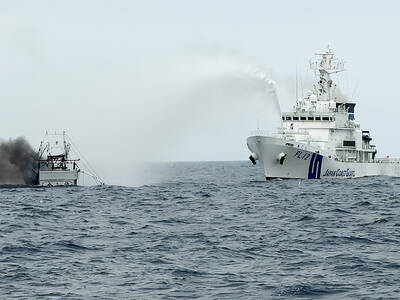
CREDIT-GRABBER: China said its coast guard rescued the crew of a fishing vessel that caught fire, who were actually rescued by a nearby Taiwanese boat and the CGA Maritime search and rescue operations do not have borders, and China should not use a shipwreck to infringe upon Taiwanese sovereignty, the Coast Guard Administration (CGA) said yesterday. The coast guard made the statement in response to the China Coast Guard (CCG) saying it saved a Taiwanese fishing boat. The Chuan Yu No. 6 (全漁6號), a fishing vessel registered in Keelung, on Thursday caught fire and sank in waters northeast of Diaoyutai Islands (釣魚台). The vessel left Keelung’s Badouzih Fishing Harbor (八斗子漁港) at 3:35pm on Sunday last week, with seven people on board — a 62-year-old Taiwanese captain surnamed Chang (張) and six
LEVERAGE: China did not ‘need to fire a shot’ to deny Taiwan airspace over Africa when it owns ‘half the continent’s debt,’ a US official said, calling it economic warfare The EU has raised concerns about overflight rights following the delay of President William Lai’s (賴清德) planned state visit to the Kingdom of Eswatini after three African nations denied overflight clearance for his charter at the last minute. Taiwanese allies Paraguay and Saint Kitts and Nevis, as well as several US lawmakers and the Inter-Parliamentary Alliance on China (IPAC) condemned China for allegedly pressuring the countries. Lai was scheduled to fly directly to Taiwan’s only African ally from yesterday to Sunday to celebrate the 40th anniversary of King Mswati III’s accession and his 58th birthday, but Seychelles, Mauritius and Madagascar suddenly revoked
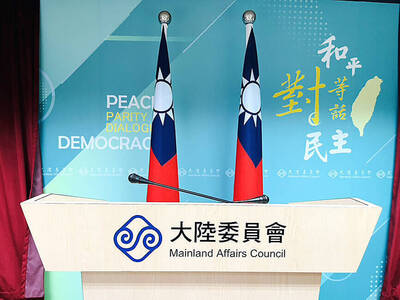
RISKY BUSINESS: The ‘incentives’ include initiatives that get suspended for no reason, creating uncertainty and resulting in considerable losses for Taiwanese, the MAC said China’s “incentives” failed to sway sentiment in Taiwan, as willingness to work in China hit a record low of 1.6 percent, a Ministry of Labor survey showed. The Directorate-General of Budget, Accounting and Statistics (DGBAS) also reported that the number of Taiwanese workers in China has nearly halved from a peak of 430,000 in 2012 to an estimated 231,000 in 2024. That marked a new low in the proportion of Taiwanese going abroad to work. The ministry’s annual survey on “Labor Life and Employment Status” includes questions respondents’ willingness to seek employment overseas. Willingness to work in China has steadily declined from
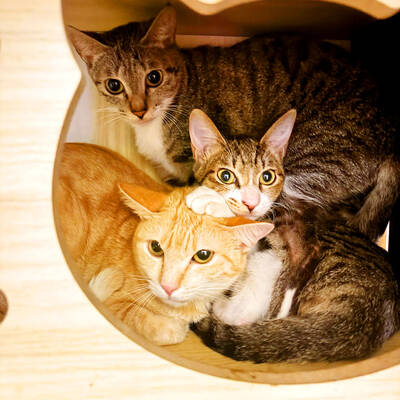
The number of pet cats in Taiwan surpassed that of pet dogs for the first time last year, reaching 1,742,033, a 32.8 percent increase from 2023, the Ministry of Agriculture said yesterday, citing a survey. By contrast, the number of pet dogs declined slightly by 1.2 percent over the same period to 1,462,528, the ministry said. Despite the shift, households with dogs still slightly outnumber those with cats by 1.2 percent. However, while the number of households with multiple dogs has remained relatively stable, households keeping more than two cats have increased, contributing to the overall rise in the feline population. The trend


 RSS
RSS