


The government has asked Philippine authorities to arrest and extradite Chen Yu-hao (陳由豪), one of the nation’s most-wanted fugitives, Ministry of Foreign Affairs (MOFA) spokeswoman Eleanor Wang (王珮玲) said yesterday.
The ministry and the Taipei Economic and Cultural Office in Manila have made several requests to Philippine authorities to extradite Chen, former chairman of conglomerate Tuntex Group (東帝士), after learning that he is planning a major investment project in the Philippines, Wang told reporters.
Chen is planning to invest US$369 billion in the Philippines as part of China’s “One Belt, One Road” initiative, which seeks to build a modern Silk Road linking Asia, Africa and Europe, she said.

Photo: CNA
Wang warned Manila about risks related to investments by Chen, as he is one of the top economic criminals to have fled Taiwan.
Despite the warning, sources from the Philippine Economic Zone Authority (PEZA) said the country welcomes Chen’s investment.
PEZA Director Charito Ching Plaza was very enthusiastic about proposed projects from Xiang Lu Dragon Group (翔鷺騰龍集團), which Chen owns, including an 85-story building in Manila and a petrochemical facility in Pangasinan province.
Asked whether the investment would be beneficial, a Filipino official who spoke on condition of anonymity said it was hard to judge based on Chen’s history, but it was evident that Chen has “connections” in the Philippines by how he was able to have his name removed from a blacklist.
On June 6, Chen was denied entry into the Philippines because he was blacklisted at the request of Taiwan. He asked for assistance from the Chinese embassy in the Philippines, but had returned to China by the time he was cleared for entry on June 9.
He then applied for a Philippine visa on June 23 and visited the country on July 7.
Chen acquired Chinese citizenship in 2013. Taiwan has since revoked his Republic of China citizenship.
“Taiwan has made repeated requests to the Philippines to extradite Chen to Taiwan, demonstrating Taiwan’s determination to bring the fugitive to justice,” Wang said.
The Philippines has denied Taiwan’s request, saying Chen had entered the country from China and it could only repatriate Chen to China.
Deputy Minister of Justice Chen Ming-tang (陳明堂) said the ministry has asked Beijing to repatriate Chen Yu-hao in accordance with the Cross-Strait Joint Crime-Fighting and Judicial Mutual Assistance Agreement (海峽兩岸共同打擊犯罪及司法互助協議), adding that the ministry would continue its efforts to secure his extradition from the Philippines.
In January last year, the government confiscated 24 plots of land in Taipei owned by Chen after they once again attracted no interest at an auction held by the Ministry of Justice. Their sale is intended to raise money to pay Chen’s outstanding tax bill.
Chen, who holds a US passport, fled to the US after dissolving Tuntex Group in 2001, when Taiwanese authorities launched a probe into allegations he embezzled NT$70 billion (US$2.31 billion at the current exchange rate). The statute of limitations on the case expired during his stay in the US.
Chen also owes the Taiwanese government NT$415 million in personal income taxes.
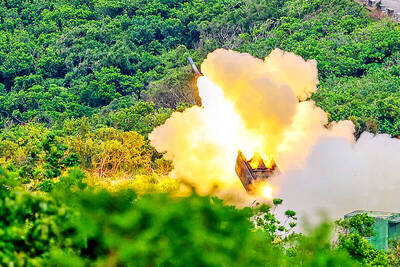
PRECISION STRIKES: The most significant reason to deploy HIMARS to outlying islands is to establish a ‘dead zone’ that the PLA would not dare enter, a source said A High Mobility Artillery Rocket System (HIMARS) would be deployed to Penghu County and Dongyin Island (東引) in Lienchiang County (Matsu) to force the Chinese military to retreat at least 100km from the coastline, a military source said yesterday. Taiwan has been procuring HIMARS and Army Tactical Missile Systems (ATACMS) from the US in batches. Once all batches have been delivered, Taiwan would possess 111 HIMARS units and 504 ATACMS, which have a range of 300km. Considering that “offense is the best defense,” the military plans to forward-deploy the systems to outlying islands such as Penghu and Dongyin so that
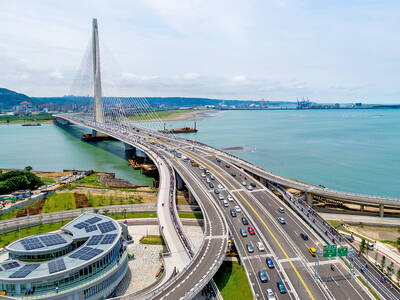
The Ministry of Transportation and Communications yesterday inaugurated the Danjiang Bridge across the Tamsui River in New Taipei City, saying that the structure would be an architectural icon and traffic artery for Taiwan. Feted as a major engineering achievement, the Danjiang Bridge is 920m long, 211m tall at the top of its pylon, and is the longest single-pylon asymmetric cable-stayed bridge in the world, the government’s Web site for the structure said. It was designed by late Iraqi-British architect Zaha Hadid. The structure, with a maximum deck of 70m, accommodates road and light rail traffic, and affords a 200m navigation channel for boats,
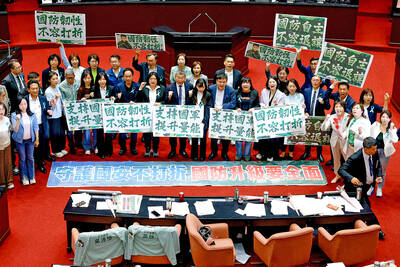
WHAT WAS ALL THAT FOR? Jaw Shaw-kong said that Cheng Li-wen had pushed for more drastic cuts and attacked him, just for the outcome to be nearly identical to his bill The legislature yesterday passed a supplementary budget bill to fund the purchase of separate packages of US military equipment, with the combined amount of spending capped at NT$780 billion (US$24.8 billion). The Chinese Nationalist Party (KMT) and Taiwan People’s Party (TPP) used their legislative majority to pass the bill, which runs until 2033 and has two main funding provisions. One was for NT$300 billion of arms sales already approved by the US for Taiwan on Dec. 17 last year, the other was for NT$480 billion for another arms package expected to be announced by Washington. The bill, which fell short of the NT$1.25
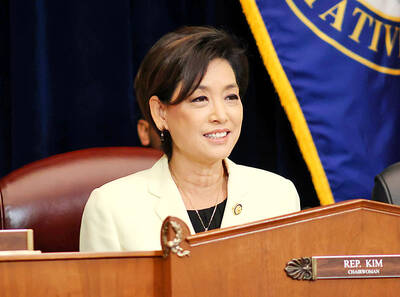
‘CLEAR MESSAGE’: The bill would set up an interagency ‘tiger team’ to review sanctions tools and other economic options to help deter any Chinese aggression toward Taiwan US Representative Young Kim has introduced a bill to deter Chinese aggression against Taiwan, calling for an interagency “tiger team” to preplan coordinated sanctions and economic measures in response to possible Chinese military or political action against Taiwan. “[Chinese President] Xi Jinping [習近平] has directed the People’s Liberation Army to be ready to invade Taiwan by 2027. China has a plan. America should have one too,” Kim said in a news release on Thursday last week. She introduced the “Deter PRC [People’s Republic of China] aggression against Taiwan act” to “ensure the US has a coordinated sanctions strategy ready should


 RSS
RSS