


CPC Corp, Taiwan (CPC, 台灣中油) chairman Derek Chen (陳金德) yesterday tendered his resignation amid mounting criticism over a nationwide blackout on Tuesday.
Premier Lin Chuan (林全) has approved Chen’s resignation, Executive Yuan spokesman Hsu Kuo-yung (徐國勇) said last night.
Chen’s decision follows Lee Chih-kung’s (李世光) resignation as minister of economic affairs on Tuesday, when a massive blackout hit businesses and households nationwide.
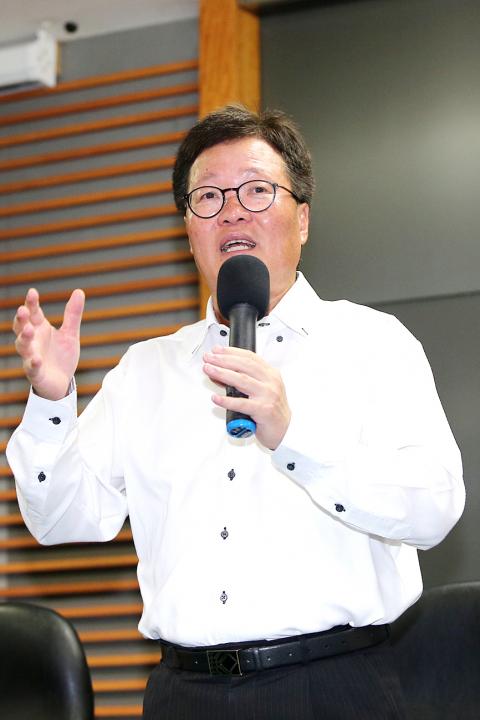
Photo: CNA
The outage was caused by human error during the replacement of power supply system components at a natural gas power plant in Taoyuan’s Datan Township (大潭).
“I tendered my verbal resignation to the premier on Wednesday, but he asked me to clear out doubts [about the incident] before leaving,” Chen told a media conference in Taipei, referring to questions whether CPC or its contractor Lumax International Corp (巨路) was responsible for the power disruption.
Chen said the state-owned refiner had investigated the blackout and shared its findings with the Cabinet earlier this week, as well as offered suggestions for reform.
“As so many people were affected by the incident, I wanted to extend CPC’s deepest apologies to the public and, as the chairman, I have to accept responsibility,” Chen said.
He denied that he was stepping down because of political interference or pressure from the Cabinet.
He also declined to talk about possible candidates for the position, saying he should not interfere with the company’s future affairs.
On Thursday, Chen said that CPC would seek to terminate its contracts with Lumax in the near term.
He said that CPC’s relationship with its contractors has been “too good” for too long, which resulted in flawed maintenance work.
However, at yesterday’s conference CPC spokeswoman Ann Bih (畢淑蒨) said CPC would first discuss contract terms with Lumax to determine responsibility in the blackout.
CPC vice president J.Z. Fang (方振仁), who is in charge of the company’s industrial safety department, announced the results of the company’s investigation into the incident, which he said confirmed what CPC had said earlier.
CPC and Lumax engineers were replacing power supply equipment for a control system at the Datan Natural Gas Power Plant on Tuesday, but forgot to switch the system from automatic to manual mode before starting the work, according to the findings of the 10-member investigation team.
Fang said the misstep caused two valves to automatically close, shutting off gas supplies to six generators, he said.
CPC has not yet made a decision on disciplinary measures, Fang said, declining to provide a timetable.
Additional reporting by Reuters

‘NO SECURITY RISK’: The Railway Bureau reassured the public that the technicians’ activities were limited to technical guidance and did not involve sensitive systems The Railway Bureau yesterday said it had invited eight Chinese technicians to assist with an airport MRT construction project. The bureau issued the confirmation after an Internet user said Chinese nationals had entered the construction zone of Taiwan Taoyuan International Airport’s Terminal 3 project. They asked why “individuals from an enemy state” were allowed access to such a major national infrastructure project, which raised serious concerns over Taiwan’s industrial safety, sensitive systems and information security. The bureau’s Northern Region Engineering Branch Office said subcontractor Taiwan Handle Industrial Co (台灣手把工業) of the Taoyuan airport MRT’s “Contract No. CU05 Project A14 Station Civil, MEP &

A US uncrewed surface vessel (USV) encountered multiple Chinese warships during an autonomous transit of the Taiwan Strait, US defense company Seasats said in a statement on Wednesday. Seasats announced that a Lightfish USV had completed the first autonomous transit of the Taiwan Strait. Over five days, the USV traversed the entire length of the Strait while constantly monitoring surface vessel traffic, the company said. The Lightfish encountered multiple Chinese warships, one of which was a Chinese People’s Liberation Army Navy (PLAN) Type 056 corvette, it said. The Chinese vessels were operating “well within Taiwan’s exclusive economic zone without transmitting their identity via the
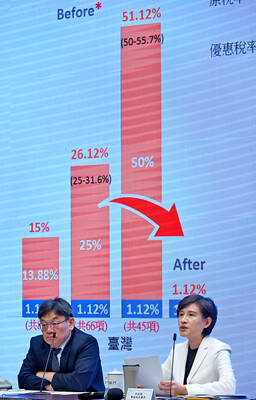
GREATER REACH? Auto parts and wood products would face tariffs of up to 15%, matching those targeting the EU, Japan and South Korea, Vice Premier said The US has announced that preferential tariff treatment for Taiwan’s non-semiconductor Section 232 goods would take effect retroactively from May 1, the Executive Yuan said yesterday. The US government yesterday posted a notice on the Federal Register’s public inspection Web site previewing tariff concessions for Taiwan under a memorandum of understanding (MOU) on Taiwan-US investment after two months of negotiations. The MOU signed on Jan. 15 stipulated three major preferential tariff arrangements: a 15 percent “reciprocal” tariff rate for Taiwan without stacking most-favored nation (MFN) rates; preferential Section 232 treatment for semiconductors and related products; and preferential Section 232 treatment for non-semiconductor

The National Chungshan Institute of Science and Technology yesterday showcased its locally developed variants of the Vision 60 robotic patrol dog, which it plans to deploy on the nation’s outlying territories in the South China Sea. The variants were produced under the Joint Lab project — created by the institute and domestic companies — and assembled with domestically produced motors, lenses and artificial intelligence (AI) systems alongside licensed tech from the US, Missile and Rocket Systems Research Division deputy director Jen Kuo-kang (任國光) told the media event at a military base in Taipei’s Dazhi (大直) area. Taiwan has built up its strengths


 RSS
RSS