


President Tsai Ing-wen (蔡英文) and Premier Lin Chuan (林全) yesterday apologized for Tuesday’s massive blackouts, while Vice Minister of Economic Affairs Shen Jong-chin (沈榮津) has been appointed to succeed outgoing Minister of Economic Affairs Lee Chih-kung (李世光).
“On behalf of the government, I apologize for the inconvenience and concerns caused by the power outage. The incident should not have occurred at all,” Tsai said ahead of a Democratic Progressive Party Central Standing Committee meeting.
“Power supply is not simply an issue that affects people’s lives, but is a matter of national security,” she said.

Photo: Chen Chih-chu, Taipei Times
The nation is running on a vulnerable power system that can be easily paralyzed by a natural disaster or human error, so it is the government’s top priority to re-examine and reinforce the nation’s infrastructure to ensure supply stability, but few efforts were made to improve grid reliability over the years, Tsai said.
The government has learned more about the importance of protecting basic infrastructure during a three-day drill this month to test security for political and military leaders in an emergency, and she ordered the government to reform the security measures of basic infrastructure to prepare for conflict scenarios, Tsai said.
“The outage tells us that improving grid security and building a distributed, renewable generation system is urgent and correct,” Tsai said, reaffirming the energy transition objectives of her administration.
Meanwhile, Lin also delivered an apology in an Executive Yuan news conference and announced that Shen has been named acting minister after Lee tendered his resignation immediately after the blackouts.
Shen had also tendered his resignation, but it was decided that he should stay and lead the ministry through the transition period, Lin said.
“The incident was caused purely by human error. It is apparent there are grave mistakes with our management system,” Lin said.
“The blackouts, preceded by the shutdown of Ho-Ping Power Plant [in Hualien] due to a typhoon, should not be considered an isolated incident. The whole series of events necessitates a complete re-examination of the nation’s power supply structure,” Lin said.
The Cabinet is to form an external task force to investigate state-run oil refiner CPC Corp, Taiwan (CPC, 台灣中油), whose mismanagement of a natural gas supply system appeared to have caused the power disruption, and Taiwan Power Co (Taipower, 台電), Lin said.
The task force, which would likely consist of international specialists, would examine the national power system and put forward improvement proposals.
While the nation has to move toward a decentralized power distribution system, a secondary, supportive system is needed for major power plants to ensure power grid stability, Lin said.
During the three-day drill, it was found that the infrastructure security measures were “very vulnerable” and could not cope with emergency situations, Lin said.
There is no evidence to suggest the power disruption was deliberately caused, but the government has to prepare for intentional or terrorist attempts to damage power infrastructure, he said.
The phase-out of nuclear power has no bearing on the power outage, because the incident caused the grid to lose about 15 percent of the total supply, which is more than the nation’s nuclear capacity.
“The incident is an issue of power grid stability and has nothing to do with nuclear power. They should not be lumped together to obscure the points,” he said.
Lawmakers have demanded Lin make a formal report at the Legislative Yuan about the power outage, which Lin said he was willing to do.

South Korea has adjusted its electronic arrival card system to no longer list Taiwan as a part of China, a move that the Ministry of Foreign Affairs said would help facilitate exchanges between the two sides. South Korea previously listed “Taiwan” as “Taiwan (China)” in the drop-down menus of its online arrival card system, where people had to fill out where they came from and their next destination. The ministry had requested South Korea make a revision and said it would change South Korea’s name on Taiwan’s online immigration system from “Republic of Korea” to “Korea (South),” should the issue not be

Tainan, Taipei and New Taipei City recorded the highest fines nationwide for illegal accommodations in the first quarter of this year, with fines issued in the three cities each exceeding NT$7 million (US$220,639), Tourism Administration data showed. Among them, Taipei had the highest number of illegal short-term rental units, with 410. There were 3,280 legally registered hotels nationwide in the first quarter, down by 14 properties, or 0.43 percent, from a year earlier, likely indicating operators exiting the market, the agency said. However, the number of unregistered properties rose to 1,174, including 314 illegal hotels and 860 illegal short-term rental
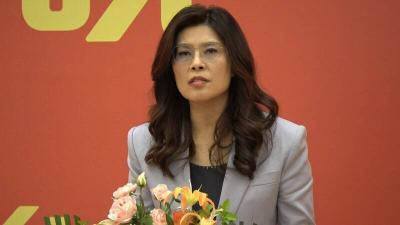
Both sides of the Taiwan Strait share a political foundation based on the “1992 consensus” and opposition to Taiwanese independence, Chinese Nationalist Party (KMT) Chairwoman Cheng Li-wun (鄭麗文) today said during her meeting with Chinese President Xi Jinping (習近平). Both sides of the Strait should plan and build institutionalized and sustainable mechanisms for dialogue and cooperation based on that foundation to make peaceful development across the Strait irreversible, she said. Peace is a shared moral value across the Strait, and both sides should move beyond political confrontation to seek institutionalized solutions to prevent war, she said. Mutually beneficial cross-strait relations are what the
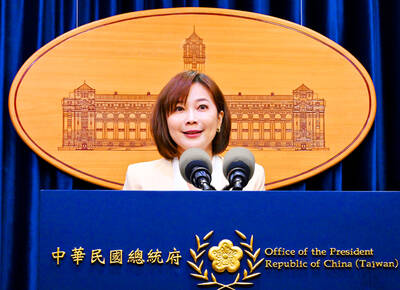
ECONOMIC COERCION: Such actions are often inconsistently applied, sometimes resumed, and sometimes just halted, the Presidential Office spokeswoman said The government backs healthy and orderly cross-strait exchanges, but such arrangements should not be made with political conditions attached and never be used as leverage for political maneuvering or partisan agendas, Presidential Office spokeswoman Karen Kuo (郭雅慧) said yesterday. Kuo made the remarks after China earlier in the day announced 10 new “incentive measures” for Taiwan, following a landmark meeting between Chinese President Xi Jinping (習近平) and Chinese Nationalist Party (KMT) Chairwoman Cheng Li-wun (鄭麗文) in Beijing on Friday. The measures, unveiled by China’s Xinhua news agency, include plans to resume individual travel by residents of Shanghai and China’s Fujian


 RSS
RSS