


The Taipei District Prosecutors’ Office has reopened a probe into allegations of financial fraud stemming from the sale of Chinese Nationalist Party (KMT) assets in 2005 and yesterday summoned Broadcasting Corp of China (BCC, 中廣) chairman Jaw Shaw-kong (趙少康) for questioning.
Former KMT administration and management committee director Chang Che-chen (張哲琛) and Wang Hai-ching (汪海清), a former general manager of KMT-controlled Central Investment Co (中央投資公司), were also summoned.
Before entering the prosecutors’ office, Jaw told reporters that he was listed as a witness in the case.
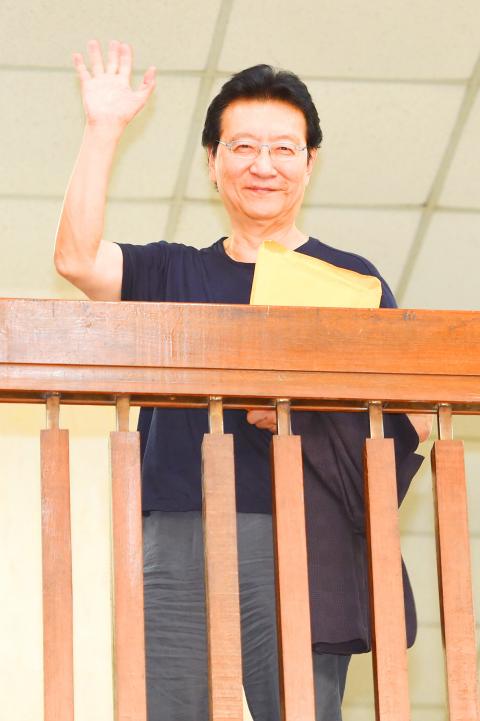
Photo: Liu Hsin-de, Taipei Times
“The defendant is [former president] Ma Ying-jeou (馬英九),” Jaw said.
Prosecutors have been looking into the sale of three major KMT-owned media companies — BCC, the nation’s largest radio broadcasting network at the time, China Television Co (CTV, 中視) and Central Motion Picture Corp (CMPC, 中影), which came during Ma’s first term as party chairman from 2005 to 2007.
The sales prompted accusations of questionable practices and deceptive reporting on the actual value of the assets.
It was also reported that the KMT had circumvented regulatory oversights to gain financial benefits.
The KMT was accused of transferring party assets to private groups while keeping control of them through key members of the party and their business associates.
The reopening of the case follows last month’s probe into CMPC, which resulted in the detention of former KMT central policy committee director Alex Tsai (蔡正元) on charges of embezzling NT$370 million (US$12.24 million).
The request to reopen the probe into the BCC sale was filed by the Ill-gotten Party Assets Settlement Committee.
Ma is accused of selling the BCC to Jaw, a close friend, through a complex transaction in a bid to conceal that the KMT retained control of the company and continued to derive financial benefits from its operations.
Investigators found that Jaw bought the BCC from KMT-owned Hua Hsia Investment Holding Co (華夏投資) — paying NT$1 billion for the BCC’s broadcasting facilities, while its real estate, which had a value of NT$4.7 billion, was registered as debt that Jaw owed Hua Hsia.
The BCC was later merged with a conglomerate of media outlets owned by Jaw, investigators said.
Jaw was a member of the KMT’s non-mainstream faction in the early 1990s and had a close relationship with Ma.
He was a KMT lawmaker until 1993, when he split from the party and established the pro-unification New Party.
The prosecutors’ decision to reopen the case was interpreted by legal experts as a rejection of a decision by the Supreme Prosecutors’ Office’s now-defunct Special Investigation Division (SID) to close the case.
The SID, which was abolished on Jan. 1, did not summon Ma for questioning during its probe, even though Ma was the decisionmaker in the sale and as party chairman at the time was therefore responsible for all major party policies.
SID officials in 2014 said the case was closed because their investigation found no evidence of illegal activity.
However, many in the legal field and members of the public criticized it for closing the case, saying the move was due to political pressure and manipulation by Ma and KMT members.
Democratic Progressive Party members and other pan-green camp supporters have claimed that Ma, during his two terms as president, repeatedly interfered with the judicial system and, in a bid to avoid prosecution, stacked the judiciary with officials aligned with himself and the KMT.
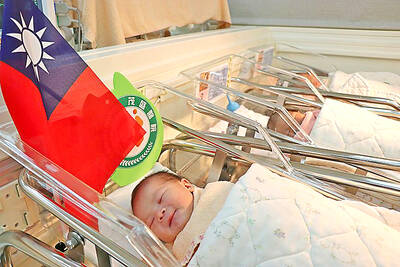
AGING: As of last month, people aged 65 or older accounted for 20.06 percent of the total population and the number of couples who got married fell by 18,685 from 2024 Taiwan has surpassed South Korea as the country least willing to have children, with an annual crude birthrate of 4.62 per 1,000 people, Ministry of the Interior data showed yesterday. The nation was previously ranked the second-lowest country in terms of total fertility rate, or the average number of children a woman has in her lifetime. However, South Korea’s fertility rate began to recover from 2023, with total fertility rate rising from 0.72 and estimated to reach 0.82 to 0.85 by last year, and the crude birthrate projected at 6.7 per 1,000 people. Japan’s crude birthrate was projected to fall below six,
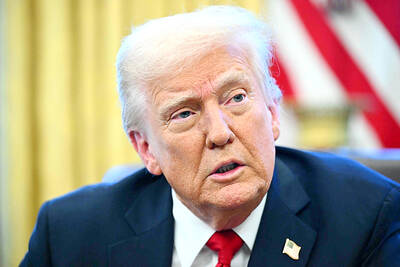
US President Donald Trump in an interview with the New York Times published on Thursday said that “it’s up to” Chinese President Xi Jinping (習近平) what China does on Taiwan, but that he would be “very unhappy” with a change in the “status quo.” “He [Xi] considers it to be a part of China, and that’s up to him what he’s going to be doing, but I’ve expressed to him that I would be very unhappy if he did that, and I don’t think he’ll do that. I hope he doesn’t do that,” Trump said. Trump made the comments in the context
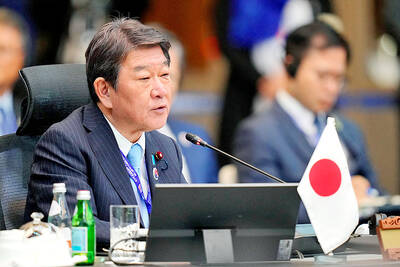
SELF-DEFENSE: Tokyo has accelerated its spending goal and its defense minister said the nation needs to discuss whether it should develop nuclear-powered submarines China is ramping up objections to what it sees as Japan’s desire to acquire nuclear weapons, despite Tokyo’s longstanding renunciation of such arms, deepening another fissure in the two neighbors’ increasingly tense ties. In what appears to be a concerted effort, China’s foreign and defense ministries issued statements on Thursday condemning alleged remilitarism efforts by Tokyo. The remarks came as two of the country’s top think tanks jointly issued a 29-page report framing actions by “right-wing forces” in Japan as posing a “serious threat” to world peace. While that report did not define “right-wing forces,” the Chinese Ministry of Foreign Affairs was

PREPAREDNESS: Given the difficulty of importing ammunition during wartime, the Ministry of National Defense said it would prioritize ‘coproduction’ partnerships A newly formed unit of the Marine Corps tasked with land-based security operations has recently replaced its aging, domestically produced rifles with more advanced, US-made M4A1 rifles, a source said yesterday. The unnamed source familiar with the matter said the First Security Battalion of the Marine Corps’ Air Defense and Base Guard Group has replaced its older T65K2 rifles, which have been in service since the late 1980s, with the newly received M4A1s. The source did not say exactly when the upgrade took place or how many M4A1s were issued to the battalion. The confirmation came after Chinese-language media reported


 RSS
RSS