


The nation’s first locally designed satellite, FORMOSAT-5, should be on its way to the US in preparation for its launch next month, National Space Organization (NSPO) officials said yesterday at a ceremony in Hsinchu.
FORMOSAT-5 is scheduled to be launched at 2:50am on Aug. 25 from the Vandenberg Air Force Base in California by the US company SpaceX, the agency said.
However, the cargo was briefly held up at customs, which said some permits for the transport of strategic and technological products were missing.
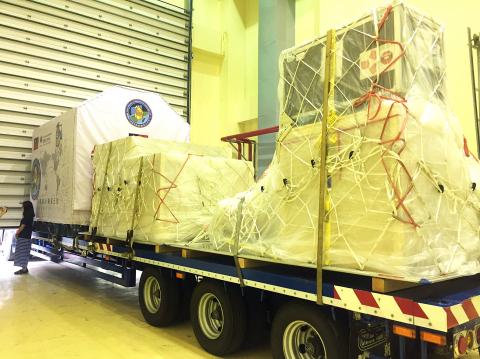
Photo: CNA
As of 8:30pm yesterday, the officials had cleared the problem and promised the cargo would leave as scheduled, NSPO Deputy Director-General Yu Shiann-jen(余憲政) said, adding that the agency was not familiar with the new rules.
The NSPO showed images of the satellite being transported from the agency’s headquarters at the Hsinchu Science Park to Taiwan Taoyuan International Airport to await its flight at 11:50pm.
It is expected to arrive at Los Angeles International Airport at 9:30pm on the same day.
The satellite has to be delivered in a low vibration environment with a temperature range of 18°C to 22°C, said Eddy Liu (劉得湶), vice president of China Airlines’ cargo sales, marketing and services division.
Commissioned to operate for five years, the satellite is tasked with collecting data for disaster evaluation and scientific research, said Chang Ho-pen (張和本), FORMOSAT-5 project director at the National Applied Research Laboratories (NARL).
Asked if the satellite’s images will be exchanged internationally, Chang said other nations would need to pay for them, but the NARL would provide free images in cases like international rescue, as it did with images of the 311 earthquake in Japan in 2011 and the Sichuan earthquake in China in 2008.
The satellite will operate in a trajectory at 720km altitude from the earth, he said.
It can orbit the Earth once every 100 minutes, he said.
The NSPO had planned to launch the satellite in October last year, but it was postponed after SpaceX’s failed rocket test in September.
Reflecting on their efforts over the past six years, NSPO Director-General Chang Guey-shin (張桂祥), holding back tears, said the team had encountered many difficulties since the project started in 2010.
When it was developing an earlier satellite named Argo, it could not find some essential components, NARL Director and former NSPO director-general Wang Yeong-her (王永和) said.
“Since then, we thought we might have to make the components by ourselves, and we could borrow from our domestic IC industry,” Wang said.
Asked about the difference between FORMOSAT-5 and FORMOSAT-2, Wang said their functions are similar, but FORMOSAT-5 was locally developed and manufactured, while FORMOSAT-2 was built by a French company.
“We hope the space technology can be developed into a national industry soon,” he added.
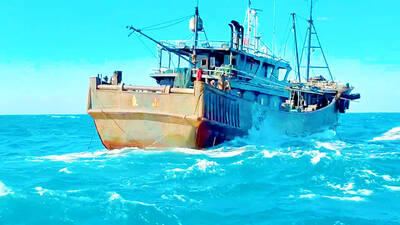
MAKING WAVES: China’s maritime militia could become a nontraditional threat in war, clogging up shipping lanes to prevent US or Japanese intervention, a report said About 1,900 Chinese ships flying flags of convenience and fishing vessels that participated in China’s military exercises around Taiwan last month and in January last year have been listed for monitoring, Coast Guard Administration (CGA) Deputy Director-General Hsieh Ching-chin (謝慶欽) said yesterday. Following amendments to the Commercial Port Act (商港法) and the Law of Ships (船舶法) last month, the CGA can designate possible berthing areas or deny ports of call for vessels suspected of loitering around areas where undersea cables can be accessed, Oceans Affairs Council Minister Kuan Bi-ling (管碧玲) said. The list of suspected ships, originally 300, had risen to about
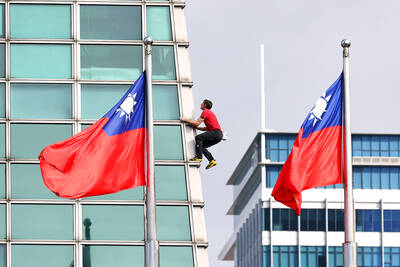
DAREDEVIL: Honnold said it had always been a dream of his to climb Taipei 101, while a Netflix producer said the skyscraper was ‘a real icon of this country’ US climber Alex Honnold yesterday took on Taiwan’s tallest building, becoming the first person to scale Taipei 101 without a rope, harness or safety net. Hundreds of spectators gathered at the base of the 101-story skyscraper to watch Honnold, 40, embark on his daredevil feat, which was also broadcast live on Netflix. Dressed in a red T-shirt and yellow custom-made climbing shoes, Honnold swiftly moved up the southeast face of the glass and steel building. At one point, he stepped onto a platform midway up to wave down at fans and onlookers who were taking photos. People watching from inside

Japan’s strategic alliance with the US would collapse if Tokyo were to turn away from a conflict in Taiwan, Japanese Prime Minister Sanae Takaichi said yesterday, but distanced herself from previous comments that suggested a possible military response in such an event. Takaichi expressed her latest views on a nationally broadcast TV program late on Monday, where an opposition party leader criticized her for igniting tensions with China with the earlier remarks. Ties between Japan and China have sunk to the worst level in years after Takaichi said in November that a hypothetical Chinese attack on Taiwan could bring about a Japanese
The WHO ignored early COVID-19 warnings from Taiwan, US Deputy Secretary of Health and Human Services Jim O’Neill said on Friday, as part of justification for Washington withdrawing from the global health body. US Secretary of State Marco Rubio on Thursday said that the US was pulling out of the UN agency, as it failed to fulfill its responsibilities during the COVID-19 pandemic. The WHO “ignored early COVID warnings from Taiwan in 2019 by pretending Taiwan did not exist, O’Neill wrote on X on Friday, Taiwan time. “It ignored rigorous science and promoted lockdowns.” The US will “continue international coordination on infectious


 RSS
RSS