


The Financial Supervisory Commission’s (FSC) affirmation of SinoPac Financial Holdings Co (永豐金控) board director Paul Chiu’s (邱正雄) eligibility to become chairman as was “a confusion of the commission’s role,” President Tsai Ing-wen (蔡英文) said yesterday.
Chiu yesterday was appointed chairman following an extraordinary meeting of the board of directors.
He had been named acting chairman on Saturday, a day after prosecutors raided the company’s offices as well as the homes of key executives allegedly involved in a series of severe lapses of governance.
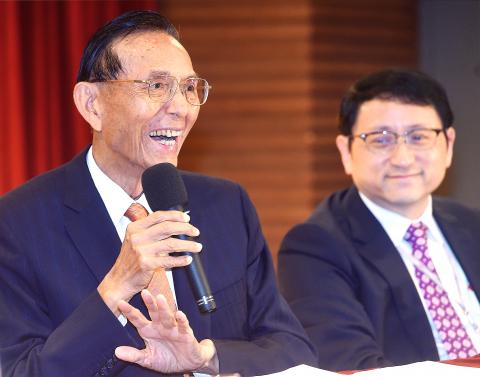
Photo: Liao Chen-huei, Taipei Times
Tsai made the remarks at a Democratic Progressive Party (DPP) Central Standing Committee (CSC) meeting after Vice Premier Lin Hsi-yao (林錫耀) delivered a report on an investigation into over-lending by SinoPac, DPP spokesman Chang Chih-hao (張志豪) said.
The government would not close the investigation until those responsible are identified and investigated, Lin said.
It was improper of the commission to use the word “affirm” in its news release, CSC member Chen Ming-wen (陳明文) said.
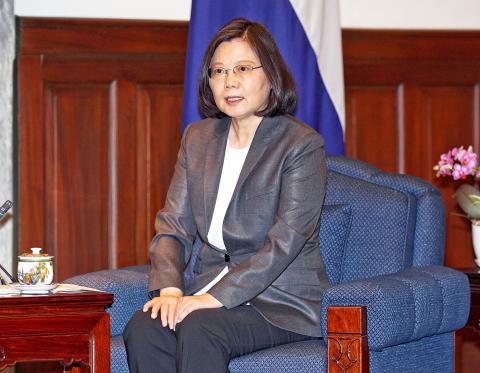
Photo: CNA
New Power Party (NPP) Executive Chairman Huang Kuo-chang (黃國昌) and DPP Legislator Tuan Yi-kang (段宜康) also questioned Chiu’s eligibility to be chairman.
As Chiu was a member of the company’s board when the over-lending occurred there was no reason Chiu would be eligible for the chairmanship, Huang said.
Tuan said on Facebook that it was “laughable” for SinoPac to appoint Chiu as chairman, adding that the Ho family was “in bed with” the higher echelons of the Chinese Nationalist Party (KMT), pointing to Chiu’s appointments as vice premier, central bank deputy governor and minister of finance under former president Ma Ying-jeou (馬英九).
SinoPac Financial chairman Ho Shou-chuan (何壽川) was detained on Sunday for suspected violations of the Securities Exchange Act (證券交易法).
His request for bail was denied on Monday and he remains in detention under conditions of restricted communications and visits, aside from constitutionally guaranteed rights of consultation.
The investigation comes after the FSC in April fined SinoPac Financial NT$10 million (US$328,181) following the discovery that the company’s leasing unit had extended NT$5 billion in questionable loans to Sun Power Development and Construction Co (三寶建設) — whose chairman is related to Ho’s wife, Chang Hsing-ju (張杏如) — and handed its findings over to prosecutors.
The loans extended to Sun Power were allegedly transferred between shell companies controlled by SinoPac and Sun Power without sufficient collateral, which violates the limitations on transactions between interested parties, as the borrower had familial ties to Ho, the commission said.
FSC Secretary-General Jean Chiu (邱淑真) said Tsai’s expression of concern meant the commission needed to be more careful with the language it uses in its news releases.
However, the commission’s primary task is to provide oversight of financial institutions and maintain stability, Jean Chiu said.
That SinoPac’s board held a meeting, appointed an acting chairman and pledged reforms relieved the public and offered stability, Jean Chiu said.
The commission had intended to show the SinoPac Financial board of directors support rather than offer an official endorsement, Jean Chiu said.
The company also appointed Lin Miao-zhen (林妙貞), who had previously worked at the lender’s financial products group office, as a Bank SinoPac (永豐銀行) board director.
Additional reporting by Su Fang-ho and Ted Chen
The Legislative Yuan’s Finance Committee yesterday approved proposed amendments to the Amusement Tax Act (娛樂稅法) that would abolish taxes on films, cultural activities and competitive sporting events, retaining the fee only for dance halls and golf courses. The proposed changes would set the maximum tax rate for dance halls and golf courses at 50 and 20 percent respectively, with local governments authorized to suspend the levies. Article 2 of the act says that “amusement tax shall be levied on tickets sold or fees charged by amusement places, facilities or activities” in six categories: “Cinema; professional singing, story-telling, dancing, circus, magic show, acrobatics

Tainan, Taipei and New Taipei City recorded the highest fines nationwide for illegal accommodations in the first quarter of this year, with fines issued in the three cities each exceeding NT$7 million (US$220,639), Tourism Administration data showed. Among them, Taipei had the highest number of illegal short-term rental units, with 410. There were 3,280 legally registered hotels nationwide in the first quarter, down by 14 properties, or 0.43 percent, from a year earlier, likely indicating operators exiting the market, the agency said. However, the number of unregistered properties rose to 1,174, including 314 illegal hotels and 860 illegal short-term rental
INFLATION UP? The IMF said CPI would increase to 1.5 percent this year, while the DGBAS projected it would rise to 1.68 percent, with GDP per capita of US$44,181 The IMF projected Taiwan’s real GDP would grow 5.2 percent this year, up from its 2.1 percent outlook in January, despite fears of global economic disruptions sparked by the US-Iran conflict. Taiwan’s consumer price index (CPI) is projected to increase to 1.5 percent, while unemployment would be 3.4 percent, roughly in line with estimates for Asia as a whole, the international body wrote in its Global Economic Outlook Report published in the US on Monday. The figures are comparatively better than the IMF outlook for the rest of the world, which pegged real GDP growth at 3.1 percent, down from 3.3 percent
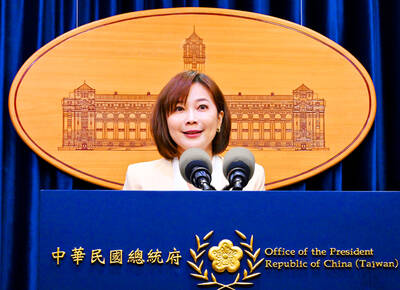
ECONOMIC COERCION: Such actions are often inconsistently applied, sometimes resumed, and sometimes just halted, the Presidential Office spokeswoman said The government backs healthy and orderly cross-strait exchanges, but such arrangements should not be made with political conditions attached and never be used as leverage for political maneuvering or partisan agendas, Presidential Office spokeswoman Karen Kuo (郭雅慧) said yesterday. Kuo made the remarks after China earlier in the day announced 10 new “incentive measures” for Taiwan, following a landmark meeting between Chinese President Xi Jinping (習近平) and Chinese Nationalist Party (KMT) Chairwoman Cheng Li-wun (鄭麗文) in Beijing on Friday. The measures, unveiled by China’s Xinhua news agency, include plans to resume individual travel by residents of Shanghai and China’s Fujian


 RSS
RSS