


The American Chamber of Commerce in Taipei (AmCham) yesterday released its Taiwan White Paper, characterizing President Tsai Ing-wen’s (蔡英文) Democratic Progressive Party (DPP) administration’s policy initiatives over the past year as a “mixed bag” of successes and disappointments.
The AmCham commended the government for improving regulatory coherence by adopting a 60-day notice and comment period, and for taking steps to promote innovative industries.
However, AmCham Taipei chairman Albert Chang (章錦華) said that the new “one fixed day off, one flexible rest day” policy is a step backward in Taiwan’s aim to transform its industries, as the scheme is better suited to manage “old economy” factory workers and moves away from ongoing efforts — such as the “five plus two” innovative industries plan for an “Asian Silicon Valley,” “intelligent” machinery, “green” energy technology, biomedicine and national defense, as well as a new agricultural business model and a circular economy — to promote services and knowledge-based industries.
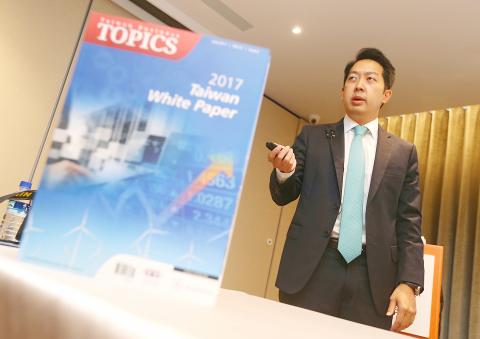
Photo: CNA
The new labor rules bring needless obstacles to the workings of fledgling start-ups, whose engineers require the flexibility to balance lulls and overtime, Chang said, adding that the prescriptive policy is not ideal.
The National Development Council’s Asian Silicon Valley initiative might be overly focused on hardware and funding, while neglecting education and the development of a “start-up culture,” Chang said.
The white paper also encouraged the nation to enter into negotiations for bilateral trade agreements with the US following Washington’s exit from the Trans-Pacific Partnership.
The report said that while US President Donald Trump is opposed to multilateral trade blocs, he is not against bilateral free-trade agreements, which the AmCham said is a feasible path toward bolstering economic ties between the two sides.
However, negotiations on free-trade deals would depend on Taipei’s willingness to make concessions on importing US pork and beef, AmCham said.
As US pork and beef products already meet stringent international guidelines, the concessions should be deemed acceptable by the public, it said.
Taiwan should allow the use of genetically modified fresh produce in school meals, the paper said.
The paper urged financial regulators to base commissions on fund sales by distributors on an assets under management (AUM) scheme, as the current transaction amount-based system incentivizes distributors to frequently churn funds.
Consequently, Taiwanese investors have been treating metal funds more like stocks, looking for short-term gains while paying high front-end fees to distributors.
Other adverse effects include large redemptions after initial public offerings for new funds, which affects long-term investors’ net asset value, as well as increasing difficulties in investment management, as volatility rises with frequent trading, the document said.
In a separate news conference, the Financial Supervisory Commission said that although the AUM scheme has been widely adopted in developed markets across the world, it was still awaiting consensus from industry associations, as many institutions have been affected by declining profits from wealth-management products.

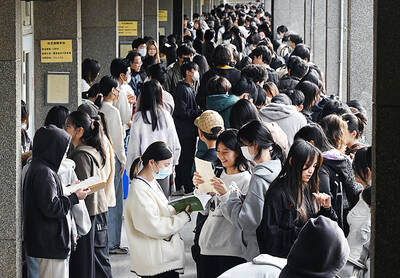
A global survey showed that 60 percent of Taiwanese had attained higher education, second only to Canada, the Ministry of the Interior said. Taiwan easily surpassed the global average of 43 percent and ranked ahead of major economies, including Japan, South Korea and the US, data from the Organisation for Economic Co-operation and Development (OECD) for 2024 showed. Taiwan has a high literacy rate, data released by the ministry showed. As of the end of last year, Taiwan had 20.617 million people aged 15 or older, accounting for 88.5 percent of the total population, with a literacy rate of 99.4 percent, the data
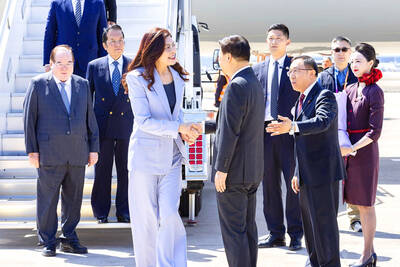
CCP ‘PAWN’? Beijing could use the KMT chairwoman’s visit to signal to the world that many people in Taiwan support the ‘one China’ principle, an academic said Chinese Nationalist Party (KMT) Chairwoman Cheng Li-wun (鄭麗文) yesterday arrived in China for a “peace” mission and potential meeting with Chinese President Xi Jinping (習近平), while a Taiwanese minister detailed the number of Chinese warships currently deployed around the nation. Cheng is visiting at a time of increased Chinese military pressure on Taiwan, as the opposition-dominated Legislative Yuan stalls a government plan for US$40 billion in extra defense spending. Speaking to reporters before going to the airport, Cheng said she was going on a “historic journey for peace,” but added that some people felt uneasy about her trip. “If you truly love Taiwan,

NEW LOW: The council in 2024 based predictions on a pessimistic estimate for the nation’s total fertility rate of 0.84, but last year that rate was 0.69, 17 percent lower An expected National Development Council (NDC) report expects the nation’s population to drop below 12 million by 2065, with the old-age dependency ratio to top 100 percent sooner than 2070, sources said yesterday. The council is slated to release its latest population projections in August, using an ultra-low fertility model, the sources said. The previous report projected that Taiwan’s population would fall to 14.37 million by 2070, but based on a new estimate of the total fertility rate (TFR) — the average number of children born to a woman over her lifetime — the population is expected to reach 12 million by
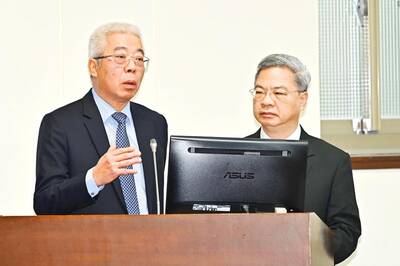
Taiwan has arranged for about 8 million barrels of crude oil, or about one-third of its monthly needs, to be shipped from the Red Sea this month to bypass the Strait of Hormuz and ease domestic supply pressures, CPC Corp, Taiwan (CPC, 台灣中油) said yesterday. The state-run oil company has worked with Middle Eastern suppliers to secure routes other than the Strait of Hormuz, through which about 20 percent of the world’s oil and liquefied natural gas typically passes, CPC chairman Fang Jeng-zen (方振仁) said at a meeting of the legislature’s Economics Committee in Taipei. Suppliers in Saudi Arabia have indicated they


 RSS
RSS