


The armed forces yesterday conducted a live-fire exercise in the Penghu islands, concluding the main part of the 33rd annual Han Kuang military exercises, with President Tsai Ing-wen (蔡英文) observing the drill which simulated a landing attempt by China’s People’s Liberation Army (PLA).
The scenario involved a landing by the PLA, with the nation’s armed forces launching an operation to repel the attack.
The Marine Corps acting as PLA troops launched an amphibious assault, with a naval formation of Keelung-class destroyers, a Tuo Chiang-class stealth corvette and Kuang Hua VI fast-attack missile boats providing covering fire.
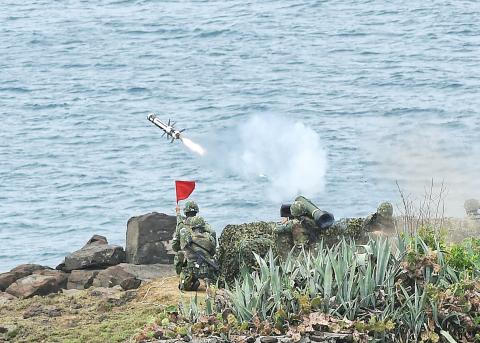
Photo: Fang Pin-chao, Taipei Times
The air force then launched the first wave of counterattack, with a group of fighter jets firing missiles at target areas at sea, and the army mobilized attack helicopters, tanks and infantry units, and launched an artillery barrage against landing troops.
More than 3,900 soldiers, sailors, airmen and marines participated in the exercise, and weapons and equipment used in the drill included F-16 jets, Indigenous Defense Fighters, AH-64E Apache helicopters, UH-60M Blackhawk helicopters, CH-47 Chinook transport helicopters, RT-2000 multiple launch rocket systems, M60A3 tanks, 155mm and 105mm howitzers, and other light weapons.
Tsai praised the performance of the armed forces, saying the drill was necessary to ensure national safety and the well-being of Taiwanese.
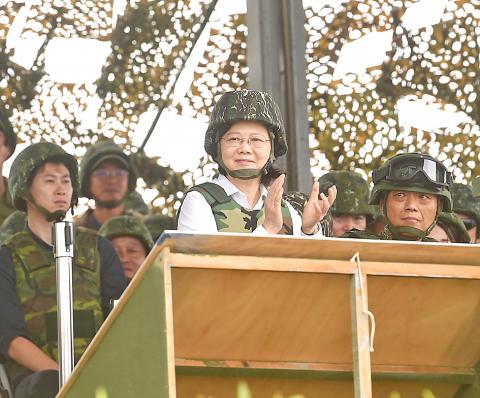
Photo: Fang Pin-chao, Taipei Times
The president reiterated her pledge to build the nation’s defense capabilities with locally developed weapons, including submarines, surface vessels and trainer jets.
The government would raise the nation’s research and manufacturing capabilities to develop necessary weapons, which could boost the local defense sector and the business environment as a whole, Tsai said.
“The most important thing in achieving defensive self-sufficiency is to show the world that Taiwan is determined to defend itself,” Tsai said.
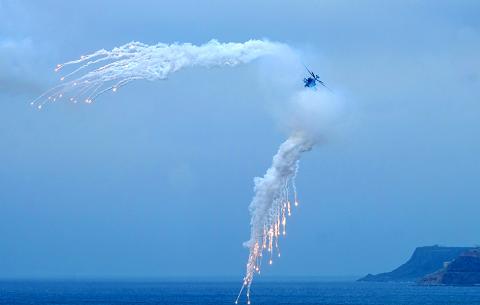
Photo: AFP/Sam Yeh
“As the commander-in-chief, I am the most reliable supporter of the armed forces. The government will fully support the military in either reforming national defense or improving the working conditions for military personnel,” she said.
Yesterday was the fourth day of this year’s Han Kuang exercises, the first such event since the Ministry of National Defense changed the nation’s defense strategy from “effective deterrence” to “multi-layered deterrence.”
Although the content shared with the media showed a traditional live-fire drill, there were electronic warfare operations involved, suggesting the military’s awareness to adapt to changes in battle strategies and tactics, Ministry of National Defense spokesman Major General Chen Chung-chi (陳中吉) said.
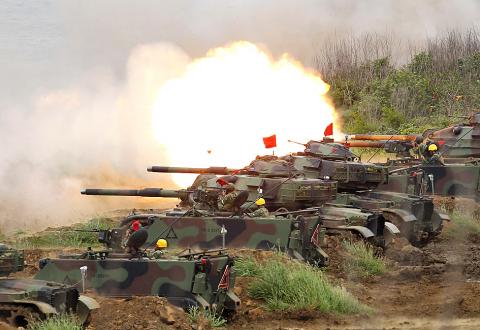
Photo: AP/Chiang Ying-ying
Today is the last day of this year’s drill, simulating a Chinese attack on the Ching Chuan Kang (清泉崗) air base in Taichung.
The response to the simulated attack is to involve all branches of the armed forces, including fighter jets and surface-to-air missiles.
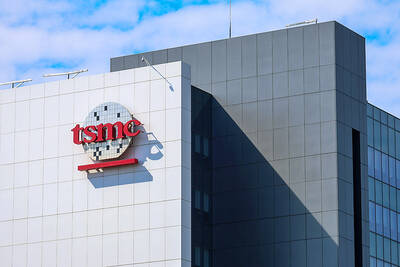
Taiwan Semiconductor Manufacturing Co (TSMC, 台積電), the world’s largest foundry service provider, yesterday said that global semiconductor revenue is projected to hit US$1.5 trillion in 2030, after the figure exceeds US$1 trillion this year, as artificial intelligence (AI) demand boosts consumption of token and compute power. “We are still at the beginning of the AI revolution, but we already see a significant impact across the whole semiconductor ecosystem,” TSMC deputy cochief operating officer Kevin Zhang (張曉強) said at the company’s annual technology symposium in Hsinchu City. “It is fair to say that in the past decade, smartphones and other mobile devices were
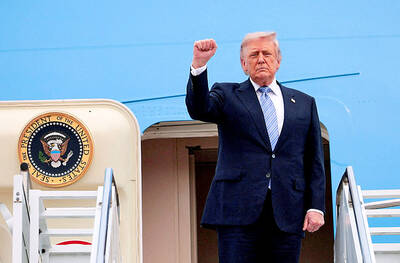
US-CHINA SUMMIT: MOFA welcomed US reassurance of no change in its Taiwan policy; Trump said he did not comment when Xi talked of opposing independence US President Donald Trump yesterday said he has not made a decision on whether to move forward with a major arms package for Taiwan after hearing concerns about it from Chinese President Xi Jinping (習近平). Trump’s comments on Taiwan came as he flew back to Washington after wrapping up critical talks in which both leaders said important progress was made in stabilizing US-China relations even as deep differences persist between the world’s two biggest powers on Iran and Taiwan. “I will make a determination,” Trump said, adding: “I’ll be making decisions. But, you know, I think the last thing we need right
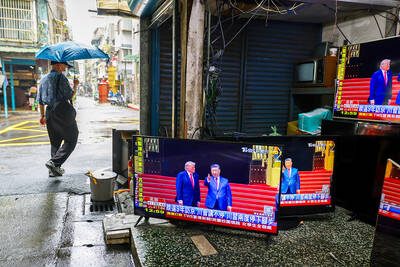
TAIWAN ISSUE: US treasury secretary Scott Bessent said on the first day of meetings that ‘it wouldn’t be a US-China summit without the Taiwan issue coming up’ There were no surprises on the first day of the summit between US President Donald Trump and Chinese President Xi Jinping (習近平), the Mainland Affairs Council (MAC) said yesterday, as the government reiterated that cross-strait stability is crucial to the Asia-Pacific region, as well as the world. As the two presidents met for a highly anticipated summit yesterday, Chinese state media reported that Xi warned Trump that missteps regarding Taiwan could push their two countries into “conflict.” Trump arrived in China with accolades for his host, calling Xi a “great leader” and “friend,” and extending an invitation to visit the White House
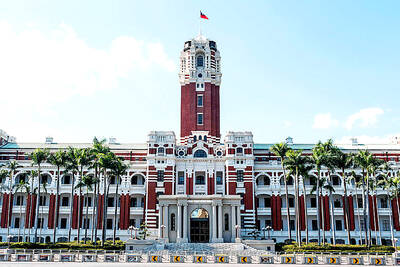
SECURITY: Taipei presses the US for arms supplies, saying the arms sales are not only a reflection of the US security commitment to Taiwan but also serve as a mutual deterrent against regional threats Taiwan is committed to preserving the cross-strait “status quo” and contributing to regional peace and stability, the Presidential Office said yesterday. “It is an undeniable fact that the Republic of China is a sovereign and independent democratic nation,” Presidential Office spokeswoman Karen Kuo (郭雅慧) reiterated, adding that Beijing has no right to claim sovereignty over Taiwan. The statements came after US President Donald Trump warned against Taiwanese independence. Trump wrapped up a state visit to Beijing on Friday, during which Chinese President Xi Jinping (習近平) had pressed him not to support Taiwan. Taiwan depends heavily on US security backing to deter China from carrying


 RSS
RSS