


Democratic Progressive Party (DPP) mayors and county commissioners yesterday issued a joint statement urging the passage of the Forward-looking Infrastructure Development Program bill, which has been stalled in the legislature, while President Tsai Ing-wen (蔡英文) ordered the DPP to make a concerted effort to ensure the bill’s passage.
In a rare move, all of the DPP’s mayors and county commissioners urged the Chinese Nationalist Party (KMT) to stop obstructing the passage of the eight-year NT$882.4 billion (US$29.15 billion) program, with the mayors of the four DPP-ruled special municipalities attending a news conference advocating the program.
“We are not advocating the program for our own cities’ development ... but for national unity and [efficient] resource allocation. Parties are urged to cease irrational opposition for the sake of the nation’s economy and equal regional development,” Kaohsiung Mayor Chen Chu (陳菊) said.
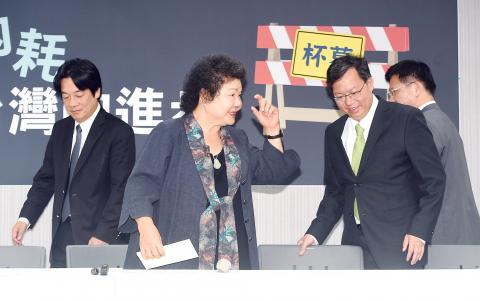
Photo: Liao Chen-huei, Taipei Times
The infrastructure program — which consists of the construction of railways, aquatic infrastructure, renewable energy, digital infrastructure and urban development — would play a key role in transforming industry, bridging the rural-urban development gap, and improving living quality and national competitiveness, Chen said.
The plan, with a focus on railway construction in cities outside Taipei and New Taipei City, would help develop central and southern cities, Tainan Mayor William Lai (賴清德) said.
The government has invested NT$1.2 trillion in Mass Rapid Transit construction in Taipei and New Taipei City, but central and southern Taiwan has not been financially supported to develop transport systems, Lai said.
The lack of infrastructure in Tainan results in population outflow and an aging population. The infrastructure program would solve that development inequality, Lai said.
The program is a government-led investment in the domestic market to boost the nation’s economy when the global economy has stagnated, Taichung Mayor Lin Chia-lung (林佳龍) said.
Former president Ma Ying-jeou (馬英九) rolled out the “Love Taiwan 12 Major Construction Plans,” which were not opposed in the legislature, although there was criticism of the efficiency of the projects, Lin said.
The planned budget for railway construction in the program is about NT$300 billion, just one-fourth of the budget allocated to Taipei and New Taipei City, and the program would address “transportation justice,” Taoyuan Mayor Cheng Wen-tsan (鄭文燦) said.
KMT Taichung and Taoyuan legislators, despite having expressed approval of the program during negotiations with the mayors, are nevertheless actively involved in obstructing the review, Lin and Cheng said.
“The KMT has ‘kidnapped’ its lawmakers who expressed approval of the program [and the hijacking] would hold back the KMT’s development,” Cheng said.
Meanwhile, the president ordered her administration and DPP lawmakers to take immediate action to ensure the passage of the bill, despite the opposition.
“The public has entrusted us with administrative responsibility and the majority of legislative seats, so we have an obligation to move the nation forward,” Tsai said.
The infrastructure program and pension reform are the top priority bills for this legislative session, because they invest in and relieve the financial burden of next generation, she said.
“The KMT’s opposition is confusing. We have not seen the KMT identify which of the ‘Forward-looking’ program projects they are against,” Tsai said.
She asked the DPP caucus to ensure that other key legislation, including draft amendments to the Referendum Act (公民投票法) and Statute for Industrial Innovation (產業創新條例), as well as draft bills on the regulation of nonprofit organizations, rental housing development and foreign recruitment, are passed by the end of the year, if not in this legislative session, which is expected to recess at the end of this month.
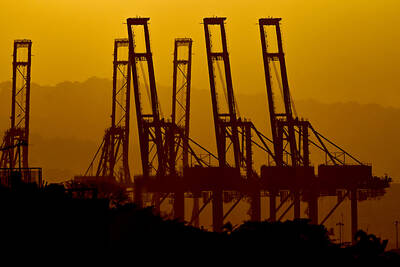
A subsidiary of a Hong Kong-based company that has lost control of two critical ports on the Panama Canal said it is seeking US$2 billion of compensation in damages from Panama over its “illegal” takeover of the ports. Panama Ports Co, a unit of Hong Kong’s CK Hutchison Holdings (長江和記實業), on Friday said in a statement that it is demanding the sum under international arbitration proceedings that it had already started. The Panamanian government last week seized control of the Balboa and Cristobal ports on each end of the Panama Canal, after the country’s Supreme Court declared earlier that a concession allowing
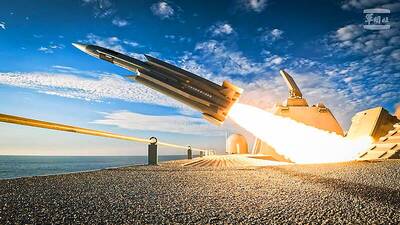
DETERRENCE: With 1,000 indigenous Hsiung Feng II and III missiles and 400 Harpoon missiles, the nation would boast the highest anti-ship missile density in the world With Taiwan wrapping up mass production of Hsiung Feng II and III missiles by December and an influx of Harpoon missiles from the US, Taiwan would have the highest density of anti-ship missiles in the world, a source said yesterday. Taiwan is to wrap up mass production of the indigenous anti-ship missiles by the end of year, as the Chungshan Institute of Science and Technology has been meeting production targets ahead of schedule, a defense official with knowledge of the matter said. Combined with the 400 Harpoon anti-ship missiles Taiwan expects to receive from the US by 2028, the nation would have

POSSIBILITIES EMERGE: With Taiwan’s victory and Japan’s narrow win over Australia, Taiwan now have a chance to advance if South Korea also beat the Aussies Taiwan has high hopes that the national baseball team would advance to the World Baseball Classic (WBC) quarter-finals after clinching a crucial 5-4 victory over South Korea in a nail-biting extra-inning game at the Tokyo Dome yesterday. Boosted by three home runs — two solo shots by Yu Chang (張育成) and Cheng Tsung-che (鄭宗哲) and a two-run homer by Stuart Fairchild — the triumph gave Taiwan a much-needed second victory in the five-team Pool C, where only the top two finishers would advance to the knockout stage in Miami, Florida. Entering extra innings with the game tied at four apiece, Taiwan scored
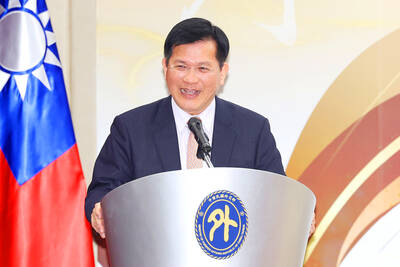
MISSION OF PEACE: The foreign minister urged Beijing to respect Taiwan’s existence as an independent nation, and work together to ensure peace and stability in the region Minister of Foreign Affairs Lin Chia-lung (林佳龍) yesterday rejected Chinese Minister of Foreign Affairs Wang Yi’s (王毅) comments about Taiwan, criticizing China as a “troublemaker” in the international community and a disruptor of cross-strait peace. Speaking at a news conference on the sidelines of the Chinese National People’s Congress, Wang said that Taiwan has always been a territory of China and that it would be impossible for it to become its own country. The “return” of Taiwan to China was the natural outcome of the Chinese people’s resistance against Japan in World War II, and that any pursuit of independence was “doomed


 RSS
RSS