


Taiwan is to send a delegation to Geneva, Switzerland, for the annual World Health Assembly (WHA) this month, even if it is not invited, Minister of Health and Welfare Chen Shih-chung (陳時中) said yesterday.
Chen told the legislature’s Social Welfare and Environmental Hygiene Committee that the government is preparing to go to Geneva and make its presence felt while the WHA is in session, even without an invitation.
The WHA, the decisionmaking body of the WHO, is scheduled to meet from May 22 to May 31.
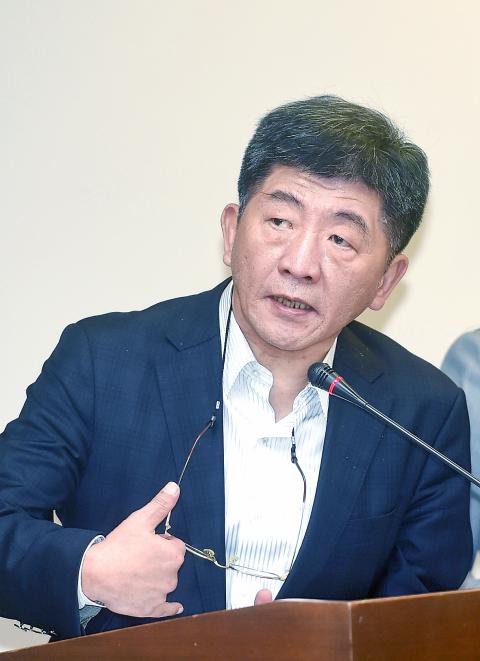
Photo: Fang Pin-chao, Taipei Times
Taiwan wants to attend the meeting as an observer, as has been the case for the past eight years. The deadline for online registration for this year’s WHA session is Monday, and Taiwan is still hoping for an invitation.
Many believe an invitation will not be forthcoming because of Beijing’s ongoing campaign to suppress Taiwan’s participation in international organizations.
That campaign has intensified since President Tsai Ing-wen (蔡英文) took office in May last year.
Chen said the ministry has been trying to forge closer ties with many countries to secure support for Taiwan’s bid to attend the meeting.
The government has not ruled out holding an international news conference in Geneva as a sign of protest if Taiwan is not invited to attend the WHA as an observer, the minister said.
Holding an international news conference would be just one way to protest, Chen said, but he did not mention what other options the delegation might have.
He said the health ministry and the Ministry of Foreign Affairs would continue to work on the bid, but did not disclose details, saying now was not the time.
Tsai has sent repeated tweets to solicit international support for Taiwan’s WHA bid, citing the nation’s contribution to the international community by providing medical assistance to millions of people around the world.
The president shared a video of a photo exhibition on “Taiwan’s contributions to health for all” on Twitter on Tuesday, describing it as “Taiwan’s story.”
This was her third tweet in four days, seeking to attract international attention to Taiwan’s wish to attend this year’s WHA.
The video, which is on YouTube, ends with the slogan “WHO cares. Taiwan cares.”
On Saturday and Monday, Tsai tweeted messages detailing the medical assistance Taiwan has provided to other nations, appealing for more support for the nation’s continued role in the global healthcare system.
Taiwan first participated in the WHA as an observer in 2009, one year after then-president Ma Ying-jeou’s (馬英九) government came to power, which pursued a more conciliatory policy toward China.
Last year, Taiwan received a late invitation to the WHA prior to Tsai taking office, but it contained an unexpected reference to UN Resolution No. 2758, which many saw as a political message.
The resolution, passed on Oct. 25, 1971, recognized the People’s Republic of China as “the only legitimate representative of China to the UN.”

The Legislative Yuan’s Finance Committee yesterday approved proposed amendments to the Amusement Tax Act (娛樂稅法) that would abolish taxes on films, cultural activities and competitive sporting events, retaining the fee only for dance halls and golf courses. The proposed changes would set the maximum tax rate for dance halls and golf courses at 50 and 20 percent respectively, with local governments authorized to suspend the levies. Article 2 of the act says that “amusement tax shall be levied on tickets sold or fees charged by amusement places, facilities or activities” in six categories: “Cinema; professional singing, story-telling, dancing, circus, magic show, acrobatics

Tainan, Taipei and New Taipei City recorded the highest fines nationwide for illegal accommodations in the first quarter of this year, with fines issued in the three cities each exceeding NT$7 million (US$220,639), Tourism Administration data showed. Among them, Taipei had the highest number of illegal short-term rental units, with 410. There were 3,280 legally registered hotels nationwide in the first quarter, down by 14 properties, or 0.43 percent, from a year earlier, likely indicating operators exiting the market, the agency said. However, the number of unregistered properties rose to 1,174, including 314 illegal hotels and 860 illegal short-term rental
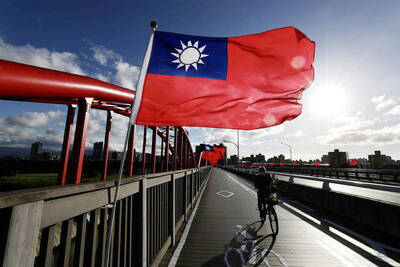
INFLATION UP? The IMF said CPI would increase to 1.5 percent this year, while the DGBAS projected it would rise to 1.68 percent, with GDP per capita of US$44,181 The IMF projected Taiwan’s real GDP would grow 5.2 percent this year, up from its 2.1 percent outlook in January, despite fears of global economic disruptions sparked by the US-Iran conflict. Taiwan’s consumer price index (CPI) is projected to increase to 1.5 percent, while unemployment would be 3.4 percent, roughly in line with estimates for Asia as a whole, the international body wrote in its Global Economic Outlook Report published in the US on Monday. The figures are comparatively better than the IMF outlook for the rest of the world, which pegged real GDP growth at 3.1 percent, down from 3.3 percent
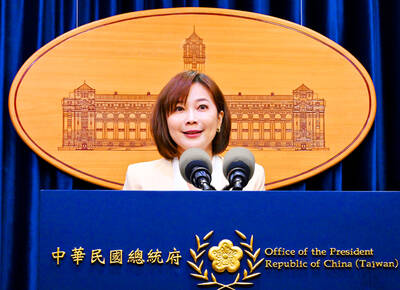
ECONOMIC COERCION: Such actions are often inconsistently applied, sometimes resumed, and sometimes just halted, the Presidential Office spokeswoman said The government backs healthy and orderly cross-strait exchanges, but such arrangements should not be made with political conditions attached and never be used as leverage for political maneuvering or partisan agendas, Presidential Office spokeswoman Karen Kuo (郭雅慧) said yesterday. Kuo made the remarks after China earlier in the day announced 10 new “incentive measures” for Taiwan, following a landmark meeting between Chinese President Xi Jinping (習近平) and Chinese Nationalist Party (KMT) Chairwoman Cheng Li-wun (鄭麗文) in Beijing on Friday. The measures, unveiled by China’s Xinhua news agency, include plans to resume individual travel by residents of Shanghai and China’s Fujian


 RSS
RSS