


A legislative review of draft acts to reform the civil servants’ pension plan reached some conclusions yesterday despite brawls and procedural disruptions.
Several clauses of the draft acts proposed by the Examination Yuan, Democratic Progressive Party (DPP), the New Power Party and the People First Party were agreed upon during a meeting of the Judiciary and Organic Laws and Statutes Committee yesterday.
There was an extensive debate over the base figure for the calculation of income replacement rate, the minimum pension level, pension contribution rates, parental benefits and the government responsibility for pension payment.
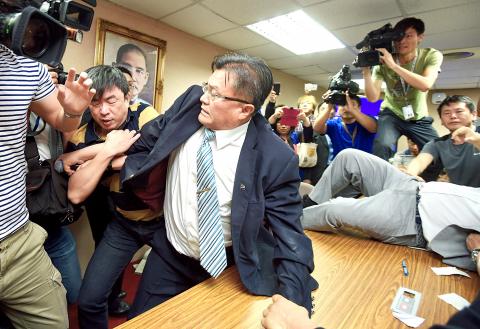
Photo: Chien Jung-fong, Taipei Times
The base figure for the calculation of the income replacement rate was determined to be “two times a civil servant’s basic salary,” but the committee did not decide on the minimum pension level, saying that it should be decided upon in cross-caucus negotiations.
The committee also did not reach consensus on how much the government should help civil servants taking parental leave in paying for their pension premiums to boost the nation’s falling birth rate.
A fight erupted between DPP and Chinese Nationalist Party (KMT) lawmakers after DPP Legislator Tuan Yi-kang (段宜康), a co-convener of the committee, rejected the KMT caucus’ request to have Ministry of Justice officials attend the meeting to provide legal advice on the wording of a clause because Legislative Research Bureau officials were already in attendance.
KMT lawmakers stormed the podium, and tempers flared as KMT Legislator Yosi Takun (孔文吉) scuffled with Tuan as he tried to seize Tuan’s microphone.
The meeting was adjourned for nearly an hour until a ministry official arrived.
Even before that, KMT lawmakers had tried to delay the discussion, first with a series of procedural maneuvers and then a series of extended speeches that took up most of the morning.
The seven motions raised by the KMT caucus included ending the review at 5:30pm to prevent Legislative Yuan staff having to work overtime on Workers’ Day; postponing the review until the Executive Yuan and the Examination Yuan report to the legislature on pension issues; that the government announce long-term reform plans to keep the pension funds afloat for at least 30 years; and for a constitutional interpretation to be sought on conflicting reform proposals.
The DPP majority on the committee was able to reject the KMT motions.
Saying that it did not oppose the reform, the KMT said the principle of legitimate expectation needed to be recognized.
Some of the proposals might breach legitimate expectations, as civil servants “decided to take government jobs under the presumption that they would be entitled to retirement benefits guaranteed by the existing system,” KMT Legislator Lin Te-fu (林德福) said.
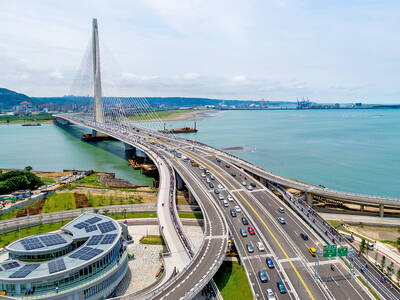
The Ministry of Transportation and Communications yesterday inaugurated the Danjiang Bridge across the Tamsui River in New Taipei City, saying that the structure would be an architectural icon and traffic artery for Taiwan. Feted as a major engineering achievement, the Danjiang Bridge is 920m long, 211m tall at the top of its pylon, and is the longest single-pylon asymmetric cable-stayed bridge in the world, the government’s Web site for the structure said. It was designed by late Iraqi-British architect Zaha Hadid. The structure, with a maximum deck of 70m, accommodates road and light rail traffic, and affords a 200m navigation channel for boats,
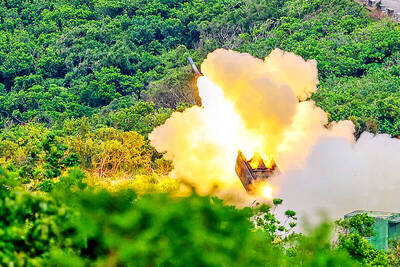
PRECISION STRIKES: The most significant reason to deploy HIMARS to outlying islands is to establish a ‘dead zone’ that the PLA would not dare enter, a source said A High Mobility Artillery Rocket System (HIMARS) would be deployed to Penghu County and Dongyin Island (東引) in Lienchiang County (Matsu) to force the Chinese military to retreat at least 100km from the coastline, a military source said yesterday. Taiwan has been procuring HIMARS and Army Tactical Missile Systems (ATACMS) from the US in batches. Once all batches have been delivered, Taiwan would possess 111 HIMARS units and 504 ATACMS, which have a range of 300km. Considering that “offense is the best defense,” the military plans to forward-deploy the systems to outlying islands such as Penghu and Dongyin so that

Taiwan Semiconductor Manufacturing Co (TSMC, 台積電), the world’s largest foundry service provider, yesterday said that global semiconductor revenue is projected to hit US$1.5 trillion in 2030, after the figure exceeds US$1 trillion this year, as artificial intelligence (AI) demand boosts consumption of token and compute power. “We are still at the beginning of the AI revolution, but we already see a significant impact across the whole semiconductor ecosystem,” TSMC deputy cochief operating officer Kevin Zhang (張曉強) said at the company’s annual technology symposium in Hsinchu City. “It is fair to say that in the past decade, smartphones and other mobile devices were
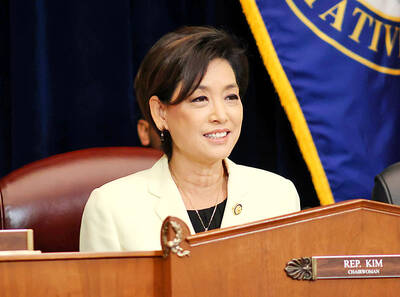
‘CLEAR MESSAGE’: The bill would set up an interagency ‘tiger team’ to review sanctions tools and other economic options to help deter any Chinese aggression toward Taiwan US Representative Young Kim has introduced a bill to deter Chinese aggression against Taiwan, calling for an interagency “tiger team” to preplan coordinated sanctions and economic measures in response to possible Chinese military or political action against Taiwan. “[Chinese President] Xi Jinping [習近平] has directed the People’s Liberation Army to be ready to invade Taiwan by 2027. China has a plan. America should have one too,” Kim said in a news release on Thursday last week. She introduced the “Deter PRC [People’s Republic of China] aggression against Taiwan act” to “ensure the US has a coordinated sanctions strategy ready should


 RSS
RSS