


Taiwanese trekker Liang Sheng-yueh (梁聖岳) is recovering in hospital after rescuers found him and the body of his dead girlfriend on a mountainside in Nepal where they had been stranded for 47 days, surviving on only water and salt after their food ran out.
Liu Chen-chun (劉宸君), 18, died just three days before the rescue team located the couple in northwest Nepal, but her boyfriend managed to survive despite losing 30kg during the ordeal.
A severely malnourished Liang, 20, was being treated in hospital in Kathmandu, where he was airlifted after being rescued from the remote region.

Photo: EPA
Liu’s body was also airlifted to the Nepalese capital.
They were on a long trek on the Ganesh Himal trail, which is not as crowded as other routes, when they were caught in a snowstorm last month and lost their way.
Rescuers said the pair followed a river downstream in the hope of finding a village after getting lost, but they became stuck when they reached the edge of a waterfall and were unable climb back up.
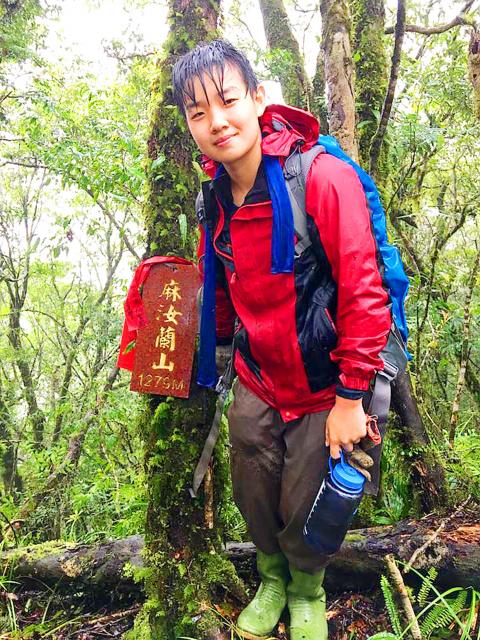
Screengrab from Facebook
“They had a drop of about 100 meters on one side and a steep uphill on the other. They were trapped,” said Asian Trekking agency official Madhav Basnet, who rescued them.
Speaking haltingly and in broken English as he sipped hot soup, Liang late on Wednesday said that it had been “very cold” on the mountain, and difficult to sleep.
Basnet said that it was snowing heavily in the region when the couple reached the cliff and they had to shelter under a rock because they could not erect their tent on the uneven ground.
They survived on potatoes and noodles until their food ran out, leaving them with nothing more than salt and water.
Rescuers first scoured the area for two weeks before suspending their search, but resumed the search on Thursday last week. They headed to the isolated area after they saw crows hovering above.
Basnet said they spotted a red tent and managed to climb down, where they found the pair lying down
“We found the man alive and able to speak to us, but the woman was already dead. We could not carry them so we called a helicopter,” he said.
“The area was so deep and narrow that it was impossible for a helicopter to land,” Basnet said.
The team used a long line to airlift them out and bring them to Kathmandu.
Doctors treating Liang said that as well as his extreme weight loss, maggots had infested his right leg and his head had been infested with lice, but he was recovering and regaining strength.
The couple’s families had alerted authorities when they failed to get in touch as scheduled on March 10.
Liang’s father travelled to Nepal after the couple went missing and chartered a helicopter to search for them, but returned to Taiwan when the air search turned up no sign of the pair.
He told the Liberty Times (the Taipei Times’ sister paper) on Wednesday that the family was full of joy after learning that his son had been found alive.
He thanked the Ministry of Foreign Affairs and the Nepalese authorities for their support and said his family would soon leave for Nepal to see Liang.
He also said that he was grieved about Liu’s death and had talked to Liu’s family, but could not quote them.
Chou Chiang-chieh, a friend of the pair, said they were biking from India to Nepal on a “dream adventure.”
“She [Lui] fought to survive in the Himalayas for so long and I am really sad she didn’t make it, it’s such a pity, she’s like family to me,” Chou said.
Another high-school friend posted a tribute to Liu, remembering her as a “happy child” always seeking new places to go.
The couple had been hiking at about 3,000m without a guide.
Tour operators in Nepal have been pushing for guides to be mandatory if trekkers go above a certain altitude to ensure their safety, said Ang Tsering Sherpa, the head of the nation’s mountaineering association.
“Even popular routes can be tricky to navigate for new trekkers if there is snow or any other disturbances,” he said.
Trekking Agencies’ Association of Nepal president Chandra Prasad Risal said accidents could be avoided if guides were used.
“We hope this serves as a wake-up call to authorities,” he said.
Additional reporting by AP and Hung Mei-hsiu

PROVOCATIVE: Chinese Deputy Ambassador to the UN Sun Lei accused Japan of sending military vessels to deliberately provoke tensions in the Taiwan Strait China denounced remarks by Japan and the EU about the South China Sea at a UN Security Council meeting on Monday, and accused Tokyo of provocative behavior in the Taiwan Strait and planning military expansion. Ayano Kunimitsu, a Japanese vice foreign minister, told the Council meeting on maritime security that Tokyo was seriously concerned about the situation in the East China and South China seas, and reiterated Japan’s opposition to any attempt to change the “status quo” by force, and obstruction of freedom of navigation and overflight. Stavros Lambrinidis, head of the EU delegation to the UN, also highlighted South China Sea

SILENCING CRITICS: In addition to blocking Taiwan, China aimed to prevent rights activists from speaking out against authoritarian states, a Cabinet department said The Ministry of Foreign Affairs (MOFA) yesterday condemned transnational repression by Beijing after RightsCon, a major digital human rights conference scheduled to be held in Zambia this week, was abruptly canceled due to Chinese pressure over Taiwanese participation. This year’s RightsCon, the world’s largest conference discussing issues “at the intersection of human rights and technology,” was scheduled to take place from tomorrow to Friday in Lusaka, and expected to draw 2,600 in-person attendees from 150 countries, along with 1,100 online participants. However, organizers were forced to cancel the event due to behind-the-scenes pressure from China, the ministry said, expressing its “strongest condemnation”
Taiwan Semiconductor Manufacturing Co (TSMC, 台積電), the world’s largest contract chipmaker, said it expects its 2-nanometer (2nm) chip capacity to grow at a compound annual rate of 70 percent from this year to 2028. The projection comes as five fabs begin volume production of 2-nanometer chips this year — two in Hsinchu and three in Kaohsiung — TSMC senior vice president and deputy cochief operating officer Cliff Hou (侯永清) said at the company’s annual technology symposium in Silicon Valley, California, last week. Output in the first year of 2-nanometer production, which began in the fourth quarter of last year, is expected to

Taiwan’s economy grew far faster than expected in the first quarter, as booming demand for artificial intelligence (AI) applications drove a surge in exports, spilling over into investment and consumption, the Directorate-General of Budget, Accounting and Statistics (DGBAS) said yesterday. GDP growth was 13.69 percent year-on-year during the January-to-March period, beating the DGBAS’ February forecast by 2.23 percentage points and marking the most robust growth in nearly four decades, DGBAS senior official Chiang Hsin-yi (江心怡) told a news conference in Taipei. The result was powered by exports, which remain the backbone of Taiwan’s economy, Chiang said. Outbound shipments jumped 51.12 percent year-on-year to


 RSS
RSS