


Marking the nation’s first Freedom of Speech Day, President Tsai Ing-wen (蔡英文) yesterday pledged to continue fighting for Taiwan’s “people of democracy and freedom.”
Tsai made the remarks during a ceremony commemorating the 28th anniversary of the death of democracy pioneer Deng Nan-jung (鄭南榕) at his tomb in New Taipei City’s Jinbaoshan Cemetery. Deng’s widow, former Presidential Office secretary-general Yeh Chu-lan (葉菊蘭), was at the event.
Deng, who ran a number of dissident magazines, self-immolated on April 7, 1989, in protest against government restrictions on freedom of speech. In December last year, the Tsai administration designated April 7 as Freedom of Speech Day to honor Deng’s pursuit of freedom of expression.
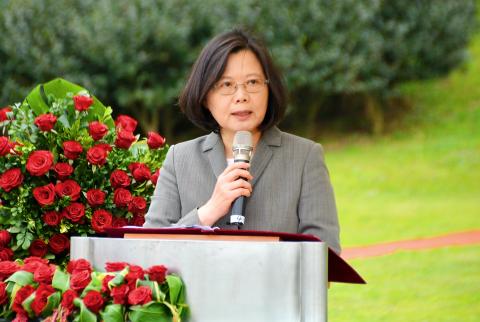
Photo: CNA
“When Deng immolated himself in 1989, many things were left undone. At the time, the National Assembly had yet to be re-elected and there were no direct presidential elections, while Article 100 of the Criminal Code and the Punishment of Rebellion Act (懲治叛亂條例) restricted people’s freedom of speech,” Tsai said.
Article 100 of the Criminal Code, which was amended in 1992, provided the legal basis for the imprisonment of people suspected of plotting to overthrow the then-Chinese Nationalist Party (KMT) government.
The Punishment of Rebellion Act, abolished in 1991, was promulgated in 1949 and originally targeted communists, but was soon used as a means to control and oppress political activities.
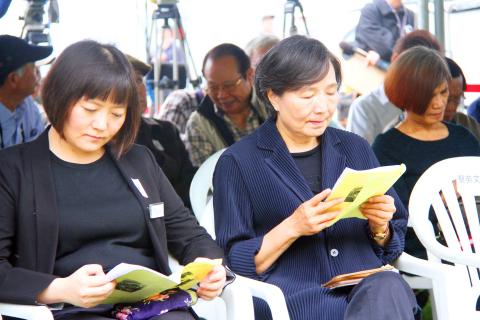
Photo: Lin Hsin-han, Taipei Times
While the nation has realized many democratic achievements over the past 28 years, including three peaceful transitions of political power, new problems have emerged that need to be solved, Tsai said.
The government’s commitment to the pursuit of democracy, fairness and justice is unwavering, as evidenced by the decision in May last year to drop all criminal charges against members of the Sunflower movement who occupied the Executive Yuan in 2014 to protest a controversial cross-strait service trade agreement, she said.
Further proof of the government’s determination includes the promulgation of the Act Governing the Handling of Ill-gotten Properties by Political Parties and Their Affiliate Organizations (政黨及其附隨組織不當取得財產處理條例) in August last year in a bid to put the nation’s politics on the right track, she added.
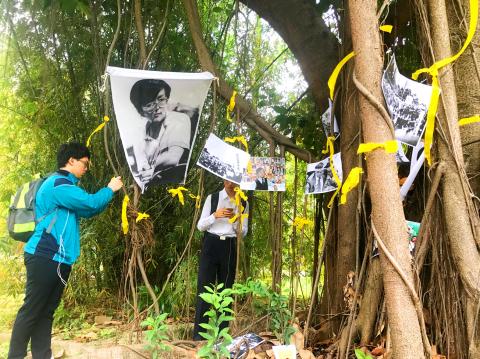
Photo: Yeh Kuan-yu, Taipei Times
“On this national day, we should remind one another that freedom and democracy do not fall from the sky; they need to be fought for,” Tsai said, vowing to defend the nation’s democracy and hard-earned freedom.
“Taiwanese are a people of democracy and freedom,” Tsai said. “My government will spare no effort to fight for the rights of our nation’s 23 million democratic people.”

A signaling system malfunction disrupted high-speed rail (HSR) services beginning at 8am today, with trains temporarily reduced to three northbound and three southbound trains per hour as authorities conduct inspections. The malfunction occurred on a section of track in Miaoli County during pre-operation checks early this morning, forcing northbound and southbound trains to use a single track, the HSR operator said. The regular schedule has been replaced with three hourly trains offering only nonreserved seating in each direction, stopping at every station, it said, adding that business class cars would still have reserved seating. Departures from terminal stations are scheduled at the top

DRONE CENTRAL: Taiwan aims to become Asia’s democratic hub for drones, with most exports focused on high-quality military-grade models, an official said Taiwan’s drone industry is expected to expand significantly by 2030, producing 100,000 units per month and exporting half of them, the Ministry of Economic Affairs said yesterday. Current drone production capacity is about 15,000 units per month, but the industry can quickly scale up as demand increases, Industrial Development Administration Director-General Chiou Chyou-huey (邱求慧) told a news conference in Taipei. Taiwan’s drone output grew 2.5-fold last year to NT$12.9 billion (US$408.3 million) under a government program to develop the uncrewed vehicle sector, he said. The Executive Yuan in October last year approved plans to invest NT$44.2 billion into domestic production of uncrewed aerial

VERBOSE VESSELS: A CGA cutter and a China Coast Guard exchanged verbal barbs for more than a day in Taiwanese-controlled waters before the Chinese vessel left The Taiwanese and Chinese coast guards had a standoff near the strategically located Pratas Islands (Dongsha Islands, 東沙群島) in the north of the South China Sea, the Coast Guard Administration (CGA) said yesterday. The two sides engaged in intense radio exchanges over sovereignty claims during the 33-hour standoff. China Coast Guard vessel 3501 eventually left the restricted waters, 26.6 nautical miles (49.2km) west of the Pratas Islands, at 5pm yesterday, the CGA said. Lying approximately between southern Taiwan and Hong Kong, the Taiwan-controlled Pratas are seen by some security experts as vulnerable to Chinese attack due to their distance — more than
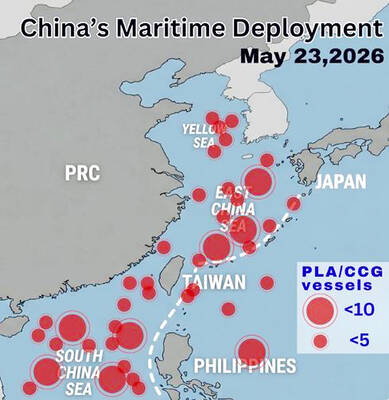
WARNING: China should stop engaging in actions that undermine regional peace and stability, as it would only build resentment among people across the Strait, the CGA said China has deployed more than 100 navy, coast guard and other vessels in waters from the Yellow Sea to the South China Sea and the western Pacific since US President Donald Trump and Chinese President Xi Jinping (習近平) met in Beijing, National Security Council Secretary-General Joseph Wu (吳釗燮) said yesterday. “In this part of the world, #China is the one & only PROBLEM wrecking the #StatusQuo & threatening regional peace & stability,” Wu wrote on X. In a separate post, he said Beijing was coercing Taiwan’s maritime domain, calling it illegal and provocative, after the Coast Guard Administration (CGA) expelled a


 RSS
RSS