


The regulation concerning the criteria for foreigners with professional skills to obtain Republic of China citizenship, without being required to renounce their original citizenship, is to be promulgated today, the Ministry of the Interior announced.
The ministry is to promulgate today the regulation, which is in accordance with and supplementing an amendment to the Nationality Act (國籍法) passed by the legislature in December last year that states foreign nationals may be exempted from submitting a certificate of loss of original nationality if “they are high-level professionals in the technological, economic, educational, cultural, art, sports, or other domains who have been recommended by the central competent authority.”
Foreigners with five years of residency and specific professional qualifications in six specified categories can be granted citizenship without renouncing their prior citizenship, it said.
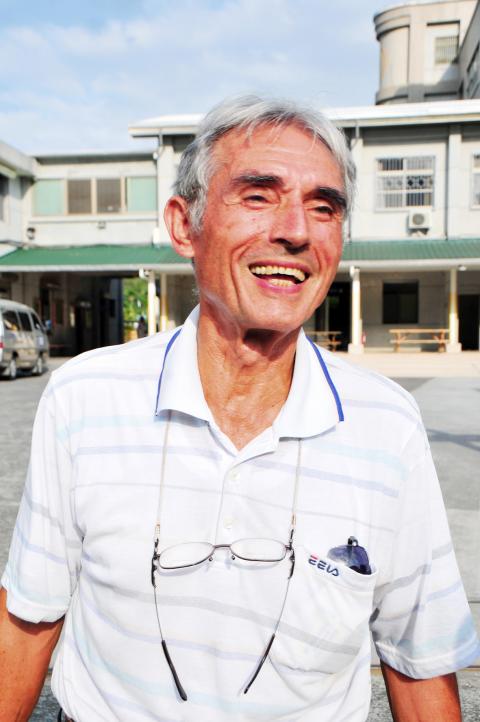
Photo: Hua Meng-ching, Taipei Times
The amendment does not apply to Chinese citizens or residents of Hong Kong or Macau, as their naturalization falls under the purview of the Act Governing Relations Between the People of the Taiwan Area and the Mainland Area (臺灣地區與大陸地區人民關係條例), it said.
The professional categories included in the regulation are technology, economics, arts and culture, education, sports and “special,” the ministry said.
The technology category includes experts in high-value technical fields such as nanotechnology, optoelectronics, information technology, biotechnology, military science and technology, artificial intelligence, robotics and other cutting-edge technologies.
The economics category includes those with technical skills or knowledge of subjects that could contribute to the upgrading of industry, such as those involving semiconductors, biomedical technology, “green” energy, cultural industries and tourism.
The arts and culture category includes those who received recognition from distinguished institutions or major media outlets; have served on the panels of major arts and cultural prizes; accomplished preservers or restorers; or outstanding performers.
The educational category includes foreigners who are employed at a Taiwanese academic institution with a rank of assistant professor or above and those who have published in internationally renowned academic journals.
The sports category includes athletes who have finished in the top three places in international competition, national team coaches, international referees and distinguished players.
The special category includes distinguished democratic, human rights and religious advocates; those who have authored major works of literature; those who have received international honors or distinctions; and those with a recognized contribution to finance, medicine, transportation, telecommunications, aviation and navigation, meteorology, earthquake studies and popular culture.
French Catholic priest Yves Moal — also known as Liu Yi-feng (劉一峰) — yesterday said he is heartened to be able to be a citizen of both Taiwan and France.
Moal, 76, said he has served the Catholic Church in Taiwan for the past 51 years and has since 1986 managed a Hualien-based charity for mentally challenged children, works that have earned him a Presidential Office commendation.
“Taiwan has been my home for a long time. I spend almost twice as much time in Taiwan as in France, and I will be more than happy to live out my old age in Taiwan,” Moal said, adding that he expects to receive his national identification card next week.
Additional reporting by Hua Meng-ching

A signaling system malfunction disrupted high-speed rail (HSR) services beginning at 8am today, with trains temporarily reduced to three northbound and three southbound trains per hour as authorities conduct inspections. The malfunction occurred on a section of track in Miaoli County during pre-operation checks early this morning, forcing northbound and southbound trains to use a single track, the HSR operator said. The regular schedule has been replaced with three hourly trains offering only nonreserved seating in each direction, stopping at every station, it said, adding that business class cars would still have reserved seating. Departures from terminal stations are scheduled at the top
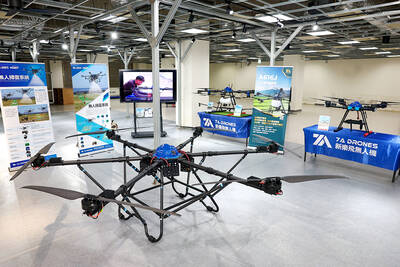
DRONE CENTRAL: Taiwan aims to become Asia’s democratic hub for drones, with most exports focused on high-quality military-grade models, an official said Taiwan’s drone industry is expected to expand significantly by 2030, producing 100,000 units per month and exporting half of them, the Ministry of Economic Affairs said yesterday. Current drone production capacity is about 15,000 units per month, but the industry can quickly scale up as demand increases, Industrial Development Administration Director-General Chiou Chyou-huey (邱求慧) told a news conference in Taipei. Taiwan’s drone output grew 2.5-fold last year to NT$12.9 billion (US$408.3 million) under a government program to develop the uncrewed vehicle sector, he said. The Executive Yuan in October last year approved plans to invest NT$44.2 billion into domestic production of uncrewed aerial
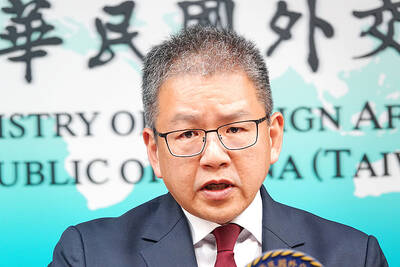
Taiwan is still in the process of assessing the possibility of recruiting workers from Eswatini, the Ministry of Foreign Affairs said yesterday, adding that its goal is to help Eswatini upgrade its vocational training centers. If there are plans to recruit workers from Eswatini, safeguarding national security, protecting public health and ensuring the employment rights of Taiwanese would be prerequisites, Department of West Asian and African Affairs Director-General Yen Chia-liang (顏嘉良) told a news conference. Key considerations would also include filling labor shortages in specific industries, and fostering bilateral professional and technical exchanges, he said. Yen was asked about the progress of labor

VERBOSE VESSELS: A CGA cutter and a China Coast Guard exchanged verbal barbs for more than a day in Taiwanese-controlled waters before the Chinese vessel left The Taiwanese and Chinese coast guards had a standoff near the strategically located Pratas Islands (Dongsha Islands, 東沙群島) in the north of the South China Sea, the Coast Guard Administration (CGA) said yesterday. The two sides engaged in intense radio exchanges over sovereignty claims during the 33-hour standoff. China Coast Guard vessel 3501 eventually left the restricted waters, 26.6 nautical miles (49.2km) west of the Pratas Islands, at 5pm yesterday, the CGA said. Lying approximately between southern Taiwan and Hong Kong, the Taiwan-controlled Pratas are seen by some security experts as vulnerable to Chinese attack due to their distance — more than


 RSS
RSS