


The Chinese Nationalist Party (KMT) yesterday said it has discovered gold bonds issued by the Republic of China (ROC) government in 1947 worth nearly NT$38.5 billion (US$1.258 billion), touting the find as proof of the party’s contributions to the nation.
KMT Administration and Management Committee director Chiu Da-chan (邱大展) said the large batch of gold bonds, found during the KMT’s recent inspection of its assets, are still in good condition.
“These gold bonds had been recorded multiple times in the party’s documents and were transported to Taiwan during the [Chinese Civil] war, before being stored in 68 boxes and placed in the trust of CTBC Bank Co (中國信託銀行),” Chiu told a news conference in Taipei.
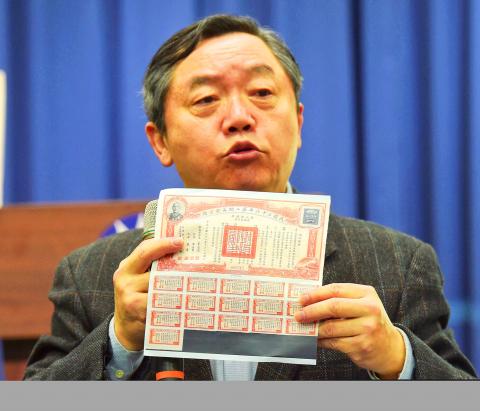
Photo: Huang Yao-cheng, Taipei Times
The bonds remain in the bank, as the KMT’s request last year to retrieve them was denied, he said.
The bonds’ unclaimed principal and interest total approximately US$36.4 million, which, based on the US’ fixed gold standard of US$35 per ounce, can be converted to about 32,319kg of gold.
“With gold on Friday last week valued at NT$1,188 per gram, the bonds are worth nearly NT$38.5 billion,” Chiu said, adding that the bonds were listed as KMT property when it was registered as a corporate entity in February 1989.
Chiu said the fact that the Act Governing Relations Between the People of the Taiwan Area and the Mainland Area (臺灣地區與大陸地區人民關係條例) promulgated by the KMT in 1992 forbids repayment of the short-term gold bonds, which were issued in China in 1949, showed that the KMT is not out to serve its own interests.
The KMT purchased the bonds to help rebuild the economy, Chiu said.
The reason it never redeemed them was because the party regarded salvaging the nation’s economy as its priority, he said.
Urging the Cabinet’s Ill-gotten Party Assets Settlement Committee to acknowledge the KMT’s dedication to the ROC, Chiu said the party would report the gold bonds to the committee soon and hoped a fair investigation would be conducted.
Assets committee spokeswoman Shih Chin-fang (施錦芳) said that the committee would process the bonds once the KMT reports them.
Presidential Office spokesman Sidney Lin (林鶴明) said that as the bonds were issued by the KMT regime in China before the promulgation of the ROC Constitution in 1947, they do not concern Taiwanese, nor the committee’s ongoing effort to probe the KMT’s ill-gotten assets.
However, the discovery raised questions as to how the bonds had remained hidden from past investigations and whether there are more assets like them, Lin said.
Democratic Progressive Party Legislator Lin Chun-hsien (林俊憲) said on Facebook the act stipulates that both “outstanding foreign-currency bonds issued in the mainland [China] prior to 1949 and the short-term Gold Bonds of 1949” and “various debts owed by any government bank, as well as any other financial institution accepting deposits before [the KMT’s] retreat from the mainland ... shall not be repaid prior to national unification.”
“Now I know why the KMT has been obsessed with the idea of unification, despite its dismal popularity; it is all for the money, as the bonds cannot be cashed as long as the nation is not unified,” Lin Chun-hsien wrote.
“It would be an otherworldly miracle if they could be repaid,” he added.
Additional reporting by Alison Hsiao and CNA
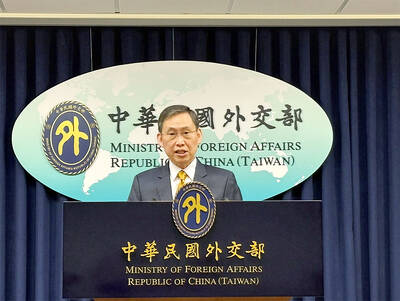
A Ministry of Foreign Affairs official yesterday said that a delegation that visited China for an APEC meeting did not receive any kind of treatment that downgraded Taiwan’s sovereignty. Department of International Organizations Director-General Jonathan Sun (孫儉元) said that he and a group of ministry officials visited Shenzhen, China, to attend the APEC Informal Senior Officials’ Meeting last month. The trip went “smoothly and safely” for all Taiwanese delegates, as the Chinese side arranged the trip in accordance with long-standing practices, Sun said at the ministry’s weekly briefing. The Taiwanese group did not encounter any political suppression, he said. Sun made the remarks when

PREPAREDNESS: Given the difficulty of importing ammunition during wartime, the Ministry of National Defense said it would prioritize ‘coproduction’ partnerships A newly formed unit of the Marine Corps tasked with land-based security operations has recently replaced its aging, domestically produced rifles with more advanced, US-made M4A1 rifles, a source said yesterday. The unnamed source familiar with the matter said the First Security Battalion of the Marine Corps’ Air Defense and Base Guard Group has replaced its older T65K2 rifles, which have been in service since the late 1980s, with the newly received M4A1s. The source did not say exactly when the upgrade took place or how many M4A1s were issued to the battalion. The confirmation came after Chinese-language media reported
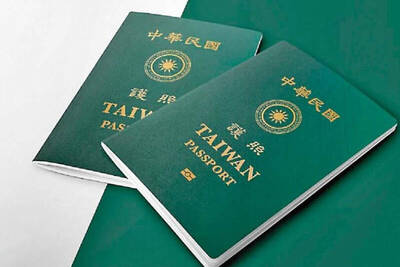
The Taiwanese passport ranked 33rd in a global listing of passports by convenience this month, rising three places from last month’s ranking, but matching its position in January last year. The Henley Passport Index, an international ranking of passports by the number of designations its holder can travel to without a visa, showed that the Taiwan passport enables holders to travel to 139 countries and territories without a visa. Singapore’s passport was ranked the most powerful with visa-free access to 192 destinations out of 227, according to the index published on Tuesday by UK-based migration investment consultancy firm Henley and Partners. Japan’s and
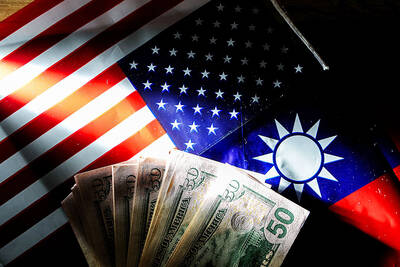
BROAD AGREEMENT: The two are nearing a trade deal to reduce Taiwan’s tariff to 15% and a commitment for TSMC to build five more fabs, a ‘New York Times’ report said Taiwan and the US have reached a broad consensus on a trade deal, the Executive Yuan’s Office of Trade Negotiations said yesterday, after a report said that Washington is set to reduce Taiwan’s tariff rate to 15 percent. The New York Times on Monday reported that the two nations are nearing a trade deal to reduce Taiwan’s tariff rate to 15 percent and commit Taiwan Semiconductor Manufacturing Co (TSMC, 台積電) to building at least five more facilities in the US. “The agreement, which has been under negotiation for months, is being legally scrubbed and could be announced this month,” the paper said,


 RSS
RSS