


An increase in consumer prices is inevitable because of the newly promulgated labor law amendments that increase overtime pay for workers, Premier Lin Chuan (林全) said, adding that the Cabinet plans to increase corporate income tax rates and lower personal income tax rates as part of a tax reform scheme.
In an interview with the Chinese-language China Times published yesterday, Lin said that transportation fares and prices at restaurants are likely to increase following the amendments to the Labor Standards Act (勞動基準法). The revisions stipulate a five-day workweek with one fixed day off and one flexible day off, with employees entitled to overtime pay if requested to work on their flexible day off.
Transport operators have to increase fares to pay for more drivers under the new system, Lin said, while urging operators to slow the pace and degree of price hikes to mitigate the effects.
While in some sectors, employee salaries are not likely to increase, leave time will, which is a major objective of the legislation, Lin said.
The public must accept that if restaurants close on Saturdays to reduce personnel costs this is the “price of modernization,” Lin said.
However, he called on businesses not to use the legislation as an excuse for an across-the-board price hike.
A shift from labor-intensive to automated manufacturing is a natural development in different sectors, which is little associated with the legislation, he said.
In another interview with the Chinese-language Economic Daily News, Lin said the government would adjust corporate and personal income tax rates, but ensure it does not affect tax revenues.
The highest personal income tax rate is 45 percent and the maximum corporate income tax rate is 17 percent. The tax gap has encouraged local investors to use offshore accounts and shell companies to invest in the local market, Lin said.
To reduce tax evasion while maintaining a healthy economy, the Cabinet is considering narrowing the gap between the taxes while ensuring premise that the total tax revenue would remain unchanged.
Lin said there would not be a large-scale adjustment and the Executive Yuan has yet to propose an adjustment plan.
Lin’s remarks prompted criticism from some politicians and business leaders.
Former Presidential Office deputy secretary-general Lo Chih-chiang (羅智強) said the price hikes would lead to inflation.
Citing President Tsai Ing-wen’s (蔡英文) criticism that former president Ma Ying-jeou’s (馬英九) adjustments to petroleum and electricity prices in 2008 might trigger “inflation” as consumers would panic over rising prices, Lo said Lin’s comments could trigger the same response.
“Are you, as the premier, trying to create panic over rising prices and trigger inflation by announcing publicly that price hikes are inevitable?” Lo, who served in Ma’s administration, wrote on Facebook.
Far Eastern Group (遠東集團) chairman Douglas Hsu (徐旭東) said the proposed tax rate adjustment was “interesting” amid a global trend to reduce taxes.
Chinese National Association of Industry and Commerce chairman Lin Por-fong (林伯豐) said the maximum corporate tax rate should be maintained at 17 percent because the labor legislation would increase businesses’ personnel costs by between 5 and 8 percent.
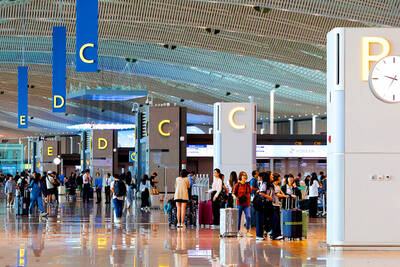
South Korea has adjusted its electronic arrival card system to no longer list Taiwan as a part of China, a move that the Ministry of Foreign Affairs said would help facilitate exchanges between the two sides. South Korea previously listed “Taiwan” as “Taiwan (China)” in the drop-down menus of its online arrival card system, where people had to fill out where they came from and their next destination. The ministry had requested South Korea make a revision and said it would change South Korea’s name on Taiwan’s online immigration system from “Republic of Korea” to “Korea (South),” should the issue not be

Tainan, Taipei and New Taipei City recorded the highest fines nationwide for illegal accommodations in the first quarter of this year, with fines issued in the three cities each exceeding NT$7 million (US$220,639), Tourism Administration data showed. Among them, Taipei had the highest number of illegal short-term rental units, with 410. There were 3,280 legally registered hotels nationwide in the first quarter, down by 14 properties, or 0.43 percent, from a year earlier, likely indicating operators exiting the market, the agency said. However, the number of unregistered properties rose to 1,174, including 314 illegal hotels and 860 illegal short-term rental
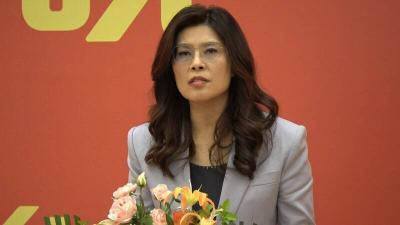
Both sides of the Taiwan Strait share a political foundation based on the “1992 consensus” and opposition to Taiwanese independence, Chinese Nationalist Party (KMT) Chairwoman Cheng Li-wun (鄭麗文) today said during her meeting with Chinese President Xi Jinping (習近平). Both sides of the Strait should plan and build institutionalized and sustainable mechanisms for dialogue and cooperation based on that foundation to make peaceful development across the Strait irreversible, she said. Peace is a shared moral value across the Strait, and both sides should move beyond political confrontation to seek institutionalized solutions to prevent war, she said. Mutually beneficial cross-strait relations are what the
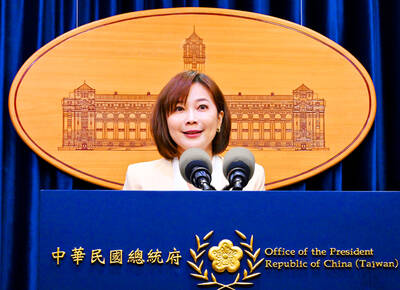
ECONOMIC COERCION: Such actions are often inconsistently applied, sometimes resumed, and sometimes just halted, the Presidential Office spokeswoman said The government backs healthy and orderly cross-strait exchanges, but such arrangements should not be made with political conditions attached and never be used as leverage for political maneuvering or partisan agendas, Presidential Office spokeswoman Karen Kuo (郭雅慧) said yesterday. Kuo made the remarks after China earlier in the day announced 10 new “incentive measures” for Taiwan, following a landmark meeting between Chinese President Xi Jinping (習近平) and Chinese Nationalist Party (KMT) Chairwoman Cheng Li-wun (鄭麗文) in Beijing on Friday. The measures, unveiled by China’s Xinhua news agency, include plans to resume individual travel by residents of Shanghai and China’s Fujian


 RSS
RSS