


Democratic Progressive Party (DPP) lawmakers yesterday proposed an amendment that would cancel pensions for retired civil servants and military personnel who participate in political activities in China, as more details emerged about former military officers attending an event in Beijing last week that featured a policy address by Chinese President Xi Jinping (習近平).
The amendment would revoke pensions for retired military officers engaging in political activities in China, as their behavior could imperil national security and seriously erode the morale and loyalty of active-service personnel, DPP legislators Chen Chi-mai (陳其邁), Chuang Ruei-hsiung (莊瑞雄) and Lee Chun-yi (李俊俋) said at a news conference.
Seven retired generals, 12 former lieutenant generals and 18 retired major generals attended the event in Beijing commemorating the 150th anniversary of the birth of Republic of China founder Sun Yat-sen (孫逸仙), Chen said, citing information provided by the National Security Bureau.
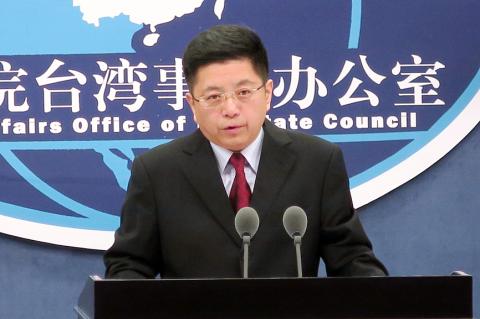
Photo: CNA
The updated figure was greater than the list of 32 retired officers provided two days ago, which included retired lieutenant general Wu Sz-huai (吳斯懷), and former generals Wang Wen-hsieh (王文燮) and Hsia Ying-chou (夏瀛洲), he added.
“These retired high-ranking officers have violated provisions of the Act Governing Relations Between the People of the Taiwan Area and the Mainland Area (台灣地區與大陸地區人民關係條例) against engaging in political activities in China,” Chen said.
“We have asked the Ministry of National Defense and the Mainland Affairs Council to investigate whether these retired officers have participated in similar events and whether the Chinese government provided them with subsidies, which could include travel expenses, meals and accommodation,” he added.
A recently released video of the event — at which Xi delivered a speech warning against Taiwanese “separatism” — shows the retired officers standing at attention and singing the Chinese national anthem along with Chinese political and military elites, Chuang said.
“We must deal with this matter now by cutting off their pensions,” Chuang said. “The image of these retired generals singing the Chinese national anthem are painful to all Taiwanese and is demoralizing to troops who are protecting the nation.”
The act prohibits individuals, organizations and registered foundations from engaging in any cooperative or political activity organized by Chinese officials, organizations or military personnel, Chuang said.
“The law currently only allows for a fine as punishment, so we will work toward amending regulations to cancel retirement pay for violators,” he added.
When asked to comment at a routine news conference in Beijing yesterday, China’s Taiwan Affairs Office spokesman Ma Xiaoguang (馬曉光) said some DPP members are stalwart supporters of Taiwanese independence and have sought to incite hostility and confrontation across the Taiwan Strait through political means.
“The DPP administration’s oppression of Taiwanese attending cross-strait events is clearly designed to have a chilling effect on cross-strait relations,” Ma said.
DPP spokesman David Huang (黃適卓) later issued a statement rejecting Ma’s criticism, saying: “The conduct of retired military officers, who gave no consideration to their special status and took part in a Chinese Communist Party event promoting unification, is unacceptable to the public, especially as they stood at attention during the playing of the Chinese national anthem.”
“How is [public disgust with their conduct] a chilling effect?” Huang asked.
It is imperative that soldiers, including retired military personnel, remain loyal to the nation and protect national security,” he added.
Additional reporting by Chen Wei-han

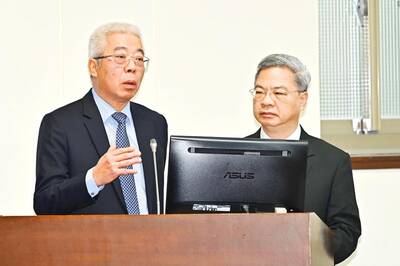
Taiwan has arranged for about 8 million barrels of crude oil, or about one-third of its monthly needs, to be shipped from the Red Sea this month to bypass the Strait of Hormuz and ease domestic supply pressures, CPC Corp, Taiwan (CPC, 台灣中油) said yesterday. The state-run oil company has worked with Middle Eastern suppliers to secure routes other than the Strait of Hormuz, through which about 20 percent of the world’s oil and liquefied natural gas typically passes, CPC chairman Fang Jeng-zen (方振仁) said at a meeting of the legislature’s Economics Committee in Taipei. Suppliers in Saudi Arabia have indicated they
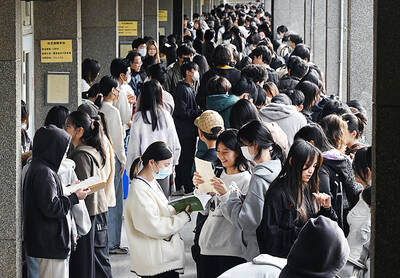
A global survey showed that 60 percent of Taiwanese had attained higher education, second only to Canada, the Ministry of the Interior said. Taiwan easily surpassed the global average of 43 percent and ranked ahead of major economies, including Japan, South Korea and the US, data from the Organisation for Economic Co-operation and Development (OECD) for 2024 showed. Taiwan has a high literacy rate, data released by the ministry showed. As of the end of last year, Taiwan had 20.617 million people aged 15 or older, accounting for 88.5 percent of the total population, with a literacy rate of 99.4 percent, the data
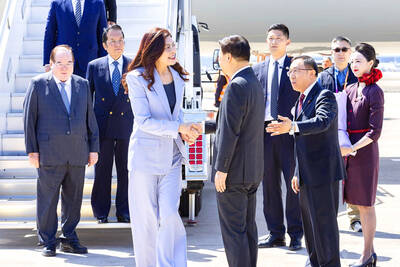
CCP ‘PAWN’? Beijing could use the KMT chairwoman’s visit to signal to the world that many people in Taiwan support the ‘one China’ principle, an academic said Chinese Nationalist Party (KMT) Chairwoman Cheng Li-wun (鄭麗文) yesterday arrived in China for a “peace” mission and potential meeting with Chinese President Xi Jinping (習近平), while a Taiwanese minister detailed the number of Chinese warships currently deployed around the nation. Cheng is visiting at a time of increased Chinese military pressure on Taiwan, as the opposition-dominated Legislative Yuan stalls a government plan for US$40 billion in extra defense spending. Speaking to reporters before going to the airport, Cheng said she was going on a “historic journey for peace,” but added that some people felt uneasy about her trip. “If you truly love Taiwan,

NEW LOW: The council in 2024 based predictions on a pessimistic estimate for the nation’s total fertility rate of 0.84, but last year that rate was 0.69, 17 percent lower An expected National Development Council (NDC) report expects the nation’s population to drop below 12 million by 2065, with the old-age dependency ratio to top 100 percent sooner than 2070, sources said yesterday. The council is slated to release its latest population projections in August, using an ultra-low fertility model, the sources said. The previous report projected that Taiwan’s population would fall to 14.37 million by 2070, but based on a new estimate of the total fertility rate (TFR) — the average number of children born to a woman over her lifetime — the population is expected to reach 12 million by


 RSS
RSS