


Premier Lin Chuan (林全) yesterday reaffirmed the government’s plan to lift a ban on Japanese food products from five radiation-affected prefectures, saying that the deregulation would be carried out scientifically and gradually, while confirming that extra public hearings are planned after the 10 held over the weekend and on Monday ended in chaos due to protesters’ interference.
Taiwan and China are the only two nations that maintain a ban on food imports from the Japanese prefectures of Fukushima, Ibaraki, Tochigi, Gunma and Chiba, but Taiwan has to adopt a scientific approach to the food safety issue, as the ban creates an unfair trading environment, Lin said on Monday during a televised interview.
“Scientifically speaking, if the products pose no health risk, should we not reopen [imports of banned Japanese food] like other nations?” Lin said. “From a free trade perspective, it is absolutely unreasonable to prohibit products that are not radioactively contaminated.”
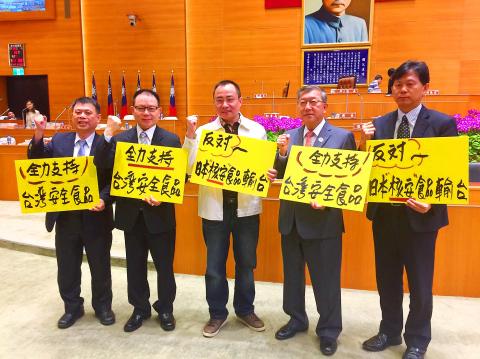
Photo: Tsai Meng-shang, Taipei Times
The nation has suspended food imports from the five prefectures since the Fukushima Dai-ichi nuclear power plant disaster in March 2011.
Lin said that the ban would be lifted partially and conditionally, as food products from Fukushima Prefecture are to remain banned and products from Ibaraki, Tochigi, Gunma and Chiba are to be allowed conditionally, while aquatic products and wild mushrooms from those prefectures would remain prohibited.
Produce from the Ibaraki, Tochigi, Gunma and Chiba have been collectively and mistakenly described as radioactively contaminated, Lin said, likening the prefectures to Changhua and Miaoli counties’ proximity to nuclear power plants in New Taipei City.
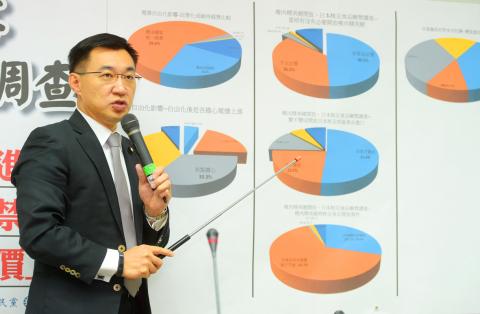
Photo: Chang Chia-ming, Taipei Times
The government will not lift the ban on products considered to be risky to consumers, even if they are allowed to circulate in Japan, such as foods that are prohibited for people younger than 18 due to high radioactivity.
“Our standards will only be stricter, not more relaxed, than those of Japan,” Lin said.
Lin’s remarks were aimed at easing public concern about the proposed lifting of the ban, as the controversy surrounding the issue has escalated, with protesters paralyzing 10 public hearings held by the Cabinet on the issue, while a Democratic Progressive Party (DPP) lawmaker has publicly opposed the proposal.
Lin said he regretted violence at the hearings, adding that the government has not yet finalized a deregulation plan and welcomes the public’s opinions.
“The new government has been dealing with unfair trade [regulations] on Japanese food imports at a gradual pace, but the government does not have to lift the ban now,” Lin said.
The Japanese government complained about Taiwan’s strict import rules well before the DPP took power in May, and Japanese trade representatives paid him a visit when he was running a DPP think tank, Lin said.
He rejected allegations that the proposed easing was made in exchange for closer economic ties and a meeting between People First Party James Soong (宋楚瑜) and Japanese Prime Minister Shinzo Abe at this weekend’s APEC summit, at which Soong is to represent President Tsai Ing-wen (蔡英文).
“The allegations are too far-fetched, too unrealistic. I have to say that there is no such a thing,” he said.
Lin confirmed that extra public hearings on lifting the ban would be held, but did not specify how many or when they would take place.
Meanwhile, the legislature yesterday failed to reach a consensus on the issue, as DPP lawmakers did not show up for a cross-caucus negotiation.
The Chinese Nationalist Party (KMT) caucus has demanded that a Taiwan-Japan mutual judicial assistance agreement be signed before the ban on food products from Japan’s radiation-affected regions be lifted.
The New Power Party caucus has called for the establishment of a Taiwan-Japan investigation and evaluation team, saying no imports should be allowed before the team presents a comprehensive report to the legislature.
Additional reporting by CNA
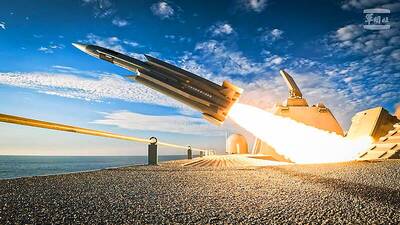
DETERRENCE: With 1,000 indigenous Hsiung Feng II and III missiles and 400 Harpoon missiles, the nation would boast the highest anti-ship missile density in the world With Taiwan wrapping up mass production of Hsiung Feng II and III missiles by December and an influx of Harpoon missiles from the US, Taiwan would have the highest density of anti-ship missiles in the world, a source said yesterday. Taiwan is to wrap up mass production of the indigenous anti-ship missiles by the end of year, as the Chungshan Institute of Science and Technology has been meeting production targets ahead of schedule, a defense official with knowledge of the matter said. Combined with the 400 Harpoon anti-ship missiles Taiwan expects to receive from the US by 2028, the nation would have

North Korea yesterday fired about 10 ballistic missiles to the sea toward Japan, the South Korean Joint Chiefs of Staff (JCS) said, days after Pyongyang warned of “terrible consequences” over ongoing South Korea-US military drills. Pyongyang recently dashed hopes of a diplomatic thaw with Seoul, Washington’s security ally, describing its latest peace efforts as a “clumsy, deceptive farce.” Seoul’s military detected “around 10 ballistic missiles launched from the Sunan area in North Korea toward the East Sea [Sea of Japan] at around 1:20pm,” JCS said in a statement, referring to South Korea’s name for the body of water. The missiles
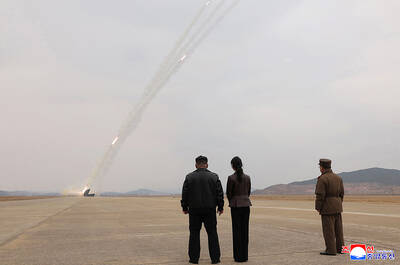
North Korea tested nuclear-capable rocket launchers, state media reported yesterday, a day after Seoul detected the launch of about 10 ballistic missiles. The test comes after South Korean and US forces launched their springtime military drills, due to run until Thursday. North Korean leader Kim Jong-un on Saturday oversaw the testing of the multiple rocket launcher system (MRLS), the Korean Central News Agency (KCNA) said. The test involved 12 600mm-caliber ultra-precision multiple rocket launchers and two artillery companies, it said. Kim said the drill gave Pyongyang’s enemies, within the 420km striking range, a sense of “uneasiness” and “a deep understanding

‘UNWAVERING FRIENDSHIP’: A representative of a Japanese group that co-organized a memorial, said he hopes Japanese never forget Taiwan’s kindness President William Lai (賴清德) yesterday marked the 15th anniversary of the Tohoku earthquake and tsunami, urging continued cooperation between Taiwan and Japan on disaster prevention and humanitarian assistance. Lai wrote on social media that Taiwan and Japan have always helped each other in the aftermath of major disasters. The magnitude 9 earthquake struck northeastern Japan on March 11, 2011, triggering a massive tsunami that claimed more than 19,000 lives, according to data from Japanese authorities. Following the disaster, Taiwan donated more than US$240 million in aid, making it one of the largest contributors of financial assistance to Japan. In addition to cash donations and


 RSS
RSS