


Chinese Nationalist Party (KMT) Chairwoman Hung Hsiu-chu (洪秀柱) is expected to meet with Chinese President Xi Jinping (習近平) when she goes to Beijing at the beginning of next month for the annual KMT-Chinese Communist Party (CCP) get-together, the KMT said yesterday.
The annual forum is also to change from an economy-centered meeting to one focusing on peaceful cross-strait development, it said.
In a news release issued in the morning, the KMT said the decision to change the nature of the forum was made in response to the current cross-strait situation and the emergence of new variables in Taiwan’s political and economic development due to the suspension of official cross-strait communications between Taipei and Beijing.
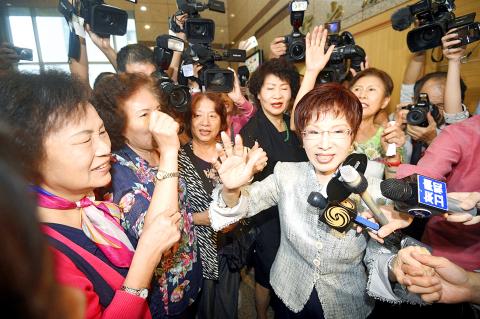
Photo: George Tsorng, Taipei Times
“After negotiations between the two parties [the KMT and the CCP], we decided to support civic organizations in their efforts to build a communication platform and transform the Cross-Strait Economic, Trade and Culture Forum to the ‘Cross-Strait Peaceful Development Forum,’” the KMT said.
This year’s forum is scheduled for Nov. 2 and Nov. 3, it said.
Later in the day, Hung told the weekly meeting of the KMT’s Central Standing Committee that she would lead a delegation to pay tribute to Republic of China (ROC) founding father Sun Yat-sen (孫中山) at his mausoleum in Nanjing on Oct. 31, before heading to Beijing to attend the forum.
It was reported that Hung is likely to meet with Xi, who is the CCP’s general-secretary, on Nov. 1, although China’s Taiwan Affairs Office spokesman An Fengshan (安峰山) did not give a direct answer when asked by reporters at a news conference in Beijing yesterday morning.
A detailed itinerary for the forum is still being planned is all that An would say.
Asked if a Hung-Xi meeting would occur, KMT Culture and Communications Committee deputy director Hu Wen-chi (胡文琦) said on the sidelines of the committee meeting: “That is for sure.”
The forum, which is to be hosted by 20 organizations invited by both parties, is to serve as an open discussion platform for leaders from various sectors of society to exchange opinions and offer advice on maintaining peaceful and stable cross-strait development, the KMT said.
The new forum is to consist of five different discussion groups: the “political group,” which is to focus on mutual political trust and friendly interactions; the “economic group,” which is to focus on economic development and cross-strait cooperation; the “social group” to deepen people-to-people interactions across the Taiwan Strait; the “cultural group,” which is to emphasize cultural inheritance and innovation; and the “youth group,” the KMT said.
The tradition of an annual KMT-CCP forum was started after then-KMT chairman Lien Chan’s (連戰) 2005 China visit, which saw the first formal meeting between the two parties since the Chinese Civil War.
Last year’s forum in Shanghai in May was attended by then-KMT chairman Eric Chu (朱立倫), during which he met with Xi.
There had been calls within the KMT for the abolition of the forum following the party’s disastrous defeat in the Jan. 16 presidential election, which prompted debates about whether the party should become more Taiwan-centric to regain public support.
New Power Party Executive Chairman Huang Kuo-chang (黃國昌) said the announcement of Hung’s trip shows that “the KMT has not learned any lessons from its defeats.”
He urged the former ruling party not to repeat “mistakes of the past.”
“If you insist on holding the KMT-CCP forum, you cannot blame Taiwanese for believing that the KMT is joining hands with the CCP as it implements its ‘united front’ strategy,” he said.
Additional reporting by Abraham Gerber
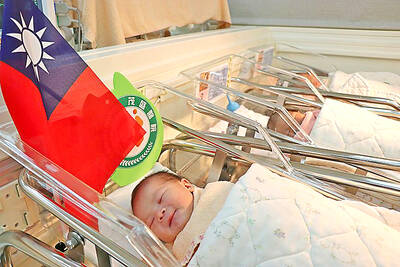
AGING: As of last month, people aged 65 or older accounted for 20.06 percent of the total population and the number of couples who got married fell by 18,685 from 2024 Taiwan has surpassed South Korea as the country least willing to have children, with an annual crude birthrate of 4.62 per 1,000 people, Ministry of the Interior data showed yesterday. The nation was previously ranked the second-lowest country in terms of total fertility rate, or the average number of children a woman has in her lifetime. However, South Korea’s fertility rate began to recover from 2023, with total fertility rate rising from 0.72 and estimated to reach 0.82 to 0.85 by last year, and the crude birthrate projected at 6.7 per 1,000 people. Japan’s crude birthrate was projected to fall below six,
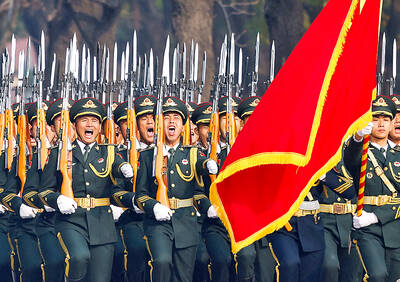
Conflict with Taiwan could leave China with “massive economic disruption, catastrophic military losses, significant social unrest, and devastating sanctions,” a US think tank said in a report released on Monday. The German Marshall Fund released a report titled If China Attacks Taiwan: The Consequences for China of “Minor Conflict” and “Major War” Scenarios. The report details the “massive” economic, military, social and international costs to China in the event of a minor conflict or major war with Taiwan, estimating that the Chinese People’s Liberation Army (PLA) could sustain losses of more than half of its active-duty ground forces, including 100,000 troops. Understanding Chinese
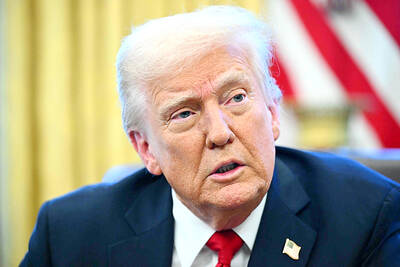
US President Donald Trump in an interview with the New York Times published on Thursday said that “it’s up to” Chinese President Xi Jinping (習近平) what China does on Taiwan, but that he would be “very unhappy” with a change in the “status quo.” “He [Xi] considers it to be a part of China, and that’s up to him what he’s going to be doing, but I’ve expressed to him that I would be very unhappy if he did that, and I don’t think he’ll do that. I hope he doesn’t do that,” Trump said. Trump made the comments in the context
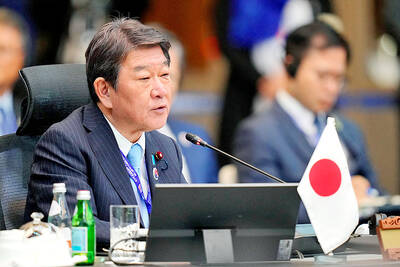
SELF-DEFENSE: Tokyo has accelerated its spending goal and its defense minister said the nation needs to discuss whether it should develop nuclear-powered submarines China is ramping up objections to what it sees as Japan’s desire to acquire nuclear weapons, despite Tokyo’s longstanding renunciation of such arms, deepening another fissure in the two neighbors’ increasingly tense ties. In what appears to be a concerted effort, China’s foreign and defense ministries issued statements on Thursday condemning alleged remilitarism efforts by Tokyo. The remarks came as two of the country’s top think tanks jointly issued a 29-page report framing actions by “right-wing forces” in Japan as posing a “serious threat” to world peace. While that report did not define “right-wing forces,” the Chinese Ministry of Foreign Affairs was


 RSS
RSS