


Controversy over a police visit to the parents of labor rights campaigner Lu Chyi-horng (盧其宏) erupted yesterday, with Premier Lin Chuan (林全) promising to investigate after the incident sparked widespread criticism.
The Workers Struggle Alliance, with which Lu is closely affiliated, late on Friday posted online messages that Lu said he had received from his father telling him that police had stopped by his parents’ home earlier in the day because they wanted to “understand” the cause of Lu’s “dissatisfaction” with the government.
“Be careful! The Democratic Progressive Party (DPP) might be starting to take actions which will be disadvantageous to those of you who are singing a different tune,” the message said. “What can you do if they decide to take forceful actions? For your own safety, do not keep pushing things.”
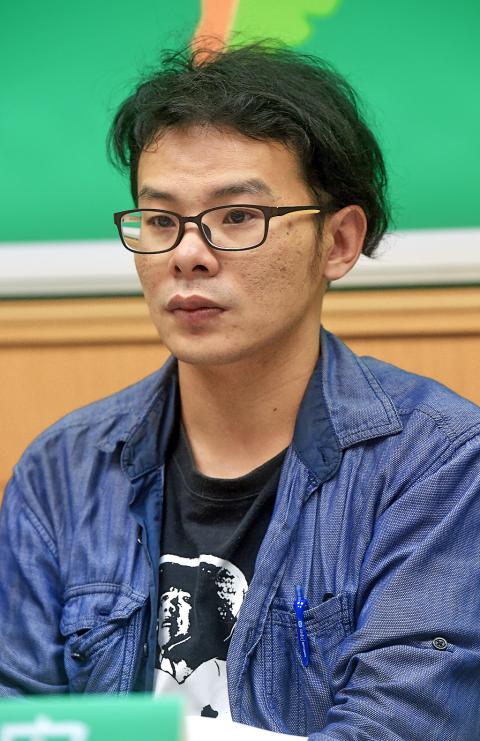
Photo: Chien Jung-fong, Taipei Times
The police action followed a protest outside President Tsai Ing-wen’s (蔡英文) private residence on Dunhua S Road in Taipei on Wednesday, which saw Lu wield a microphone as protesters clashed with police.
Tsai earlier this week directed the DPP’s legislative caucus to prioritize passage of controversial amendments to the Labor Standards Act (勞動基準法), which passed out of the legislature’s Social Welfare and Environmental Hygiene Committee shortly after Wednesday’s protest.
The messages posted by the Workers Struggle Alliance quickly drew an enthusiastic online response, receiving almost 1,500 Facebook reactions and 800 shares by press time last night.
“This is absolutely unbelievable,” netizen Yang Chun-yan (楊俊彥) said. “There is no way we can permit a backsliding of our democracy, much less a new version of White Terror!”
The White Terror refers to a period of political oppression which saw thousands of suspected political dissidents disappear over the first few decades of Chinese Nationalist Party (KMT) rule in Taiwan.
“I do not want police to be looking up any of my family members — if they want to look someone up, they should look me up,” Lu Chyi-horng said, adding that the incident made him feel that the “state apparatus” was putting its focus on his family.
“If they think I have committed a crime or they want to understand why I am dissatisfied with the government, they could have just arrested me at the protest site,” he said.
The revelation drew a swift response from Lin, who posted a response within hours saying that he had directed the National Police Agency to investigate the claims and he had told police officers the government would not tolerate interference with citizens’ freedom of expression.
Police in New Taipei City’s Sindian District (新店), where Lu’s parents’ home is, said that police officers had visited their home, but denied any intention to intimidate.
“Our police officer knew that [Lu’s father] was the father of a social activist, and as they were chatting happened to ask about where Lu lives,” said Hung Hsien-cheng (洪獻政), the chief of Sindian’s Jiangling police station, adding that police were conducting a “normal, routine household visit” with no special intention.
He denied that they had received any directive from superiors to conduct the visit.
“Our colleagues’ lack of experience probably led to a misunderstanding by the citizen during the questioning process,” he said, adding that he personally accompanied the police officer to return to the family’s home to apologize.
Lu said the police explanation was “difficult to understand,” given that his household registration is no longer his parents’ residence.
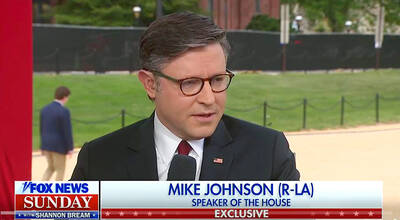
RESOLUTE BACKING: Two Republican senators are planning to introduce legislation that would impose immediate sanctions on China if it attempts to invade Taiwan US House of Representatives Speaker Mike Johnson on Sunday reaffirmed US congressional support for Taiwan, saying the US and “all freedom-loving people” have a stake in preventing China from seizing Taiwan by force. Johnson made the remarks in an interview with Fox News Sunday on US President Donald Trump’s summit with Chinese President Xi Jinping (習近平) last week. In an interview that aired on Friday on Fox News, just as Trump wrapped up a high-stakes visit to China, he said he has yet to green-light a new US$14 billion arms package to Taiwan and that it “depends on China.” “It’s a very good

DRONE CENTRAL: Taiwan aims to become Asia’s democratic hub for drones, with most exports focused on high-quality military-grade models, an official said Taiwan’s drone industry is expected to expand significantly by 2030, producing 100,000 units per month and exporting half of them, the Ministry of Economic Affairs said yesterday. Current drone production capacity is about 15,000 units per month, but the industry can quickly scale up as demand increases, Industrial Development Administration Director-General Chiou Chyou-huey (邱求慧) told a news conference in Taipei. Taiwan’s drone output grew 2.5-fold last year to NT$12.9 billion (US$408.3 million) under a government program to develop the uncrewed vehicle sector, he said. The Executive Yuan in October last year approved plans to invest NT$44.2 billion into domestic production of uncrewed aerial
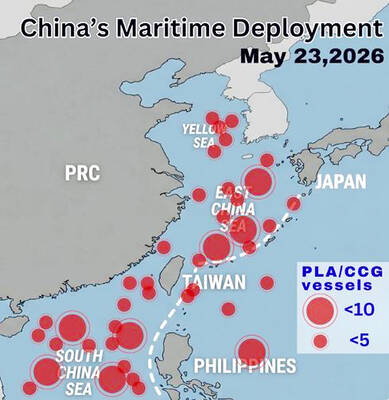
WARNING: China should stop engaging in actions that undermine regional peace and stability, as it would only build resentment among people across the Strait, the CGA said China has deployed more than 100 navy, coast guard and other vessels in waters from the Yellow Sea to the South China Sea and the western Pacific since US President Donald Trump and Chinese President Xi Jinping (習近平) met in Beijing, National Security Council Secretary-General Joseph Wu (吳釗燮) said yesterday. “In this part of the world, #China is the one & only PROBLEM wrecking the #StatusQuo & threatening regional peace & stability,” Wu wrote on X. In a separate post, he said Beijing was coercing Taiwan’s maritime domain, calling it illegal and provocative, after the Coast Guard Administration (CGA) expelled a
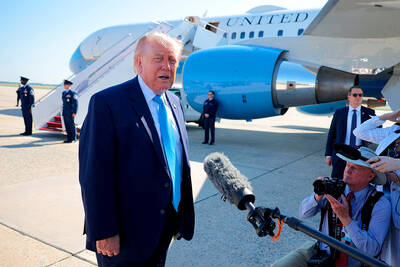
US President Donald Trump yesterday said he would speak to President William Lai (賴清德) as his administration considers whether to move ahead with a US$14 billion weapons sale to Taiwan — a potential arms deal that has drawn criticism from China. “Well, I’ll speak to him. I speak to everybody,” Trump told reporters yesterday when asked if he had any plans to call his counterpart, although he did not offer a time frame for when such a conversation could take place. Trump previously said he would speak to the person “that’s running Taiwan,” without specifying who he meant. “We have that situation very


 RSS
RSS