


Three of four Taiwanese fishing boats on their way to Taiwan-held Itu Aba Island (Taiping Island, 太平島) in the South China Sea were scheduled to reach the island’s shores last night, a spokesman for the group of fishing boats said earlier in the day.
The fourth boat, which was carrying three reporters from Hong Kong-based Phoenix Television, was to drop anchor in waters off the island, said Lo Chiang-fei (羅強飛), who acts as a spokesman for the fishermen.
The fishing boats left Taiwan on Wednesday last week to assert that Itu Aba is an island under international law and reaffirm their fishing rights in the South China Sea in response to a July 12 ruling by the Permanent Court of Arbitration in The Hague, the Netherlands.
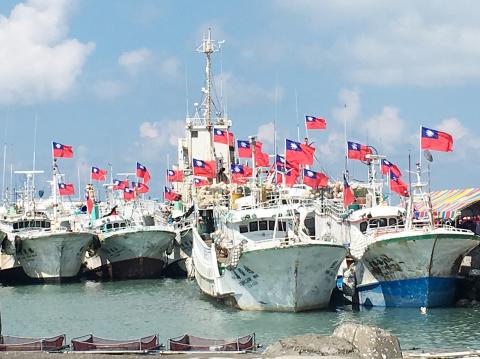
Photo: CNA
In a case brought by the Philippines against China, the court said all high-tide features in the Spratly Islands (Nansha Islands, 南沙群島), including Itu Aba Island, are legally “rocks” rather than islands and therefore not entitled to 200 nautical mile (370km) exclusive economic zones.
Although Taiwan was not a party to the case and has said it would not be bound by the ruling, other nations in the region could use it to limit where Taiwanese fishermen can operate.
As of 11:14am yesterday, the fishing boat fleet was 53 nautical miles from Taiping, which lies 864 nautical miles from Kaohsiung, Lo said.
By press time last night, there was no update on the boats’ position.
They did not anticipate any trouble landing on Itu Aba, even though it is categorized as a military-controlled zone into which fishermen are prohibited from entering without authorization from the Ministry of National Defense, the spokesman said.
Lo said the fishermen would ask Coast Guard Administration personnel stationed on the island to provide assistance on the grounds that they are in need of emergency shelter and have to replenish their supplies there.
Regarding the three TV reporters who joined the group, Lo said that while they had crew permits to board the ships, the boat carrying them would stop short of the island to prevent their presence from becoming a distraction.
Amid questions that the three reporters might have received financial support from China to participate, Lo said it was an activity conducted purely by civilians without the support of political parties or groups.
Lo said that reporters from several media outlets expressed interest in covering the trip, but only those with crew boarding permits were allowed to participate.
He said the group did not favor the Hong Kong-based TV station over other media outlets and reiterated that it did not have any political affiliation.
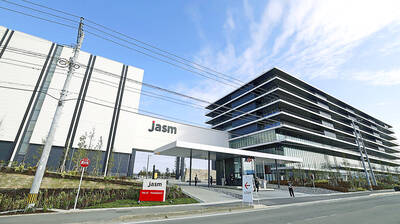
The subsidiary of Taiwan Semiconductor Manufacturing Co (TSMC, 台積電) in Kumamoto, Japan, turned a profit in the first quarter of this year, marking the first time the first fab of the unit has become profitable since mass production started at the end of 2024. According to the contract chipmaker’s financial statement released on Friday, Japan Advanced Semiconductor Manufacturing Inc (JASM), a joint venture running the fab in Kumamoto, posted NT$951 million (US$30.19 million) in profit in the January-to-March period, compared with a loss of NT$1.39 billion in the previous quarter, and a loss of NT$3.25 billion in the first quarter of
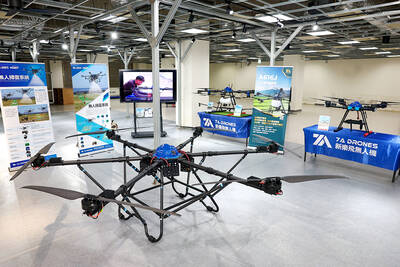
DRONE CENTRAL: Taiwan aims to become Asia’s democratic hub for drones, with most exports focused on high-quality military-grade models, an official said Taiwan’s drone industry is expected to expand significantly by 2030, producing 100,000 units per month and exporting half of them, the Ministry of Economic Affairs said yesterday. Current drone production capacity is about 15,000 units per month, but the industry can quickly scale up as demand increases, Industrial Development Administration Director-General Chiou Chyou-huey (邱求慧) told a news conference in Taipei. Taiwan’s drone output grew 2.5-fold last year to NT$12.9 billion (US$408.3 million) under a government program to develop the uncrewed vehicle sector, he said. The Executive Yuan in October last year approved plans to invest NT$44.2 billion into domestic production of uncrewed aerial
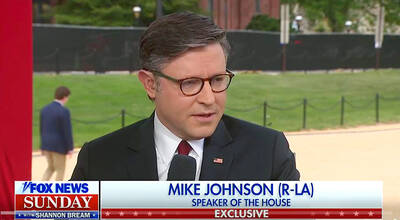
RESOLUTE BACKING: Two Republican senators are planning to introduce legislation that would impose immediate sanctions on China if it attempts to invade Taiwan US House of Representatives Speaker Mike Johnson on Sunday reaffirmed US congressional support for Taiwan, saying the US and “all freedom-loving people” have a stake in preventing China from seizing Taiwan by force. Johnson made the remarks in an interview with Fox News Sunday on US President Donald Trump’s summit with Chinese President Xi Jinping (習近平) last week. In an interview that aired on Friday on Fox News, just as Trump wrapped up a high-stakes visit to China, he said he has yet to green-light a new US$14 billion arms package to Taiwan and that it “depends on China.” “It’s a very good
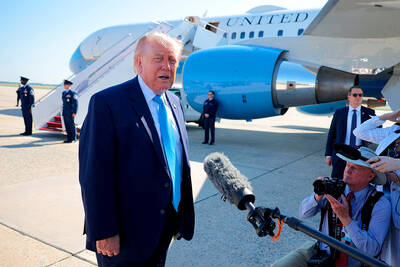
US President Donald Trump yesterday said he would speak to President William Lai (賴清德) as his administration considers whether to move ahead with a US$14 billion weapons sale to Taiwan — a potential arms deal that has drawn criticism from China. “Well, I’ll speak to him. I speak to everybody,” Trump told reporters yesterday when asked if he had any plans to call his counterpart, although he did not offer a time frame for when such a conversation could take place. Trump previously said he would speak to the person “that’s running Taiwan,” without specifying who he meant. “We have that situation very


 RSS
RSS