


A statement issued by the Ministry of Justice (MOJ) late on Saturday has further fueled conflict between lawmakers and Minister of Justice Luo Ying-shay (羅瑩雪), with netizens accusing Luo of treating the ministry’s Web site as her personal Facebook page.
The nearly 500-word statement, titled: “Blaming others when you are wrong,” galvanized an outpouring of criticism on the Internet almost immediately after it was published on the ministry’s official Web site on Saturday evening.
Singling out New Power Party (NPP) Legislator Hsu Yung-ming (徐永明), the statement said lawmakers and political commentators were indiscriminately demanding that the government rescue Taiwanese who have been forcibly deported or face possible deportation to China from other nations, without having some basic knowledge of how cross-strait negotiations are conducted.
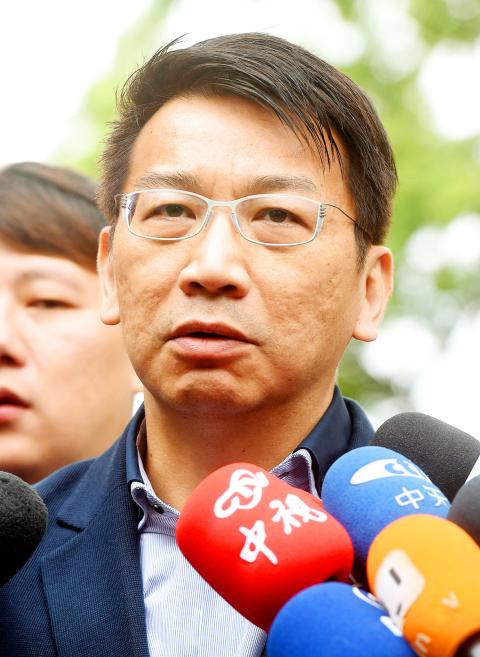
Photo: Fang Pin-chao, Taipei Times
“As you all know, cross-strait ties are complicated. It is not like the other side [of the Taiwan Strait] will agree to whatever we say. Just like in Taiwan, not all students listen to their professors,” the statement said.
Under the 2009 Cross-Strait Joint Crime-Fighting and Judicial Mutual Assistance Agreement (海峽兩岸共同打擊犯罪及司法互助協議), everything ranging from exchanging criminal intelligence resources and launching joint investigations to handing over evidence can only be carried out following cross-strait negotiations, the statement said.
“The ministry is not entitled to make any unilateral decisions,” it added.
The statement went on to blast lawmakers, saying they were shifting blame onto the ministry over the release of 20 Taiwanese fraud suspects deported to Taiwan from Malaysia on Friday last week due to a lack of evidence, which is still in China’s hands and has yet to be referred to Taiwanese authorities.
“These lawmakers act as if China is at the ministry’s beck and call, and have no regard for the time needed for bilateral negotiations. They denounce China, on one hand for the sake of sowing hatred and social divisions, and on the other hand, they ask the ministry to obtain relevant evidence from China,” the statement said.
“Such manipulation of populism is likely to have a disastrous effect on Taiwan. Please, lawmakers, if you truly love Taiwan, stop now before going too far. Give Taiwan a break,” it said.
Hsu was quick to respond to the statement, criticizing Luo on Facebook on Saturday for what he called her continued reluctance to reflect on her mistakes after her “sophistry and absurd stance” on China’s recent forced deportation of 45 Taiwanese from Kenya turned her into a “nationwide laughingstock.”
Luo faced a barrage of criticism and questions from lawmakers at a legislative session on Thursday last week, primarily because of her justification of China’s controversial handling of the group’s deportation, which contradicted the Ministry of Foreign Affairs’ categorization of the incident as an “illegal abduction.”
“China’s Taiwan Affairs Office adopted a commanding tone after the return of the 20 Taiwanese fraud suspects, criticizing Taiwan for setting free criminals and demanding that we ‘immediately correct the mistake,’” Hsu said on Facebook.
“Instead of taking a tougher stance [against Beijing], the justice ministry chose to take issue with lawmakers. It is beyond comprehension,” Hsu said.
The NPP caucus issued a statement expressing regret over the ministry’s remarks.
“All government agencies are endeavoring to devise counter-strategies and send a negotiating delegation to China. However, the justice ministry has not only sabotaged such efforts, but has apparently attempted to use emotional rhetoric to detract public attention from its preposterous handling of the incident,” the caucus said.
Hung Chi-kune (洪智坤), a former adviser to Taipei Mayor Ko Wen-je (柯文哲), said it was clear that Luo was seeking to pick a fight with lawmakers and to turn a cross-strait issue into an internal conflict.
The ministry’s statement also triggered heated discussions on the Professional Technology Temple (PTT), the nation’s largest online academic bulletin board.
A netizen with the username “umenosola” said it was a “wonder of the world” that a ministry head would use an official government Web site like their own Facebook page, while another netizen, who went by the pseudonym “Leon419,” said that the statement revealed the ministry’s incompetence.
In a telephone interview with TVBS that was aired yesterday, Luo acknowledged that she wrote the statement, but added that she made some revisions after consulting with her colleagues.
“Of course we want to see [the deported Taiwanese returned] as soon as possible. Who does not? But you [lawmakers] cannot just pay lip service,” Luo said.

‘NO SECURITY RISK’: The Railway Bureau reassured the public that the technicians’ activities were limited to technical guidance and did not involve sensitive systems The Railway Bureau yesterday said it had invited eight Chinese technicians to assist with an airport MRT construction project. The bureau issued the confirmation after an Internet user said Chinese nationals had entered the construction zone of Taiwan Taoyuan International Airport’s Terminal 3 project. They asked why “individuals from an enemy state” were allowed access to such a major national infrastructure project, which raised serious concerns over Taiwan’s industrial safety, sensitive systems and information security. The bureau’s Northern Region Engineering Branch Office said subcontractor Taiwan Handle Industrial Co (台灣手把工業) of the Taoyuan airport MRT’s “Contract No. CU05 Project A14 Station Civil, MEP &

The National Chungshan Institute of Science and Technology yesterday showcased its locally developed variants of the Vision 60 robotic patrol dog, which it plans to deploy on the nation’s outlying territories in the South China Sea. The variants were produced under the Joint Lab project — created by the institute and domestic companies — and assembled with domestically produced motors, lenses and artificial intelligence (AI) systems alongside licensed tech from the US, Missile and Rocket Systems Research Division deputy director Jen Kuo-kang (任國光) told the media event at a military base in Taipei’s Dazhi (大直) area. Taiwan has built up its strengths

NOT IMMEDIATE: Taiwan has a chance to appeal the proposed 10 percent tariff before it starts, while other countries face a 12.5 percent tariff from the trade office Taiwan is among 60 economies determined by the US to have failed to impose or enforce a ban on the importation of goods produced with forced labor, according to a notice released on Tuesday by the Office of the US Trade Representative (USTR), which proposed imposing an additional 10 percent or more tariff on them. The USTR in a statement said that following an investigation, it had determined under Section 301 of the Trade Act of 1974 that the failure of the 60 economies to impose and effectively enforce a prohibition on the importation of goods produced with forced labor is

TIT-FOR-TAT: The US allegedly revoked the visa of a Chinese national working at Xinhua News Agency in the US in response to Beijing’s expulsion of Vivian Wang The Presidential Office yesterday condemned China for expelling a New York Times correspondent from Beijing following the newspaper’s interview with President William Lai (賴清德), saying the move highlighted Beijing’s suppression of press freedom and its threat to international news media. Taiwan has noted a series of recent incidents in which Beijing used similar tactics to “threaten and pressure international media outlets and journalists,” Presidential Office spokeswoman Karen Kuo (郭雅慧) said in a statement. “This concerns not only press freedom and freedom of expression, but also the safety of journalists, and Taiwan and relevant partners are paying close attention to the situation,” she


 RSS
RSS