


The government yesterday issued a strongly worded statement denouncing China’s role in the Kenyan police’s deportation of Taiwanese citizens who had been acquitted in a lawsuit in the African country to Beijing and not Taipei, calling the act an “uncivilized, illegal abduction.”
A total of eight Taiwanese were deported to China on Friday, three days after they and 15 other Taiwanese were ordered to leave Kenya within 21 days following their acquittal in a telecoms fraud trial on Tuesday last week, the Ministry of Foreign Affairs (MOFA) said in the statement.
The case involved 48 Chinese, 28 Taiwanese and one Thai, who were arrested by Kenyan police in November 2014 and later indicted on charges of unlicensed telecoms activities, unlicensed use of radio equipment and organized crime.
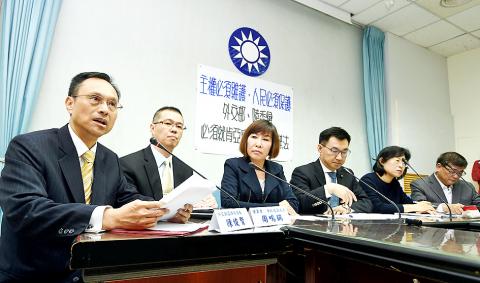
Photo: Fang Pin-chao, Taipei Times
“When the first batch of 37 defendants acquitted by the court — which included the 23 Taiwanese — went to a local police station in the Kilimani area of Nairobi on Tuesday last week to retrieve their passports, they were detained by the police for no reason,” the ministry said.
On learning of the detentions, the ministry said it instructed the Taipei Liaison Office in South Africa to negotiate with the Kenyan police, with the office urging them to release the Taiwanese in accordance with the court’s ruling and to follow the customary practice of allowing acquitted defendants to be deported to their respective home countries.
An official of the liaison office subsequently flew to Kenya on Thursday last week to visit the Taiwanese detained at Kilimani Police Station, only to learn the following day that the Chinese government was pressuring the Kenyan police to deport eight of them to China, the statement said.
The ministry said that despite the liaison office’s negotiation efforts and the issuance of an injunction by the Kenyan High Court banning police from deporting the eight Taiwanese pending a hearing tomorrow, China made use of a technicality to impede its efforts and flew the eight Taiwanese to Beijing on a China Southern Airlines aircraft on Friday.
“This uncivilized act of kidnapping is a severe infringement of the basic human rights of the deported Taiwanese. The ministry has lodged a strong protest against China’s behavior,” the ministry said, demanding an immediate return of the eight Taiwanese to Taiwan.
The ministry also urged Kenyan police to honor the court’s verdict and release the other 15 detained Taiwanese.
“While we do not have a representative office in Kenya, our liaison office in South Africa will continue its efforts to ensure the safe return of the 15 Taiwanese,” it said.
The Mainland Affairs Council, the Ministry of Justice and the Criminal Investigation Bureau are also endeavoring to urge Chinese authorities to refrain from deporting the remaining 15 Taiwanese to Beijing and to handle similar cases in accordance with cross-strait agreements in the future, the statement said.
The ministry’s Department of West Asian and African Affairs Director-General Chen Chun-shen (陳俊賢) said that if people who have been acquitted of any crime can be taken away against their will by China, then every Taiwanese suspected of wrongdoing in other parts of the world might be susceptible to the same treatment.
To discus the deportations, President Ma Ying-jeou (馬英九) yesterday morning called a meeting with Vice President Wu Den-yih (吳敦義), Premier Simon Chang (張善政) and National Security Council Secretary-General Kao Hua-chu (高華柱), the Presidential Office said.
“At the meeting, the president instructed concerned government agencies to elucidate the government’s stance,” Presidential Office spokesman Ma Wei-kuo (馬瑋國) said.
The Democratic Progressive Party (DPP) lodged a stern protest against China’s behavior, saying that its actions clearly violated the human rights of the people concerned.
“We request that relevant government agencies continue their negotiations [with Beijing], collect information on the Kenyan court’s verdict and other evidence, and demand the return of our nationals in accordance with the Cross-Strait Joint Crime-Fighting and Judicial Mutual Assistance Agreement [海峽兩岸共同打擊犯罪及司法互助協議] to safeguard their judicial human rights,” DPP spokesman Wang Min-sheng (王閔生) said.
In a statement issued later in the day, Chinese Nationalist Party (KMT) Chairwoman Hung Hsiu-chu (洪秀柱) expressed regret over the Kenyan deportations and called on Nairobi to release 15 Taiwanese still in detention.
“China’s acts of forcibly taking Taiwanese to Beijing are detrimental to the stable development of cross-strait relations. We urge the Chinese authorities to return them to Taiwan at the earliest date possible,” Hung said.
The New Power Party (NPP) said it was “extremely angry” at Kenya’s “regrettable” actions because Kenya should not have made such a “ridiculous” mistake even if that nation does not have formal diplomatic relations with Taiwan.
The NPP statement also condemned China for being “completely unscrupulous” in “kidnapping” Taiwanese, stating that the actions made agreements that China signed with Taiwan look like “worthless scraps of paper.”
The case is reminiscent of the Philippines’ controversial deportation of 14 Taiwanese fraud suspects to China for trial in February 2011 based on Manila’s “one China” policy.
They were only returned to Taiwan five months later after negotiations between Taipei and Beijing based on the 2009 Cross-Strait Joint Crime-Fighting and Judicial Mutual Assistance Agreement.
Additional reporting by Abraham Gerber

DRONE CENTRAL: Taiwan aims to become Asia’s democratic hub for drones, with most exports focused on high-quality military-grade models, an official said Taiwan’s drone industry is expected to expand significantly by 2030, producing 100,000 units per month and exporting half of them, the Ministry of Economic Affairs said yesterday. Current drone production capacity is about 15,000 units per month, but the industry can quickly scale up as demand increases, Industrial Development Administration Director-General Chiou Chyou-huey (邱求慧) told a news conference in Taipei. Taiwan’s drone output grew 2.5-fold last year to NT$12.9 billion (US$408.3 million) under a government program to develop the uncrewed vehicle sector, he said. The Executive Yuan in October last year approved plans to invest NT$44.2 billion into domestic production of uncrewed aerial

A signaling system malfunction disrupted high-speed rail (HSR) services beginning at 8am today, with trains temporarily reduced to three northbound and three southbound trains per hour as authorities conduct inspections. The malfunction occurred on a section of track in Miaoli County during pre-operation checks early this morning, forcing northbound and southbound trains to use a single track, the HSR operator said. The regular schedule has been replaced with three hourly trains offering only nonreserved seating in each direction, stopping at every station, it said, adding that business class cars would still have reserved seating. Departures from terminal stations are scheduled at the top

VERBOSE VESSELS: A CGA cutter and a China Coast Guard exchanged verbal barbs for more than a day in Taiwanese-controlled waters before the Chinese vessel left The Taiwanese and Chinese coast guards had a standoff near the strategically located Pratas Islands (Dongsha Islands, 東沙群島) in the north of the South China Sea, the Coast Guard Administration (CGA) said yesterday. The two sides engaged in intense radio exchanges over sovereignty claims during the 33-hour standoff. China Coast Guard vessel 3501 eventually left the restricted waters, 26.6 nautical miles (49.2km) west of the Pratas Islands, at 5pm yesterday, the CGA said. Lying approximately between southern Taiwan and Hong Kong, the Taiwan-controlled Pratas are seen by some security experts as vulnerable to Chinese attack due to their distance — more than
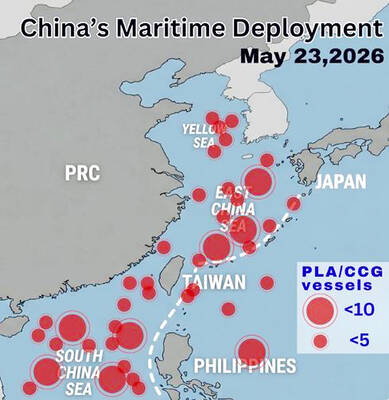
WARNING: China should stop engaging in actions that undermine regional peace and stability, as it would only build resentment among people across the Strait, the CGA said China has deployed more than 100 navy, coast guard and other vessels in waters from the Yellow Sea to the South China Sea and the western Pacific since US President Donald Trump and Chinese President Xi Jinping (習近平) met in Beijing, National Security Council Secretary-General Joseph Wu (吳釗燮) said yesterday. “In this part of the world, #China is the one & only PROBLEM wrecking the #StatusQuo & threatening regional peace & stability,” Wu wrote on X. In a separate post, he said Beijing was coercing Taiwan’s maritime domain, calling it illegal and provocative, after the Coast Guard Administration (CGA) expelled a


 RSS
RSS