


The death toll from the earthquake on Saturday last week rose to 62 yesterday as rescuers pulled nine bodies from the ruins of the Weiguan Jinlong complex in Tainan, while rain that began to fall at about 5pm brought with it lower temperatures.
Members of two families were among those retrieved from the disaster site in Yongkang District (永康), including two brothers, and a man and a woman whose identity has yet to be confirmed.
One of the families, surnamed Cheng (鄭), were from New Taipei City’s Sindian District and were spending the Lunar New Year holiday in an apartment on the 13th floor of Building G, which was owned by the sister of Cheng’s wife.
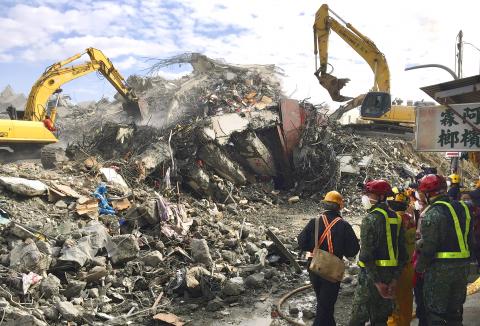
Photo: Johnson Lai, AP
Four members of the other family, surnamed Tsai (蔡), died in the quake. The father is the only survivor. Rescuers said that the grandmother of the family was holding tight to her granddaughter when their bodies were found.
As of 5:44pm, the Tainan City Government said 62 people are still believed to be under the rubble.
A woman whose relatives are among those still missing in the ruins yesterday accused the city of allowing a large excavator to be driven onto the remains of Building G to rescue survivors.
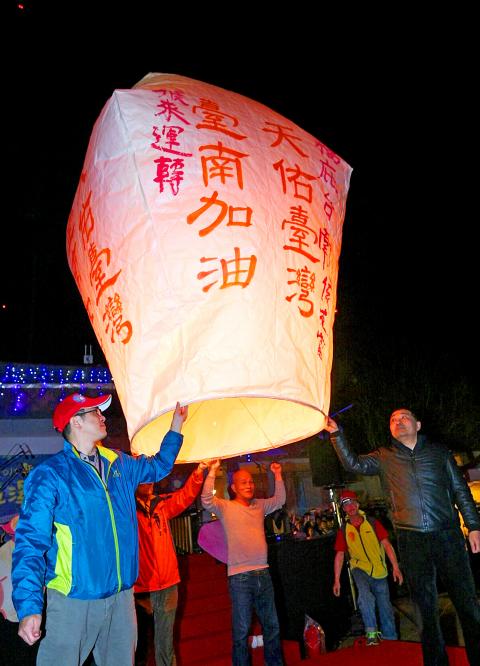
Photo: Chang Chia-ming, Taipei Times
She said that the additional weight of the excavator could further crush the bodies of the victims still under the rubble.
Tainan Mayor William Lai (賴清德) apologized to the relatives of the missing, saying the leader of a rescue team had mistakenly allowed the large piece of machinery to be moved into a cordoned-off area.
He said he had asked that the excavator be removed immediately.
However, Lai defended the use of large excavators, saying that they were being used to save lives by helping clear the way for search teams to find survivors and preserve the bodies of the deceased.
Structural engineers assisting the rescue teams at the site said that having an excavator on top of the building should not hurt any possible survivors or bodies because the building was supported by at least two beams and a wall.
Heavy rainfall did impede the search efforts later in the day and military personnel covered several locations with tarps in an attempt to prevent the rain from triggering further collapses inside the rubble.
Meanwhile, the electronics store chain TsannKuen Co (燦坤實業) denied that it had remodeled a store on the ground floor of the Weiguang Jinlong complex.
TsannKuen general manager Chang Yueh-long (張岳龍) showed reporters photographs of the store when they leased it as well as the contract banning the firm from making structural changes.
“We have rented the ground floor and the second floor since 2004 and never remodeled them,” Chang said.
There have been allegations that the landlord who owned the first four floors of buildings A, B and C in the complex had removed all of the beams and columns on those floors, which might have made the buildings less stable in an earthquake.

PROVOCATIVE: Chinese Deputy Ambassador to the UN Sun Lei accused Japan of sending military vessels to deliberately provoke tensions in the Taiwan Strait China denounced remarks by Japan and the EU about the South China Sea at a UN Security Council meeting on Monday, and accused Tokyo of provocative behavior in the Taiwan Strait and planning military expansion. Ayano Kunimitsu, a Japanese vice foreign minister, told the Council meeting on maritime security that Tokyo was seriously concerned about the situation in the East China and South China seas, and reiterated Japan’s opposition to any attempt to change the “status quo” by force, and obstruction of freedom of navigation and overflight. Stavros Lambrinidis, head of the EU delegation to the UN, also highlighted South China Sea

SILENCING CRITICS: In addition to blocking Taiwan, China aimed to prevent rights activists from speaking out against authoritarian states, a Cabinet department said The Ministry of Foreign Affairs (MOFA) yesterday condemned transnational repression by Beijing after RightsCon, a major digital human rights conference scheduled to be held in Zambia this week, was abruptly canceled due to Chinese pressure over Taiwanese participation. This year’s RightsCon, the world’s largest conference discussing issues “at the intersection of human rights and technology,” was scheduled to take place from tomorrow to Friday in Lusaka, and expected to draw 2,600 in-person attendees from 150 countries, along with 1,100 online participants. However, organizers were forced to cancel the event due to behind-the-scenes pressure from China, the ministry said, expressing its “strongest condemnation”
Taiwan Semiconductor Manufacturing Co (TSMC, 台積電), the world’s largest contract chipmaker, said it expects its 2-nanometer (2nm) chip capacity to grow at a compound annual rate of 70 percent from this year to 2028. The projection comes as five fabs begin volume production of 2-nanometer chips this year — two in Hsinchu and three in Kaohsiung — TSMC senior vice president and deputy cochief operating officer Cliff Hou (侯永清) said at the company’s annual technology symposium in Silicon Valley, California, last week. Output in the first year of 2-nanometer production, which began in the fourth quarter of last year, is expected to
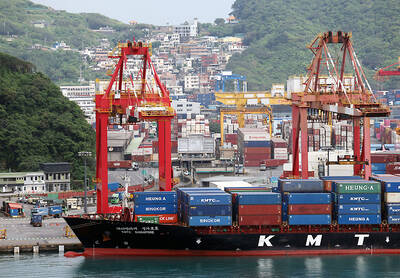
Taiwan’s economy grew far faster than expected in the first quarter, as booming demand for artificial intelligence (AI) applications drove a surge in exports, spilling over into investment and consumption, the Directorate-General of Budget, Accounting and Statistics (DGBAS) said yesterday. GDP growth was 13.69 percent year-on-year during the January-to-March period, beating the DGBAS’ February forecast by 2.23 percentage points and marking the most robust growth in nearly four decades, DGBAS senior official Chiang Hsin-yi (江心怡) told a news conference in Taipei. The result was powered by exports, which remain the backbone of Taiwan’s economy, Chiang said. Outbound shipments jumped 51.12 percent year-on-year to


 RSS
RSS