


Shouting, cheering, waving flags, blowing horns and shooting fireworks, tens of thousands of people were ecstatic when president-elect Tsai Ing-wen (蔡英文) of the Democratic Progressive Party (DPP) and her running mate Chen Chien-jen (陳建仁) took to the stage in front of her national campaign headquarters to address the crowd after her victory was confirmed yesterday.
“I’ve said that I would sacrifice my life to make you happy and now I’ve kept my promise,” Tsai told the crowd with her campaign team leaders, local government heads and other DPP heavyweights standing behind her.
“If you still have tears in your eyes, please wipe them. Let’s welcome a new age of Taiwan with joy,” she said.
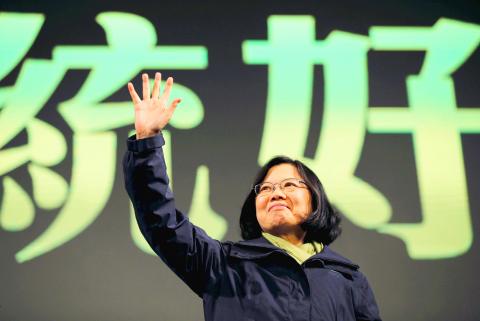
Photo: Damir Sagolj, Reuters
Thanking the crowd for their support of her and the party, Tsai said that while they can celebrate, they should not forget the responsibilities they bear.
“We may celebrate tonight; we may joyfully celebrate tonight, but when the sun comes up tomorrow, we are to shoulder the responsibilities for reforming the nation,” Tsai said.
“The new legislature will begin on Feb. 1, and as the DPP has a majority, we will put out maximum effort into reform while making sure there is no instability,” she said.
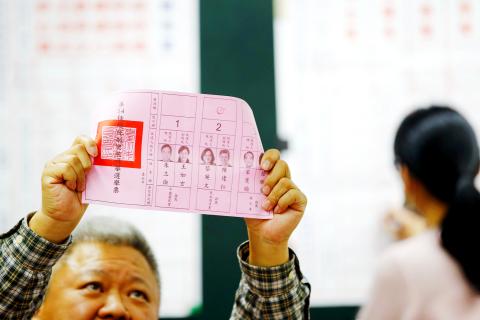
Photo: Damir Sagolj, Reuters
Tsai reiterated that she would honor her words regarding the cross-strait relationship, vowing to handle issues through continuous communications, with no provocation or accidents.
She called on DPP members and those who are to join her administration to be “humble, humble and humble” while in power.
Tsai’s speech was interrupted a number of times by cheers from the crowd and chants of zongtong hao (總統好), meaning: “Hello, president.”
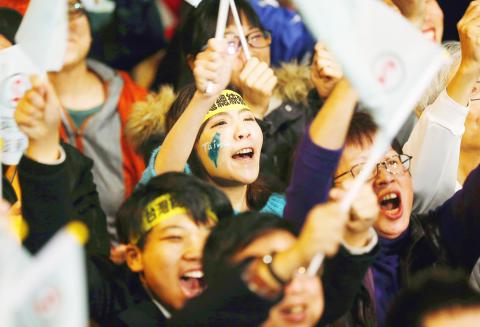
Photo: Wally Santana, AP
When Tsai was leaving the rally, the crowd surrounded her vehicle, greeting her with cheers.
Although the voting did not end until 4pm, supporters started to gather outside the venue as early as 12pm, carrying with them flags, signs and placards.
“Taiwan would not be good if the Chinese Nationalist Party (KMT) had not gone down,” one sign said.
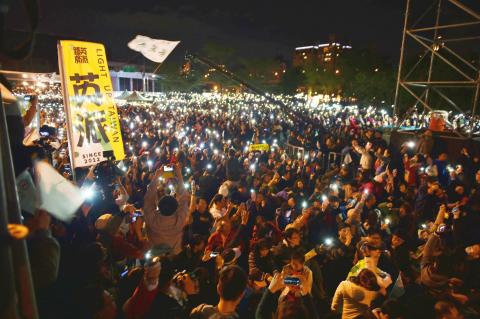
Photo: Sam Yeh, AFP
One man held another sign that read: “Tsai is Asia’s Angela Merkel,” with a photograph of Tsai and the German chancellor.
Although there was obvious joy, many supporters appeared nervous waiting for numbers on a large screen on the stage to update the vote count.
As Tsai’s numbers grew, and as the gap between her and KMT presidential candidate Eric Chu (朱立倫) widened, the crowd stood up to cheer and wave their flags.
The crowd showed similar responses to news of the DPP’s results in legislative races, whenever the party won a traditionally KMT platform, or when a KMT heavyweight — such as former Taipei mayor Hau Lung-bin (郝龍斌), who ran in Keelung on a KMT ticket — conceded defeat, cries of joy would burst from the crowd.
The mood overflowed when the gap in votes separating Tsai and Chu grew to more than 3 million, with the crowd shouting “yes” repeatedly when the hosts of the rally asked if they were happy.
Tsai arrived outside DPP headquarters at about 4:15pm and supporters waited where Tsai got out of a van to give her a hero’s welcome.
Tsai looked confident and happy, with a big smile on her face.
Police and national security personnel had to keep pushing back the crowd to secure a path for Tsai to walk into the building, where she stayed until an international press conference at 8:30pm.
That was followed by her speech to the crowd.
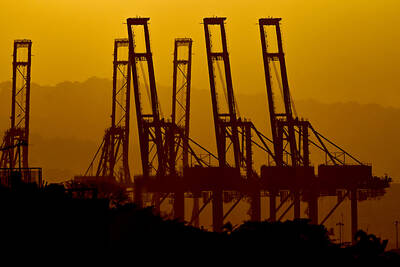
A subsidiary of a Hong Kong-based company that has lost control of two critical ports on the Panama Canal said it is seeking US$2 billion of compensation in damages from Panama over its “illegal” takeover of the ports. Panama Ports Co, a unit of Hong Kong’s CK Hutchison Holdings (長江和記實業), on Friday said in a statement that it is demanding the sum under international arbitration proceedings that it had already started. The Panamanian government last week seized control of the Balboa and Cristobal ports on each end of the Panama Canal, after the country’s Supreme Court declared earlier that a concession allowing
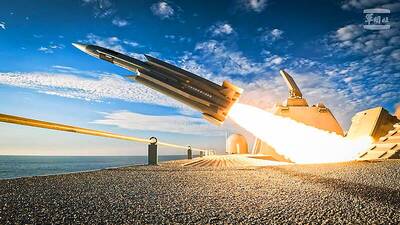
DETERRENCE: With 1,000 indigenous Hsiung Feng II and III missiles and 400 Harpoon missiles, the nation would boast the highest anti-ship missile density in the world With Taiwan wrapping up mass production of Hsiung Feng II and III missiles by December and an influx of Harpoon missiles from the US, Taiwan would have the highest density of anti-ship missiles in the world, a source said yesterday. Taiwan is to wrap up mass production of the indigenous anti-ship missiles by the end of year, as the Chungshan Institute of Science and Technology has been meeting production targets ahead of schedule, a defense official with knowledge of the matter said. Combined with the 400 Harpoon anti-ship missiles Taiwan expects to receive from the US by 2028, the nation would have

POSSIBILITIES EMERGE: With Taiwan’s victory and Japan’s narrow win over Australia, Taiwan now have a chance to advance if South Korea also beat the Aussies Taiwan has high hopes that the national baseball team would advance to the World Baseball Classic (WBC) quarter-finals after clinching a crucial 5-4 victory over South Korea in a nail-biting extra-inning game at the Tokyo Dome yesterday. Boosted by three home runs — two solo shots by Yu Chang (張育成) and Cheng Tsung-che (鄭宗哲) and a two-run homer by Stuart Fairchild — the triumph gave Taiwan a much-needed second victory in the five-team Pool C, where only the top two finishers would advance to the knockout stage in Miami, Florida. Entering extra innings with the game tied at four apiece, Taiwan scored
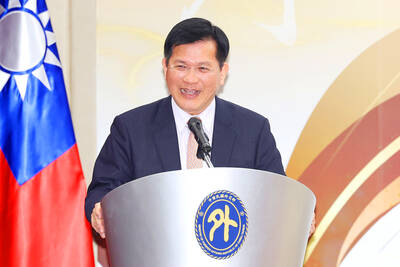
MISSION OF PEACE: The foreign minister urged Beijing to respect Taiwan’s existence as an independent nation, and work together to ensure peace and stability in the region Minister of Foreign Affairs Lin Chia-lung (林佳龍) yesterday rejected Chinese Minister of Foreign Affairs Wang Yi’s (王毅) comments about Taiwan, criticizing China as a “troublemaker” in the international community and a disruptor of cross-strait peace. Speaking at a news conference on the sidelines of the Chinese National People’s Congress, Wang said that Taiwan has always been a territory of China and that it would be impossible for it to become its own country. The “return” of Taiwan to China was the natural outcome of the Chinese people’s resistance against Japan in World War II, and that any pursuit of independence was “doomed


 RSS
RSS