

The Ministry of Foreign Affairs (MOFA) yesterday expressed its gratitude for US President Barack Obama’s recognition of Taiwan’s efforts in the global fight against terrorism, saying its current focus is on providing humanitarian assistance.
Obama on Sunday mentioned Taiwan as a member of a global coalition to counter the Islamic State during a speech at the East Asia summit in Kuala Lumpur.
He also named Australia, Canada, Japan, Malaysia, New Zealand, Singapore and South Korea as partners in the US’ anti-terrorism efforts.
“The Asia-Pacific [region] is absolutely critical to promoting security, prosperity and human dignity around the world. That’s why I’ve devoted so much of my foreign policy to deepening America’s engagement with this region,” Obama said.
“Over the years, our friends here in Asia have been victims of terrorism, and many of them are close counterterrorism partners with us,” he said.
Ministry spokeswoman Eleanor Wang (王珮玲) said Taiwan has assisted with humanitarian and emergency-response missions as part of its contributions to the international anti-terror effort.
Amid the terror attacks and civil wars in the Middle East, Taiwan has offered humanitarian aid to the region through the US, other nations and international organizations, such as donating prefabricated houses, LED lamps and nearly US$10 million in medical supplies, she said.
Taipei’s humanitarian assistance to refugees from the region has been recognized by the US and the international community, Wang said.
Taiwan’s active role in the international community as a provider of humanitarian aid and a regional peacemaker are in line with President Ma Ying-jeou’s (馬英九) foreign policy, she said.
Taipei and Washington have established strong mutual trust and have cooperated closely through various and multilayer channels in areas including politics, trade and economics, she said.
“In an effort to enhance bilateral cooperation in responding to global challenges, the two countries also signed a memorandum of understanding on the Global Cooperation Training Framework in June,” Wang said.
Taiwan and the US are to continue expanding the scope of their bilateral cooperation on regional and global issues, which is likely to raise Taipei’s international profile and increase the levels of roles it can play in the international community, she said.
In related developments, the Ministry of the Interior said the National Police Agency and the National Immigration Agency are cooperating with major countries on intelligence exchanges to safeguard the nation’s security.
Deputy Minister of the Interior Jonathan Chen (陳純敬) said that the police agency has stationed liaison officers in Southeast Asian countries to exchange information with local governments, and is working with the US and other countries on entry and departure information of travelers.
These efforts can make Taiwan more secure, Chen said.
Additional reporting by CNA
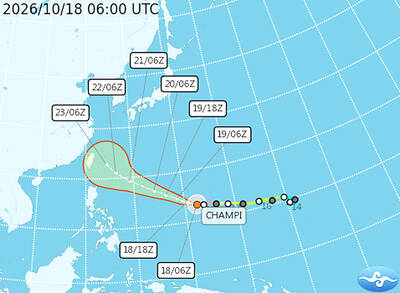
A sea warning for Typhoon Champi could be issued as early as Wednesday night, possibly followed by a land warning on Thursday night or Friday, as the storm approaches Taiwan, the Central Weather Administration (CWA) said yesterday. The typhoon is expected to have its greatest impact on Taiwan on Friday and Saturday, bringing heavy rain to central and northern Taiwan and to Yilan and Hualien counties in the east, CWA forecaster Liu Pei-teng (劉沛滕) said. As of 2pm yesterday, Champi was about 2,470km east-southeast of Oluanpi (鵝鑾鼻), Taiwan’s southernmost tip, moving westnorthwest at 20kph. It had maximum sustained winds of 191kph and a
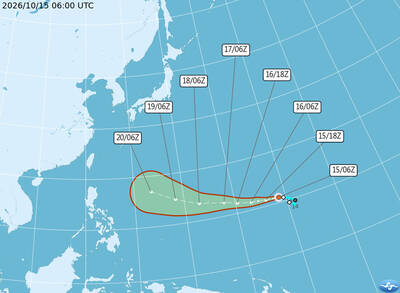
EAST OF GUAM: Tropical Storm Champi is forecast to strengthen into a typhoon, but its effect on Taiwan is uncertain due to the presence of a high-pressure system Tropical Storm Champi formed yesterday and has the potential to increase in strength, the Central Weather Administration (CWA) said yesterday. Forecasters are closely monitoring a Pacific high-pressure system that would dictate whether the storm turns north or moves toward Taiwan next week, the CWA said. The most likely scenario is that it turns northward after passing the Ryukyu Islands, CWA forecaster Cheng Chieh-jen (鄭傑仁) said. As of 8pm yesterday, Champi was east of Guam moving west-northwest at 20kph, CWA data showed. It had maximum sustained winds near the center of 72kph and gusts of up to 101kph, the data showed. If the Pacific high-pressure system
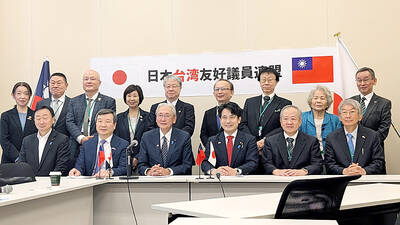
ORIGINS: A Taiwanese doctor practicing in Japan said he no longer needed to cover the nationality label on his license with a sticker, as it used to confuse his patients Starting this month, Taiwanese professionals working in Japan can list “Taiwan” as their place of origin following Tokyo’s easing of rules on “nationality” in official licensing documents. The change was announced yesterday by the Japan-Taiwan Friendship Parliamentarians’ League in Tokyo. The license revision covers 322 professions, including doctors and nurses. Previously, Taiwanese had to list “China” as their nationality on professional certifications and licenses, but the new rules updated the “nationality” to “nationality and region” or “nationality, etc,” allowing Taiwanese to use the name “Taiwan.” The league held a meeting about the revision at the House of Representatives Members’ Office Building in Tokyo
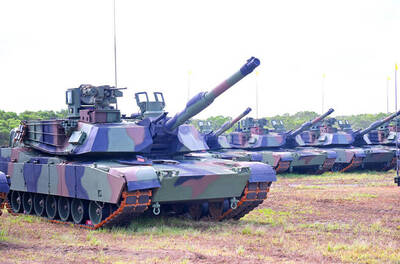
US-made M1A2T Abrams tanks are to participate in a major military exercise for the second time, when the Lien Yung exercise (聯勇操演) begin next month, a military source said yesterday. The army’s 584th Armored Brigade, which operates the US-built tanks, has already transported them to the Joint Operations Training Base in Pingtung County for the drills from late next month to December, the source said. During the month-long joint military exercise in southern Taiwan, the tanks’ crew would test their combat coordination, said the source, who asked not to be named. The M1A2T Abrams tanks were included in a major Taiwanese military exercise


 RSS
RSS