


The Chinese government strongly desires that the “one China” principle be made one of the points of “consensus” to be announced after a historic meeting between President Ma Ying-jeou (馬英九) and Chinese President Xi Jinping (習近平) in Singapore today.
However, Mainland Affairs Council (MAC) officials said that they would prefer the meeting to be based on the so-called “1992 consensus.”
As of press time last night, the two sides were still negotiating the issue.
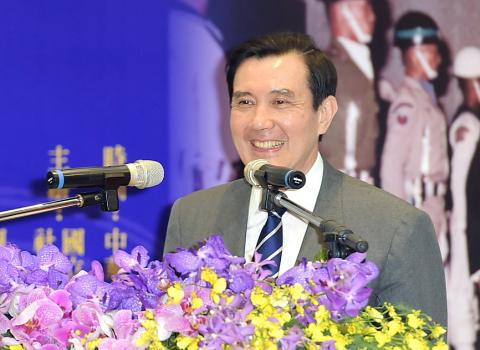
Photo: Hu Shun-hsiang, Taipei Times
The “1992 consensus,” a term former Mainland Affairs Council chairman Su Chi (蘇起) admitted making up in 2000, refers to a tacit understanding between the KMT and the Chinese government that both sides of the Taiwan Strait acknowledge there is “one China,” with each side having its own interpretation of what “China” means.
The meeting is the first of its kind since the Chinese Nationalist Party (KMT) lost the Chinese Civil War in 1949 and retreated to Taiwan and its outlying islands.
Ma said the meeting with Xi would not result in any accords, or promises to sign accords of any sort, nor a joint declaration, adding that a press conference would be held after the meeting to highlight the points on which both sides had reached a consensus.
Despite the MAC’s wish to make the so-called “1992 consensus” a point to be mentioned, a poll it conducted last month showed that only 1.3 percent of 1,087 respondents supported making the “1992 consensus” one of the issues to be talked about by the heads of state.
MAC Minister Andrew Hsia (夏立言) said that details were still being hashed out and whether the “one China” principle would make it onto the list of points of consensus would be made known today.
Hsia arrived in Singapore on Thursday and praised the facilities at the Shangri-La Hotel after inspecting the location where the meeting is to take place, adding that he would be conducting a final check today.
Hsia said that the meeting would be on equal terms and there would be no issue of Taiwan being the lesser partner in any way.
Hsia said Xi would not be attending the post-meeting press conference as it was the Chinese custom, as could be seen from Taiwan Affairs Office Minister Zhang Zhijun’s (張志軍) absence from previous post-meeting press conferences.
Meanwhile, Democratic Progressive Party (DPP) Chinese Affairs Division director Chao Tien-lin (趙天麟) said that he hoped Ma would uphold Taiwan’s dignity.
Chao said Taiwanese are not against cross-strait interaction, but such interaction must be based on the prerequisites of dignity, transparency and non-political motives.
That is the basic stance of the DPP on cross-strait interaction, seeing as how democracy and the public will are the key supports on which cross-strait interaction rests, Chao said.
Democratic procedures and ample negotiation with the public on the intentions of a meeting would to a great extent assuage public anxiety, Chao said.
Cross-strait relations should no longer be considered on the basis of benefiting a particular party or the manipulation of elections, Chao said.
The DPP hopes that Ma will be able to uphold these three tenets and not sacrifice Taiwan’s sovereignty, Chao said.
Chao said that while the DPP is not inclined to plan any rallies or protests against the meeting, public will in a democratic society has its own way of manifesting opposition.
Additional reporting by CNA

The Tourism Administration yesterday announced that it would reward repeat international visitors with incentives of up to NT$8,000 to boost inbound tourism. The incentives are available to all international tourists, it said, adding that repeat visitors would be rewarded with NT$5,000 and would receive an additional NT$3,000 if they bring travel companions. The nation received 2,990,657 inbound visitors during the first quarter, marking a 3.8 percent increase from the same period last year, agency data showed. Japanese nationals are among groups visiting Taiwan the most. About 1.48 million Japanese tourists arrived last year, a year-on-year increase of more than 12

66 FIGHTER JETS: The aircraft is likely undergoing preparations for its transfer to Taiwan — a significant step forward in the nation’s modernization program, a lawmaker said The first of Taiwan’s order of F-16V Block 70 aircraft has been sighted in Texas ahead of delivery, Democratic Progressive Party (DPP) Legislator Wang Ting-yu (王定宇) said. Taiwan’s first F-16V Block 70 two-seat aircraft, tail number 6831, was seen flying from Lockheed Martin’s production facility in Greenville, South Carolina, to Naval Air Station Joint Reserve Base Fort Worth in Texas, Wang wrote on Facebook yesterday. The plane is likely undergoing preparations for its transfer to Taiwan, marking a significant step forward in the Republic of China Air Force’s modernization program, Wang said, citing military analysts. The F-16V Block 70 is a new-build version
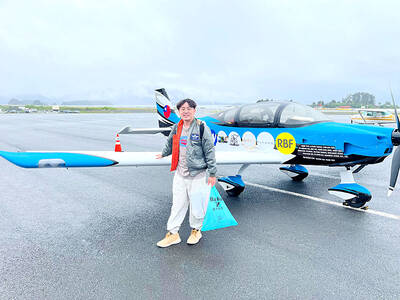
Taiwanese aviator Roger Lin (林睿哲) returned to Taiwan on Saturday after completing a nine-day round-the-world journey in a single-engine aircraft, becoming the first Taiwanese pilot to achieve the feat. Lin departed on June 5 from Los Angeles, California, and continued through Alaska, Japan, Taiwan, the Philippines, Indonesia, Malaysia, Thailand, Nepal, Jordan, Norway, Iceland and Canada before landing at the Taipei International Airport (Songshan) via Los Angeles and Japan. Lin shared numerous photos and videos of his journey on a Facebook page titled “Pilot Roger’s Around the World Flight,” including a video showing his aircraft flying over the Danjiang Bridge and
NOT JUST NUMBERS: What matters to intelligence work is crucial, reliable information, so even a few credible leads can be highly valuable to national security, a legislator said The National Security Bureau (NSB) yesterday said it has finished the establishment of an information-reporting channel for Chinese nationals, the aim of which is to broaden intelligence gathering on China’s political, military, economic and social developments. Chinese nationals can submit information on the Web page, https://report.nsb.gov.tw, the NSB said in a statement. The move aims to expand the bureau’s diverse intelligence sources and is pursuant to the National Intelligence Services Act (國家情報工作法), it said, adding that it referenced practices adopted by intelligence agencies in the US, the UK and Israel. An increasing number of people are approaching Taiwanese agencies to provide information, as


 RSS
RSS