


The US on Tuesday appeared to welcome Saturday’s planned meeting between President Ma Ying-jeou (馬英九) and Chinese President Xi Jinping (習近平), although some officials had reservations.
“We encourage authorities in Beijing and Taipei to continue their constructive dialogue on the basis of dignity and respect,” US Department of State Office of Press Relations director Elizabeth Trudeau said.
However, speaking on the strict understanding of anonymity because they were not authorized to talk on the subject, another Department of State source said there was “hope and expectation” that the meeting would produce “no surprises.”
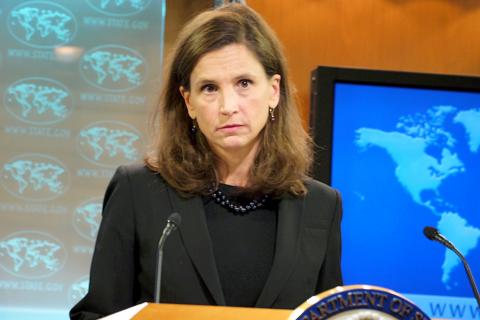
Photo: CNA
One former Department of State official said he was “uneasy” that the meeting might be used to influence the Jan. 16 presidential election.
It could not be determined how much in advance the Ma administration had informed the White House.
Asked on Tuesday about the meeting during a routine press briefing, Trudeau said the US welcomed steps taken by both sides of the Taiwan Strait in recent years to reduce tensions and improve cross-strait relations.
“The United States has a deep and abiding interest in peace and stability in the Taiwan Strait,” she said.
Trudeau said that stable and positive cross-strait ties had brought enormous benefits to the region and to the US.
She refused to discuss “our political dialogue” on the situation.
Asked if Washington had concerns about the meeting, Trudeau said: “We believe cross-strait issues should be resolved peacefully in a manner and pace acceptable to people on both sides of the Strait.”
“We have welcomed the steps both sides of the Taiwan Strait have taken in recent years,” she said. “I’m not going to speculate in advance of this. We’ve seen the reports.”
Pressed to comment about the timing of the meeting, she said: “We welcome all steps — so it’s always good timing.”
Trudeau was asked if the meeting would have any impact on US arms sales to Taiwan.
“I’m not going to speak on that. The US has a very strong unofficial relationship with Taiwan in terms of military matters,” she said.
Asked if the US played a behind-the-scenes role to facilitate the meeting, Trudeau said: “I’m not going to detail diplomatic conversations.”
White House spokesman Josh Earnest said that it was necessary to “wait to see the actual results of this meeting.”
He said that Washington’s “one China” policy was unchanged.
Other sources said that Trudeau did not deny that the US had been in some way involved in arranging the meeting.
According to the respected Nelson Report, the meeting could be seen as “an indicator of Beijing’s rising angst about the likely return of the Democratic Progressive Party [DPP] to the presidency in January.”
It quoted an unnamed “observer” as asking whether the Ma administration told the White House in advance or “was this the surprise of surprises?”
The observer said the DPP is concerned that there would be an announcement following the meeting that unless the so-called “1992 consensus” was agreed to by the DPP, then economic disaster would be in the offing.
“This is an important development in cross-strait relations, as it shows the desire of both sides to influence the upcoming elections in Taiwan, which are not looking favorable right now to either,” University of Michigan associate professor of political science Mary Gallagher told the Taipei Times.
“As with the 1996 presidential elections, it seems possible that this move could cause a strong counter-reaction in Taiwan, particularly among the younger generation,” said Gallagher, who is director of the university’s Lieberthal-Rogel Center for Chinese Studies. “It appears that the KMT [Chinese Nationalist Party] is trying to use a meeting with Xi to influence the election and this could undermine support in Taiwan for the Nationalist Party — not increase it.”
Richard Bush, a former American Institute in Taiwan (AIT) chairman who is now director for East Asia policy studies at the Brookings Institution, said he hoped the meeting would proceed in a manner completely acceptable to both sides and have a stabilizing effect on cross-strait relations.
Gerrit van der Wees, a senior policy adviser at the Formosa Association for Public Affairs, said he thought Ma was trying to salvage his legacy, turn the tide in the presidential election and pressure DPP presidential candidate Tsai Ing-wen (蔡英文) to embrace the so-called “1992 consensus.”
“A meeting between the leaders from the two sides should only be held after Taiwan has reached a broad consensus on future cross-strait relations,” Van der Wees said. “Ma is playing a political game of poker with the future of the country.”
In Taipei, AIT spokesperson Sonia Urbom yesterday said the US welcomes steps by both sides of the Taiwan Strait to reduce tensions and improve cross-strait ties.
As for whether the US was aware of, or consulted about, the unprecedented meeting in advance, Urbom declined to comment on details of diplomatic discussions.
Additional reporting by Stacy Hsu
LEVERAGE: China did not ‘need to fire a shot’ to deny Taiwan airspace over Africa when it owns ‘half the continent’s debt,’ a US official said, calling it economic warfare The EU has raised concerns about overflight rights following the delay of President William Lai’s (賴清德) planned state visit to the Kingdom of Eswatini after three African nations denied overflight clearance for his charter at the last minute. Taiwanese allies Paraguay and Saint Kitts and Nevis, as well as several US lawmakers and the Inter-Parliamentary Alliance on China (IPAC) condemned China for allegedly pressuring the countries. Lai was scheduled to fly directly to Taiwan’s only African ally from yesterday to Sunday to celebrate the 40th anniversary of King Mswati III’s accession and his 58th birthday, but Seychelles, Mauritius and Madagascar suddenly revoked
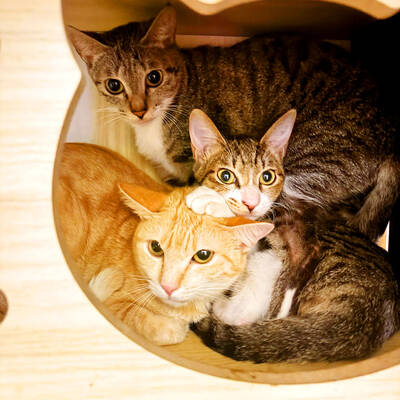
The number of pet cats in Taiwan surpassed that of pet dogs for the first time last year, reaching 1,742,033, a 32.8 percent increase from 2023, the Ministry of Agriculture said yesterday, citing a survey. By contrast, the number of pet dogs declined slightly by 1.2 percent over the same period to 1,462,528, the ministry said. Despite the shift, households with dogs still slightly outnumber those with cats by 1.2 percent. However, while the number of households with multiple dogs has remained relatively stable, households keeping more than two cats have increased, contributing to the overall rise in the feline population. The trend
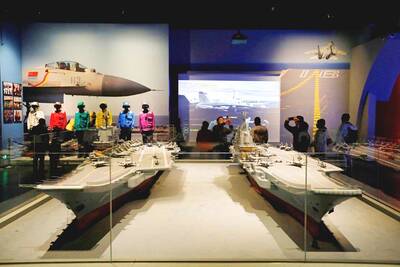
China on Wednesday teased in a video an aircraft carrier that could be its fourth, and the first using nuclear power, while making an allusion to Taiwan and vowing to further build up its islands, as it looks to boost maritime power, secure resources and bolster territorial claims. The video, issued on the eve of the 77th founding anniversary of the Chinese People’s Liberation Army Navy, featured fictional officers with names that are homophones of three commissioned aircraft carriers, the Liaoning (遼寧), Shandong (山東) and Fujian (福建). Titled Into the Deep, it showed a 19-year-old named “Hejian” (何劍) joining the group, sparking
Taiwan has signed six arms procurement offers from the US totaling more than NT$208 billion (US$6.59 billion) covering long-range precision strike systems, missile stockpile replenishment and joint production of large-caliber ammunition, the Ministry of National Defense said yesterday. The government’s proposed NT$1.25 trillion special defense budget has been stalled in the Legislative Yuan as opposition lawmakers question the amount and procurement items, while the Presidential Office and defense ministry say that the full amount is necessary to safeguard Taiwan. Minister of National Defense Wellington Koo (顧立雄) on Monday briefed the legislature’s Foreign Affairs and National Defense Committee on the defense budget for


 RSS
RSS