

Hundreds of supporters of former Chinese Nationalist Party (KMT) presidential candidate Hung Hsiu-chu (洪秀柱) yesterday held a rally in front of National Sun Yat-sen Memorial Hall in Taipei — the venue of the party’s extraordinary party congress — with some protesters threatening to storm the building.
Hung’s supporters, many of whom were wearing red and waving Republic of China (ROC) flags and banners, started to gather outside the hall well before the scheduled 2pm start time of the congress and shouted their support for Hung, calling the proceedings “illegitimate.”
Lin Cheng-chieh (林正杰), the head of Hung’s “out-of-the-party supporters’ club,” said before the vote that they were against the KMT’s use of an “illegal” procedure to replace Hung.
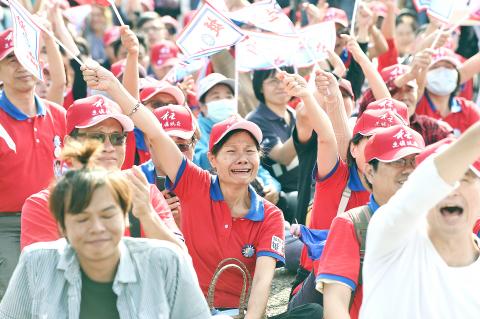
Photo: Chen Chih-chu, Taipei Times
“Hung is the candidate chosen in accordance with the party’s due process. The KMT can replace Hung only if she has committed a crime or issued bribes,” he said.
“However, Hung has done neither,” he said, adding that the KMT’s move to replace Hung is tantamount to “fraud,” as many made donations to the party only because Hung was elected as its presidential candidate.
“We would encourage Hung to take legal action to secure her right to run in the presidential election,” Lin said.
“If a lawsuit is considered not quick enough to be effective, we would then call on the intelligentsia, swing voters and deep-blue voters not to vote, and allow the KMT to collapse,” he added.
At about 3pm, after Hung and the top echelons of the KMT had finished their speeches, calling for solidarity — with KMT Chairman Eric Chu’s (朱立倫) speech met by supporters watching a live video feed outside with shouts of “filthy” and calls for him to step down — Lin called on the scores of supporters sitting before the screen to follow his lead and “storm the hall.”
Other rally leaders immediately tried to calm the crowd by saying that Hung would soon come out to address them, and begged angry protesters to sit down, which they did.
“You all know my history [of using force against the establishment]. During the dangwai [outside the party] period, I burned down a police precinct to protest the KMT’s vote rigging,” Lin had earlier told the crowd.
A supporter panned the KMT for using the same criticisms of Hung as the Democratic Progressive Party by attacking her stance on the cross-strait relationship and her “one China, same interpretation” and “ultimate unification,” comments.
“There are people saying that the younger generation are ‘natural independence supporters.’ Why? Is it because the KMT is too weak?” he said.
“Look around you my friends, are we young?” he added.
Protesters said they would boycott the KMT in presidential and legislative elections in January, but Hung, who came outside to address the gathering after her replacement was approved by a show of hands at the congress, urged them to continue to stand by the party.
“The KMT needs different voices and that is why we should stay in the party, to reform it,” Hung said, amid sobs and calls from the crowd urging her to run for party chairperson.
A group of protesters gathered to shout denunciations of the KMT and Chu, who is also New Taipei City mayor.
The Social Democratic Party and Green Party New Taipei City legislative candidates condemned Chu’s decision to run for president.
“Are New Taipei City residents not also your responsibility? You apologized in the KMT Central Standing Committee meeting, but should you not be apologizing to us as well?” they said.

PATROL PARTNERS: The ‘Chiayi’ and the ‘Penghu’ departed for a two-day joint patrol of Palau’s exclusive economic zone, the CGA’s second diplomatic visit to the country The Coast Guard Administration (CGA) set a record for its southernmost deployment of a coast guard vessel as the vessels Chiayi and the Penghu reached Palau’s Pulo Anna Island on Saturday in a cooperative exercise between the two countries. The island, about 217 nautical miles (401km) southwest of Koror in the Palauan state of Sonsorol and 1,220 nautical miles from Taiwan’s southernmost point, Oluanpi (鵝鑾鼻), is the furthest south a CGA vessel has sailed. The two vessels are in Palau for the coast guard’s second diplomatic visit to the country. They docked at Malakal Harbor on Tuesday last week. The coast guard
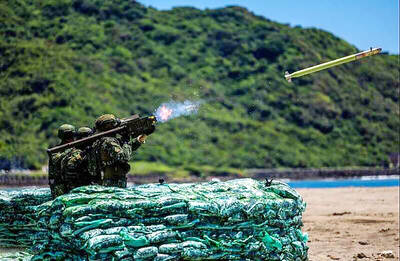
BATCH 1: The military has plans to assign the weapons to the army to defend Taiwan proper, as well as outlying islands and the navy for the Marine Corps, the official said Taiwan is to receive 500 Stinger missiles and 178 launchers from the US by the end of the year, the first batch under a planned two-stage acquisition totaling 2,621 missiles and 763 launchers, a defense official said yesterday on condition of anonymity. The portable missiles would play a vital role in the nation’s air defense capabilities, the source said. The army plans to deploy 2,235 missiles and 657 launchers to defend Taiwan proper and outlying islands, they said, citing military documents. The navy is allotted 295 missiles and 85 launchers to arm the Marine Corps and some surface vessels that lack air defense

The European Parliament on Wednesday adopted a recommendation on EU-China political relations that rejected China’s efforts to restrict Taiwan’s participation in international organizations and exchanges. The recommendation, addressed to the European Council, the European Commission and EU High Representative for Foreign Affairs and Security Policy Kaja Kallas, includes several references to EU-Taiwan relations and expresses support for closer ties, saying they would bring positive benefits and have strategic importance. Describing Taiwan as a valuable partner in trade and technology, the European Parliament said it “rejects China’s attempts to coerce international organizations, third countries and other actors into restricting Taiwan’s international participation and

Former president Tsai Ing-wen (蔡英文) on Monday arrived in San Francisco, receiving a warm welcome from hundreds of overseas Taiwanese as she launched a week-long visit. Accompanied by Representative to the US Alexander Yui (俞大?), and head of Taiwan’s San Francisco office Wu Chih-hsiang (伍志翔), Tsai arrived at her hotel, waving, smiling and giving high-fives to Taiwanese compatriots amid cheers of “Taiwan’s democracy involves you and me” to welcome her to the San Francisco Bay Area. It is Tsai’s first visit to the US since she left office in May 2024 after serving two four-year terms as president. Tsai is today to deliver


 RSS
RSS