


The New Taiwan dollar yesterday weakened against the US dollar, losing NT$0.385 to close at the day’s low of NT$32.465, after the Chinese central bank further cut the yuan’s reference rate, sending regional currencies into another tailspin.
Massive selling by foreign institutional investors on the local equity market added downward pressure on the NT dollar, pushing the currency down 1.18 percent to its weakest level since June 2010, according to Taipei Forex Inc data.
The currency on Tuesday declined 1 percent.
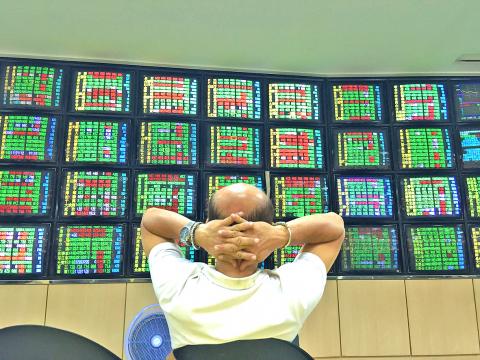
Photo: CNA
According to the Taiwan Stock Exchange, foreign institutional investors yesterday sold a net NT$8.79 billion (US$270.75 million) in shares, sending the TAIEX down 1.32 percent.
Analysts said the yuan’s depreciation has sparked more currency competition in the region.
The NT dollar could fall further as long as China continues to depress its currency to protect Chinese exporters and boost its economy, they said.
As the falling NT dollar led foreign investors to move their funds out of the nation, reducing demand for the currency, the central bank is quietly easing monetary conditions to spur growth and prevent capital flight.
While the central bank has kept benchmark borrowing costs unchanged since 2011, it cut the rate on overnight certificates of deposit for a second day yesterday.
The bank said it would pay less on 14-day debt at a sale scheduled for tomorrow.
“The move reflects that fundamentals are poor,” Ta Chong Bank Ltd (大眾銀行) economist Woods Chen (陳森林) said.
“The central bank is doing something, but it does not want to cut the benchmark rate, but the effects are similar,” Chen said.
The measures, which are aimed at boosting cash supply, came after second-quarter growth slowed to the least since 2012 and exports shrank for a sixth consecutive month last month.
Beijing’s unexpected decision on Tuesday to cut the yuan’s reference rate by a record amount roiled global financial markets and risks exacerbating outflows from Taiwan, as a weaker currency makes local assets less attractive.
“With Taiwan’s dollar following the yuan in depreciating massively, there is concern foreign investors will leave,” Fubon Financial Holding Co (富邦金控) economist Rick Lo (羅瑋) said.
“The central bank wanted to provide adequate liquidity in the market at this time,” Lo said.
The central bank yesterday lowered the rate on overnight certificates to 0.384 percent, after reducing it to 0.386 percent a day earlier in its first such cut since 2012, according to people familiar with the matter.
The one-day debt is sold daily to adjust cash supply and the rates and volumes are not released publicly.
The bank is to sell 14-day certificates at 0.47 percent this week, compared with 0.5 percent when it last sold debt of that maturity last month.
Lowering the short-term certificate of deposit rate is “equivalent to a policy-rate cut,” Lo said.
The central bank will “flexibly adjust” open-market operations according to market changes, Chen E-dawn (陳一端), director-general of the banking department, said by telephone yesterday.
The nation has kept its policy rate at 1.875 percent for a record 16 quarters amid low inflation. Speculation about a cut mounted after second-quarter growth came in at 0.64 percent, missing estimates of all economists surveyed by Bloomberg.
The next review is scheduled for next month.
“The central bank might have cut the rates in open-market operations to help push down the exchange rate,” said Ma Tieying (馬鐵英), an economist at DBS Group Holdings Ltd in Singapore.
“Psychologically, it might lead to expectations for a policy rate cut, but it does not necessarily mean there will be one,” Ma added.
Additional reporting by CNA

‘NO SECURITY RISK’: The Railway Bureau reassured the public that the technicians’ activities were limited to technical guidance and did not involve sensitive systems The Railway Bureau yesterday said it had invited eight Chinese technicians to assist with an airport MRT construction project. The bureau issued the confirmation after an Internet user said Chinese nationals had entered the construction zone of Taiwan Taoyuan International Airport’s Terminal 3 project. They asked why “individuals from an enemy state” were allowed access to such a major national infrastructure project, which raised serious concerns over Taiwan’s industrial safety, sensitive systems and information security. The bureau’s Northern Region Engineering Branch Office said subcontractor Taiwan Handle Industrial Co (台灣手把工業) of the Taoyuan airport MRT’s “Contract No. CU05 Project A14 Station Civil, MEP &

The National Chungshan Institute of Science and Technology yesterday showcased its locally developed variants of the Vision 60 robotic patrol dog, which it plans to deploy on the nation’s outlying territories in the South China Sea. The variants were produced under the Joint Lab project — created by the institute and domestic companies — and assembled with domestically produced motors, lenses and artificial intelligence (AI) systems alongside licensed tech from the US, Missile and Rocket Systems Research Division deputy director Jen Kuo-kang (任國光) told the media event at a military base in Taipei’s Dazhi (大直) area. Taiwan has built up its strengths

TIT-FOR-TAT: The US allegedly revoked the visa of a Chinese national working at Xinhua News Agency in the US in response to Beijing’s expulsion of Vivian Wang The Presidential Office yesterday condemned China for expelling a New York Times correspondent from Beijing following the newspaper’s interview with President William Lai (賴清德), saying the move highlighted Beijing’s suppression of press freedom and its threat to international news media. Taiwan has noted a series of recent incidents in which Beijing used similar tactics to “threaten and pressure international media outlets and journalists,” Presidential Office spokeswoman Karen Kuo (郭雅慧) said in a statement. “This concerns not only press freedom and freedom of expression, but also the safety of journalists, and Taiwan and relevant partners are paying close attention to the situation,” she

NOT IMMEDIATE: Taiwan has a chance to appeal the proposed 10 percent tariff before it starts, while other countries face a 12.5 percent tariff from the trade office Taiwan is among 60 economies determined by the US to have failed to impose or enforce a ban on the importation of goods produced with forced labor, according to a notice released on Tuesday by the Office of the US Trade Representative (USTR), which proposed imposing an additional 10 percent or more tariff on them. The USTR in a statement said that following an investigation, it had determined under Section 301 of the Trade Act of 1974 that the failure of the 60 economies to impose and effectively enforce a prohibition on the importation of goods produced with forced labor is


 RSS
RSS