


Kuo Yen-chun (郭彥君), the suspect in the Taipei MRT knife attack on Monday evening that injured four people, was detained yesterday after being charged with attempted murder and intentional injury.
Kuo was questioned at the Shilin District Prosecutors’ Office in Taipei yesterday morning, then taken to the Shilin District Court, where the presiding judge upheld the prosecutors’ request for detention, saying the suspect has no permanent residence and that detention was necessary to prevent him from escaping justice.
Police said the 27-year-old suspect told them: “I wanted to kill someone,” and that he had made a mistake, but “it was all too late.”
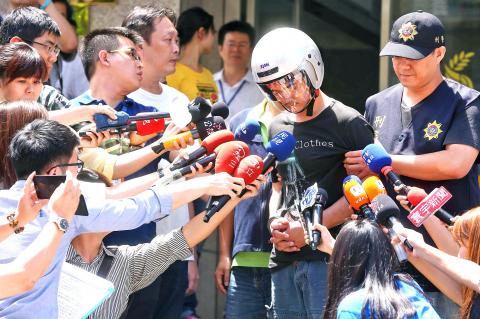
Photo: CNA
Datong District (大同) Deputy Chief of Police Chang Chin-an (張金安) alleged that Kuo headed to the Zhongshan MRT Station carrying a kitchen knife on Monday evening and slashed four people as he walked down the escalator of the No. 4 exit, creating panic as people ran away in fear.
Kuo was then disarmed and apprehended by security guards, with the help of several MRT passengers.
Chang said the four victims, three women and one man, were taken to the nearby Mackay Memorial Hospital for treatment. They all suffered lacerations that were not life-threatening.
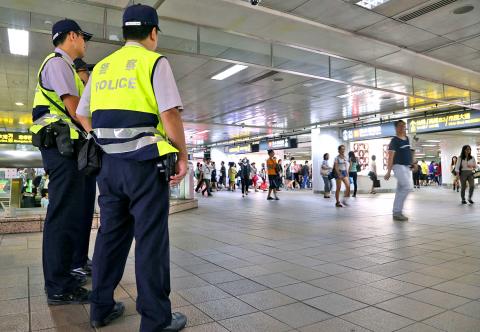
Photo: CNA
During questioning by investigators, Kuo was quoted as telling the police that he had carried out the attack because he had been unemployed for a long time and was “in a bad mood.”
Police officials said Kuo had been convicted of illegal drug use in May.
Local media reported that after his parents divorced, Kuo went to live in Japan with his mother, who subsequently married a Japanese man. After his mother died of cancer, Kuo returned to Taiwan to live in Taipei with his aunt.
Kuo was quoted by police as saying that he left home last week after having a quarrel with his aunt; since then, he had been sleeping in a public park near Hejiang Street (合江街).
In response to the MRT attacks, the National Police Agency (NPA) demanded that police in Taipei and New Taipei City increase security at public entertainment venues and university campuses to try to prevent future incidents.
Meanwhile, Taipei Mayor Ko Wen-je (柯文哲) yesterday called for a “social movement” of caring for others as a means of protecting oneself.
“The opposite of love is indifference, not hatred — if you care for others, you’re also protecting yourself,” Ko said, adding that the increase in “random” stabbings was “absolutely” a problem that needs to be addressed.
While saying Monday’s incident had been handled well, Ko said that more has to be done to prevent similar incidents, adding that the city government had discovered a “hole” in the social safety net, and that the question of how to find and counsel socially isolated people was important to address.
While the city government has systems in place for tracking alcoholics, potential suicides and drug addicts, there is no system in place to keep track of the socially isolated, he said.
Ko called for the establishment of a screening system for psychological problems.
He added that to prevent inspiring further “copy-cat” attacks, the city government would not provide security camera footage of attacks to the media.
The city government has ruled out installing X-ray machines and other security equipment on the MRT system because of the high costs doing so would entail, he said.
Additional reporting by Abraham Gerber

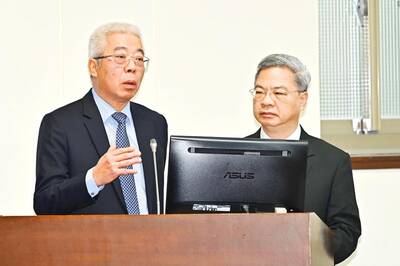
Taiwan has arranged for about 8 million barrels of crude oil, or about one-third of its monthly needs, to be shipped from the Red Sea this month to bypass the Strait of Hormuz and ease domestic supply pressures, CPC Corp, Taiwan (CPC, 台灣中油) said yesterday. The state-run oil company has worked with Middle Eastern suppliers to secure routes other than the Strait of Hormuz, through which about 20 percent of the world’s oil and liquefied natural gas typically passes, CPC chairman Fang Jeng-zen (方振仁) said at a meeting of the legislature’s Economics Committee in Taipei. Suppliers in Saudi Arabia have indicated they
South Korea has adjusted its electronic arrival card system to no longer list Taiwan as a part of China, a move that the Ministry of Foreign Affairs said would help facilitate exchanges between the two sides. South Korea previously listed “Taiwan” as “Taiwan (China)” in the drop-down menus of its online arrival card system, where people had to fill out where they came from and their next destination. The ministry had requested South Korea make a revision and said it would change South Korea’s name on Taiwan’s online immigration system from “Republic of Korea” to “Korea (South),” should the issue not be

Tainan, Taipei and New Taipei City recorded the highest fines nationwide for illegal accommodations in the first quarter of this year, with fines issued in the three cities each exceeding NT$7 million (US$220,639), Tourism Administration data showed. Among them, Taipei had the highest number of illegal short-term rental units, with 410. There were 3,280 legally registered hotels nationwide in the first quarter, down by 14 properties, or 0.43 percent, from a year earlier, likely indicating operators exiting the market, the agency said. However, the number of unregistered properties rose to 1,174, including 314 illegal hotels and 860 illegal short-term rental
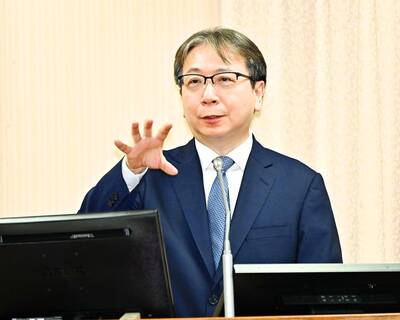
AIR ALERT: China’s reservation of airspace over the Yellow Sea and East China Sea could be an attempt to test the US’ response ahead of a Trump-Xi meeting, the NSB head said China’s attempts to infiltrate Taiwan are systematic, planned and targeted, with activity shifting from recruiting mid-level military officers to rank-and-file enlisted personnel, National Security Bureau (NSB) Director-General Tsai Ming-yen (蔡明彥) said yesterday. The Chinese Communist Party’s (CCP) integrates national security, intelligence operations and “united front” efforts into a dense network to conduct intelligence gathering and espionage in Taiwan, Tsai said at a meeting of the legislature’s Foreign Affairs and National Defense Committee. It uses specific networks to screen targets through exchange activities and recruiting local collaborators to establish intelligence-gathering organizations, he said. China is also shifting who it targets to lower-ranking military personnel,


 RSS
RSS