


The Ministry of Education (MOE) on Friday added an iron gate to the entrance of its building and put barbed wire on its outer fences ahead of demonstrations planned for today by high-school students protesting against the ministry’s adjustments to high-school curriculum guidelines.
Several student groups held a news conference yesterday announcing that protests in Taipei and Taichung are planned for today.
In both cities, black umbrellas are to be held up to symbolize the amendment of the curricula having been “shrouded in darkness.”
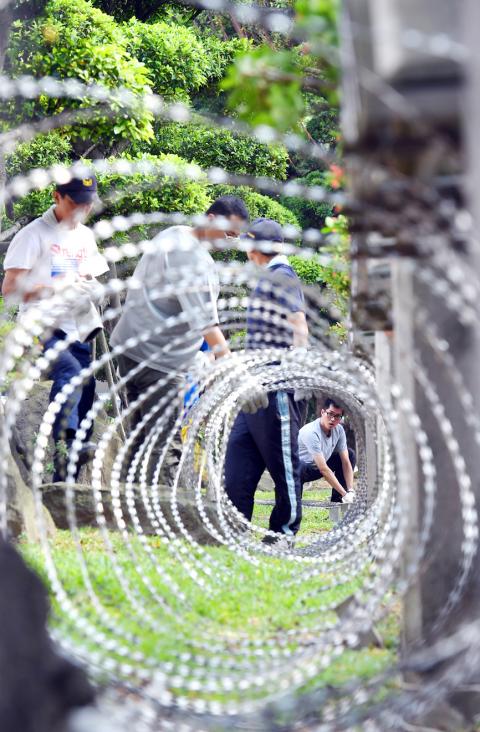
Photo: Lo Pei-der, Taipei Times
Protesters also plan to throw paper planes into the ministry in Taipei and the K-12 Education Administration office in Taichung, carrying students’ messages to Minister of Education Wu Se-hwa (吳思華) urging the government to postpone the roll-out and demanding a fair education system, the student groups said.
The students said they would act in a “peaceful and rational manner, with black umbrellas and paper planes, in response to the ministry’s iron gate and blockades.”
Deputy Minister of Education Chen Der-hwa (陳德華) confirmed that the iron gate was installed in preparation for the coming protest and said that because students had stormed into the building before, the ministry’s secretariat decided to install the gate out of safety concerns.
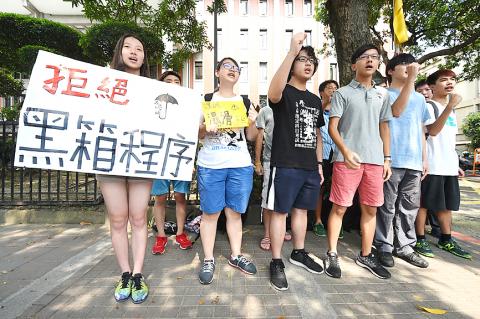
Photo: Chang Chia-ming, Taipei Times
The Deep-Root Alliance of History Teachers yesterday said that the ministry’s attempt to insulate itself from the students “was just like the Berlin Wall, which was constructed overnight to stop people from leaving.”
“What kind of government would protect itself from high-school students and isolate itself from people’s voices with barbed wire and iron gates? Are MOE officials really civil servants in a free and democratic country? Are we really citizens of a free country?” it asked.
The alliance said people should “stand up and proudly declare ‘I am Taiwanese, and a citizen of a free country,’” and show solidarity with students who epitomize “the awakening of civil consciousness and democratic enlightenment.”
National Taichung First Senior High School Apple Tree Commune Club spokesperson Chen Chien-hsun (陳建勳) said the ministry, despite setting up the barricades, would eventually have to face the students and their demands.
“The students want only to negotiate with the ministry officials and do not want to stage protests,” he said, adding that the actions of the government were making clashes more likely.
Chen said that the ministry canceled three planned question-and-answer sessions on campuses and was unwilling to talk with students publicly.
Taipei Municipal Jianguo Senior High School student Yen Hsiao-ho (閻孝和) said today’s demonstration would be peaceful and the students would form a team to monitor protesters to ensure that no clashes with the authorities occur.
“We understand that parents are concerned, but the students are standing up for their own rights and their futures,” Yen said, adding “if the right to justice is removed, it must be fought for.”
Students would be friendly toward those with opposing opinions, Yen said, adding that students planned only to stage a sit-in and throw paper airplanes into the ministry.
Additional reporting by Rachel Lin
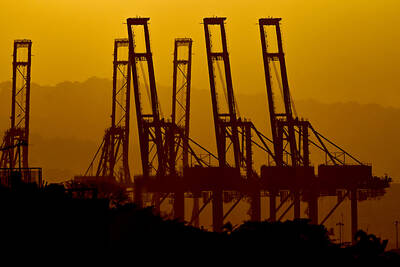
A subsidiary of a Hong Kong-based company that has lost control of two critical ports on the Panama Canal said it is seeking US$2 billion of compensation in damages from Panama over its “illegal” takeover of the ports. Panama Ports Co, a unit of Hong Kong’s CK Hutchison Holdings (長江和記實業), on Friday said in a statement that it is demanding the sum under international arbitration proceedings that it had already started. The Panamanian government last week seized control of the Balboa and Cristobal ports on each end of the Panama Canal, after the country’s Supreme Court declared earlier that a concession allowing
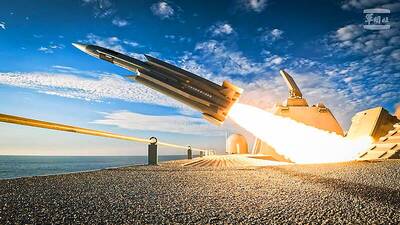
DETERRENCE: With 1,000 indigenous Hsiung Feng II and III missiles and 400 Harpoon missiles, the nation would boast the highest anti-ship missile density in the world With Taiwan wrapping up mass production of Hsiung Feng II and III missiles by December and an influx of Harpoon missiles from the US, Taiwan would have the highest density of anti-ship missiles in the world, a source said yesterday. Taiwan is to wrap up mass production of the indigenous anti-ship missiles by the end of year, as the Chungshan Institute of Science and Technology has been meeting production targets ahead of schedule, a defense official with knowledge of the matter said. Combined with the 400 Harpoon anti-ship missiles Taiwan expects to receive from the US by 2028, the nation would have

POSSIBILITIES EMERGE: With Taiwan’s victory and Japan’s narrow win over Australia, Taiwan now have a chance to advance if South Korea also beat the Aussies Taiwan has high hopes that the national baseball team would advance to the World Baseball Classic (WBC) quarter-finals after clinching a crucial 5-4 victory over South Korea in a nail-biting extra-inning game at the Tokyo Dome yesterday. Boosted by three home runs — two solo shots by Yu Chang (張育成) and Cheng Tsung-che (鄭宗哲) and a two-run homer by Stuart Fairchild — the triumph gave Taiwan a much-needed second victory in the five-team Pool C, where only the top two finishers would advance to the knockout stage in Miami, Florida. Entering extra innings with the game tied at four apiece, Taiwan scored
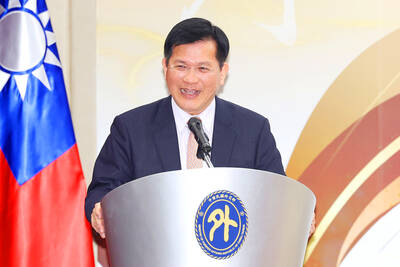
MISSION OF PEACE: The foreign minister urged Beijing to respect Taiwan’s existence as an independent nation, and work together to ensure peace and stability in the region Minister of Foreign Affairs Lin Chia-lung (林佳龍) yesterday rejected Chinese Minister of Foreign Affairs Wang Yi’s (王毅) comments about Taiwan, criticizing China as a “troublemaker” in the international community and a disruptor of cross-strait peace. Speaking at a news conference on the sidelines of the Chinese National People’s Congress, Wang said that Taiwan has always been a territory of China and that it would be impossible for it to become its own country. The “return” of Taiwan to China was the natural outcome of the Chinese people’s resistance against Japan in World War II, and that any pursuit of independence was “doomed


 RSS
RSS