


The Taiwan Alliance to Promote Civil Partnership Rights, which advocates the recognition of marriages between same-sex couples, said the US Supreme Court’s decision to rule in favor of the gay community is a significant indicator, adding that Taiwan is one step away from making a similar step after more than 30 years of campaigning.
Alliance secretary-general Chien Chih-chieh (簡至潔) said the US is a crucial indicator for the nation, as Taiwanese politicians look to Washington, even though same-sex unions have already been legalized in many European countries.
Chien said that the alliance visited Taipei Mayor Ko Wen-je (柯文哲) in the run-up to last year’s nine-in-one elections and asked him to “support marriage equality.”

Photo: Hu Shun-hsiang, Taipei Times
“Ko said he would wait until half of the US states recognized same-sex marriages,” Chien said. “Now, as it is legal nationwide in the US, we might ask him again.”
The group understands that its goals cannot be achieved in a short period of time; it took the US 20 years to get this far, Chien said.
Homosexual rights advocate Chi Chia-wei (祁家威) first called for recognition of same-sex marriage 30 years ago, Chien said, adding that it is “abominable” that the ruling and opposition parties mothballed a same-sex marriage bill in the legislature.
Deputy Minister of Justice Chen Ming-tang (陳明堂) said: “All countries are not the same. In Taiwan, the issue of legalizing same-sex marriage remains extremely controversial.”
“We must take into consideration the development of our society and public opinion,” Chen said. “So we will not consider it right now.”
Chien said the ministry should take a position “above the fray,” citing France’s decision to recognize same-sex marriages in 2013, despite more than 300,000 protesters taking to the streets in opposition to the move.
“Equal right to marriage is not about public opinion, but an issue of human rights,” Chien said, adding that no country that has made the change has had full support from the public.
“It is not an issue that should be hindered because it is controversial,” she said.
There is no known request for an interpretation on the issue before the Council of Grand Justices.
A same-sex couple withdrew a request in early 2013 after claiming to have received death threats.
Democratic Progressive Party (DPP) Chairperson Tsai Ing-wen (蔡英文) yesterday said that the US ruling is the result of a prolonged movement and expressed her expectation that Taiwan would eventually follow a similar path.
“The ruling is a significant move on equality and human rights, but the US has come a long way, with society engaged in prolonged dialogue before reaching this stage,” Tsai said while attending a presidential campaign event in Taichung.
“Taiwan is facing a similar issue and we need to bridge the social gap through rational dialogue, so that society can come to a shared way of thinking,” the presidential hopeful said.
Former premier Su Tseng-chang (蘇貞昌) posted the closing paragraph of the ruling by US Justice Anthony Kenney — which spoke about people being able to find “equal dignity in the eyes of the law” — saying that “the statement demonstrates the core value of marriage equality and serves as the best explanation for the ruling.”
DPP Legislator Cheng Li-chun (鄭麗君) said she hopes same-sex marriages would soon be recognized in Taiwan.
“Although the Council of Grand Justices who were recently approved by the legislature have not expressed support for same-sex marriage, we hope that the council will make progressive constitutional interpretations in line with universal human rights, so that Taiwan can become an equal society as soon as possible,” Cheng said on Facebook.
Jack Yu (游梓翔), Chinese Nationalist Party (KMT) presidential hopeful Hung Hsiu-chu’s (洪秀柱) spokesperson, said Hung has always been “optimistic and open” about same-sex marriage and believed that “people, as long as they have love for each other, should be protected by law, regardless of gender.”
However, Yu also said that the law concerning marriage is defined as being between a man and a woman, adding that long-term social deliberation is needed before homosexual unions can be recognized.
Additional reporting by Loa Lok-sin

A signaling system malfunction disrupted high-speed rail (HSR) services beginning at 8am today, with trains temporarily reduced to three northbound and three southbound trains per hour as authorities conduct inspections. The malfunction occurred on a section of track in Miaoli County during pre-operation checks early this morning, forcing northbound and southbound trains to use a single track, the HSR operator said. The regular schedule has been replaced with three hourly trains offering only nonreserved seating in each direction, stopping at every station, it said, adding that business class cars would still have reserved seating. Departures from terminal stations are scheduled at the top

DRONE CENTRAL: Taiwan aims to become Asia’s democratic hub for drones, with most exports focused on high-quality military-grade models, an official said Taiwan’s drone industry is expected to expand significantly by 2030, producing 100,000 units per month and exporting half of them, the Ministry of Economic Affairs said yesterday. Current drone production capacity is about 15,000 units per month, but the industry can quickly scale up as demand increases, Industrial Development Administration Director-General Chiou Chyou-huey (邱求慧) told a news conference in Taipei. Taiwan’s drone output grew 2.5-fold last year to NT$12.9 billion (US$408.3 million) under a government program to develop the uncrewed vehicle sector, he said. The Executive Yuan in October last year approved plans to invest NT$44.2 billion into domestic production of uncrewed aerial

VERBOSE VESSELS: A CGA cutter and a China Coast Guard exchanged verbal barbs for more than a day in Taiwanese-controlled waters before the Chinese vessel left The Taiwanese and Chinese coast guards had a standoff near the strategically located Pratas Islands (Dongsha Islands, 東沙群島) in the north of the South China Sea, the Coast Guard Administration (CGA) said yesterday. The two sides engaged in intense radio exchanges over sovereignty claims during the 33-hour standoff. China Coast Guard vessel 3501 eventually left the restricted waters, 26.6 nautical miles (49.2km) west of the Pratas Islands, at 5pm yesterday, the CGA said. Lying approximately between southern Taiwan and Hong Kong, the Taiwan-controlled Pratas are seen by some security experts as vulnerable to Chinese attack due to their distance — more than
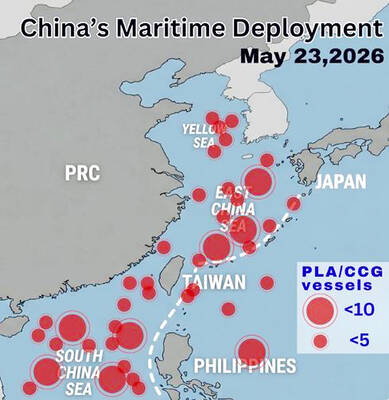
WARNING: China should stop engaging in actions that undermine regional peace and stability, as it would only build resentment among people across the Strait, the CGA said China has deployed more than 100 navy, coast guard and other vessels in waters from the Yellow Sea to the South China Sea and the western Pacific since US President Donald Trump and Chinese President Xi Jinping (習近平) met in Beijing, National Security Council Secretary-General Joseph Wu (吳釗燮) said yesterday. “In this part of the world, #China is the one & only PROBLEM wrecking the #StatusQuo & threatening regional peace & stability,” Wu wrote on X. In a separate post, he said Beijing was coercing Taiwan’s maritime domain, calling it illegal and provocative, after the Coast Guard Administration (CGA) expelled a


 RSS
RSS