


Following a landmark visit to the White House on Wednesday, Democratic Progressive Party (DPP) Chairperson Tsai Ing-wen (蔡英文) met US Deputy Secretary of State Antony Blinken on Thursday, making her the first Taiwanese presidential candidate to have entered the US Department of State headquarters.
US Department of State officials said at a post-meeting press conference that they appreciated Tsai’s visit, during which she held “constructive” talks with US officials.
Based on the US’ “one China” policy — as stipulated in the Three Joint Communiques between Washington and Beijing and the US’ Taiwan Relations Act — the US has developed solid unofficial ties with Taiwan, the officials said.
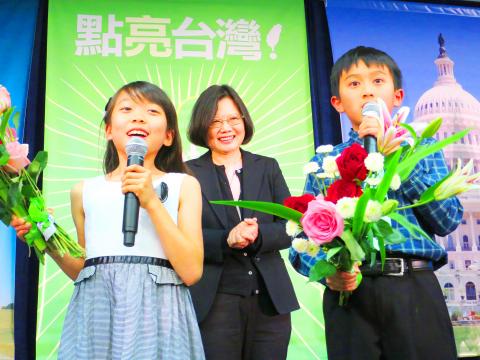
Photo: Chen Hui-ping, Taipei Times
The US has committed to supporting Taiwan’s security, freedom from coercion and economic prosperity, while helping it attain dignity and respect in the international community, they added.
Tsai entered the Harry S. Truman Building — the US Department of State headquarters — in the company of DPP Secretary-General Joseph Wu (吳釗燮), DPP Legislator Hsiao Bi-khim (蕭美琴) and the party’s Washington liaison, Michael Fonte.
The meeting with Blinken lasted about an hour.
Asked if she felt the US government has “upgraded” its treatment of her compared with her visit in 2011, Tsai said: “This is a simple fact. I walked in [the building] and that is it.”
Tsai’s meeting with the US Special Assistant to the President and Senior Director for Asia Evan Medeiros at the White House on Wednesday has been seen as a major political breakthrough for Taiwan-US relations, as she was the first Taiwanese presidential candidate to have visited the White House — a privilege not granted to Tsai on her last visit in 2011, nor to President Ma Ying-jeou (馬英九), who visited Washington as then-Taipei mayor and KMT chairman in 2006, nor to former DPP chairman Frank Hsieh (謝長廷), who visited the US as the DPP presidential candidate in 2007.
Tsai on Wednesday also met with former US deputy secretary of state Richard Armitage and former assistant secretary of state for East Asian and Pacific affairs Randall Schriver.
Separately on Thursday, while addressing a dinner held for Taiwanese expatriates in Washington, Tsai said she does not need to have her qualifications evaluated in any other nation and needs only to answer to 23 million Taiwanese.
Tsai said that the purpose of her US visit is not to have a job interview, but to convey two messages — that Taiwanese will stick to a democratic and free lifestyle, and that she is responsible and determined to maintain peace and stability across the Taiwan Strait.
Tsai was responding to comments made earlier this week by Chinese Ambassador to the US Cui Tiankai (崔天凱).
Noting that some people have said Tsai’s visit is aimed at seeking Washington’s endorsement prior to January’s election, Cui said he wondered why she would talk to foreigners, but not directly to her compatriots on the other side of the Taiwan Strait.
Additional reporting by CNA

‘NO SECURITY RISK’: The Railway Bureau reassured the public that the technicians’ activities were limited to technical guidance and did not involve sensitive systems The Railway Bureau yesterday said it had invited eight Chinese technicians to assist with an airport MRT construction project. The bureau issued the confirmation after an Internet user said Chinese nationals had entered the construction zone of Taiwan Taoyuan International Airport’s Terminal 3 project. They asked why “individuals from an enemy state” were allowed access to such a major national infrastructure project, which raised serious concerns over Taiwan’s industrial safety, sensitive systems and information security. The bureau’s Northern Region Engineering Branch Office said subcontractor Taiwan Handle Industrial Co (台灣手把工業) of the Taoyuan airport MRT’s “Contract No. CU05 Project A14 Station Civil, MEP &

A US uncrewed surface vessel (USV) encountered multiple Chinese warships during an autonomous transit of the Taiwan Strait, US defense company Seasats said in a statement on Wednesday. Seasats announced that a Lightfish USV had completed the first autonomous transit of the Taiwan Strait. Over five days, the USV traversed the entire length of the Strait while constantly monitoring surface vessel traffic, the company said. The Lightfish encountered multiple Chinese warships, one of which was a Chinese People’s Liberation Army Navy (PLAN) Type 056 corvette, it said. The Chinese vessels were operating “well within Taiwan’s exclusive economic zone without transmitting their identity via the
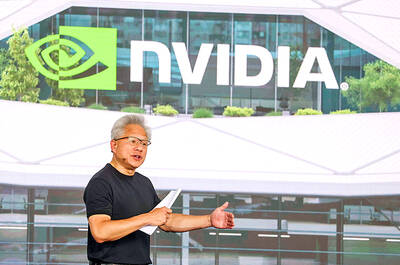
‘BOOMING’: ’ The number of partners we have here is incredible. You can see from their stock prices. They’re doing so well, they’re so happy,’ Jensen Huang said Nvidia Corp’s spending in Taiwan has ballooned to about US$150 billion a year, 10 times the US$10 billion to US$15 billion the company spent five years ago, Nvidia chief executive officer Jensen Huang (黃仁勳) said yesterday, suggesting Taiwan’s strategic importance in the global artificial intelligence (AI) supply chain. “Taiwan is the epicenter of the AI revolution. This is where the chips come, packaging comes. This is where the systems are made. This is where AI supercomputers were created,” Huang said at a meeting for the company’s employees in Beitou-Shilin Technology Park (北投士林科技園區) in Taipei, the planned site of Nvidia’s Taipei headquarters. “Taiwan
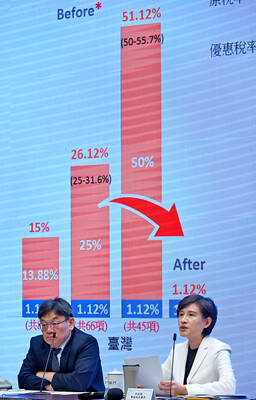
GREATER REACH? Auto parts and wood products would face tariffs of up to 15%, matching those targeting the EU, Japan and South Korea, Vice Premier said The US has announced that preferential tariff treatment for Taiwan’s non-semiconductor Section 232 goods would take effect retroactively from May 1, the Executive Yuan said yesterday. The US government yesterday posted a notice on the Federal Register’s public inspection Web site previewing tariff concessions for Taiwan under a memorandum of understanding (MOU) on Taiwan-US investment after two months of negotiations. The MOU signed on Jan. 15 stipulated three major preferential tariff arrangements: a 15 percent “reciprocal” tariff rate for Taiwan without stacking most-favored nation (MFN) rates; preferential Section 232 treatment for semiconductors and related products; and preferential Section 232 treatment for non-semiconductor


 RSS
RSS