


Chinese Nationalist Party (KMT) Chairman Eric Chu (朱立倫) said yesterday in Beijing that he hopes Taiwan and China will continue to work together based on the so-called “1992 consensus” and help increase cooperation between future generations.
In his opening remarks at a high-level meeting between the KMT and the Chinese Communist Party (CCP) — his first meeting with Chinese President and CCP General Secretary Xi Jinping (習近平) — Chu described the “1992 consensus” by saying that “both sides of the Taiwan Strait belong to ‘one China,’ but with each side ascribing different contents and definitions to the concept of ‘one China.’”
“Hopefully the two sides can promote cooperation based on the 1992 consensus and work together on issues such as regional peace, environmental protection and economic cooperation,” said Chu, who assumed chairmanship of the KMT in January.
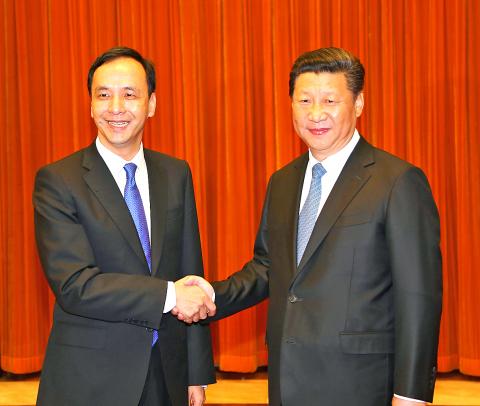
Photo: EPA/KMT
Taiwan and China “can present our ideals together in the Asia-Pacific region and make a contribution,” he said. “And this would be making a contribution to the future development of cross-strait relations, or the deepening of the 1992 consensus and the promotion of cooperation between our future generations.”
Taiwan’s younger generation would like to see the two sides work together on efforts to promote regional economic integration, including the Beijing-initiated Asian Infrastructure Investment Bank (AIIB); the “One Belt, One Road” trade initiative and the Regional Comprehensive Economic Partnership, Chu added.
Meanwhile, Xi said that cross-strait relations have reached a new and important point and would “impact the Chinese nation and the country’s future.”
Over the past decade, Taiwan and China have moved from an intense standoff on the edge of war to peaceful interaction, a development that has benefited both sides and won global recognition, he said.
The KMT and CCP should continue to build exchanges and explore new visions for people on both sides of the Taiwan Strait, Xi said.
Xinhua news agency reported that Xi also told Chu that the two sides should settle political differences through “equal consultations.”
“The two sides can consult with each other on an equal basis under the principle of ‘one China,’ and reach a reasonable arrangement,” Xi was quoted as saying.
Beijing’s “one China” policy holds that there is only one China and that Taiwan is part of it.
Xi was quoted by Xinhua as saying that both parties “should be brave when facing lingering political differences and difficulties, pool the wisdom of compatriots of both sides and actively search for a solution.”
China would ensure more economic opportunities for the people of Taiwan, adding that “our efforts to open up to Taiwanese compatriots will be bigger,” Xi said.
“Taiwan has expressed interest in joining in the Asian Infrastructure Investment Bank, which we welcome,” Xi was also quoted by Xinhua as saying.
China last month rejected Taiwan’s bid to become a founding member of the AIIB, although Beijing said Taiwan is welcome to join as an ordinary member — if it used an “appropriate name.”
The official name of Taiwan’s government is the Republic of China, but the International Olympic Committee refers to it as “Chinese Taipei,” while in the Asian Development Bank it is known as “Taipei, China.”
The talks began at 10:30am at the Great Hall of the People in Beijing and ran for about an hour; each side brought a 10-member delegation.
Chu, also New Taipei City mayor, has repeatedly said that he would not join the race for January’s presidential election, but he remains the most promising potential pan-blue camp candidate to rival Democratic Progressive Party Chairperson Tsai Ing-wen (蔡英文).
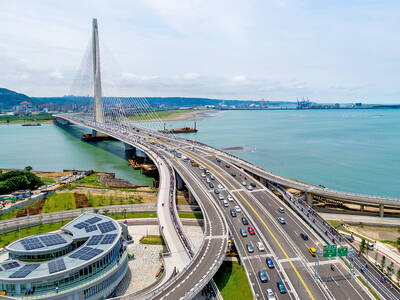
The Ministry of Transportation and Communications yesterday inaugurated the Danjiang Bridge across the Tamsui River in New Taipei City, saying that the structure would be an architectural icon and traffic artery for Taiwan. Feted as a major engineering achievement, the Danjiang Bridge is 920m long, 211m tall at the top of its pylon, and is the longest single-pylon asymmetric cable-stayed bridge in the world, the government’s Web site for the structure said. It was designed by late Iraqi-British architect Zaha Hadid. The structure, with a maximum deck of 70m, accommodates road and light rail traffic, and affords a 200m navigation channel for boats,
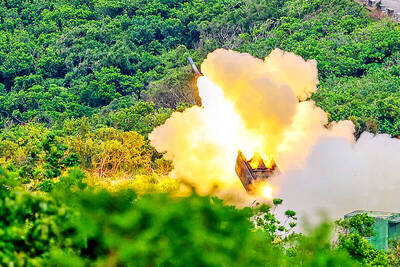
PRECISION STRIKES: The most significant reason to deploy HIMARS to outlying islands is to establish a ‘dead zone’ that the PLA would not dare enter, a source said A High Mobility Artillery Rocket System (HIMARS) would be deployed to Penghu County and Dongyin Island (東引) in Lienchiang County (Matsu) to force the Chinese military to retreat at least 100km from the coastline, a military source said yesterday. Taiwan has been procuring HIMARS and Army Tactical Missile Systems (ATACMS) from the US in batches. Once all batches have been delivered, Taiwan would possess 111 HIMARS units and 504 ATACMS, which have a range of 300km. Considering that “offense is the best defense,” the military plans to forward-deploy the systems to outlying islands such as Penghu and Dongyin so that
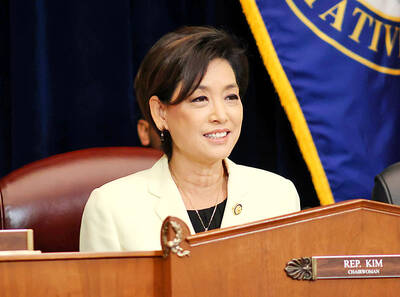
‘CLEAR MESSAGE’: The bill would set up an interagency ‘tiger team’ to review sanctions tools and other economic options to help deter any Chinese aggression toward Taiwan US Representative Young Kim has introduced a bill to deter Chinese aggression against Taiwan, calling for an interagency “tiger team” to preplan coordinated sanctions and economic measures in response to possible Chinese military or political action against Taiwan. “[Chinese President] Xi Jinping [習近平] has directed the People’s Liberation Army to be ready to invade Taiwan by 2027. China has a plan. America should have one too,” Kim said in a news release on Thursday last week. She introduced the “Deter PRC [People’s Republic of China] aggression against Taiwan act” to “ensure the US has a coordinated sanctions strategy ready should

TAIWAN ISSUE: US treasury secretary Scott Bessent said on the first day of meetings that ‘it wouldn’t be a US-China summit without the Taiwan issue coming up’ There were no surprises on the first day of the summit between US President Donald Trump and Chinese President Xi Jinping (習近平), the Mainland Affairs Council (MAC) said yesterday, as the government reiterated that cross-strait stability is crucial to the Asia-Pacific region, as well as the world. As the two presidents met for a highly anticipated summit yesterday, Chinese state media reported that Xi warned Trump that missteps regarding Taiwan could push their two countries into “conflict.” Trump arrived in China with accolades for his host, calling Xi a “great leader” and “friend,” and extending an invitation to visit the White House


 RSS
RSS