

The government and the public yesterday joined forces to organize relief missions to search for survivors of the massive earthquake that struck Nepal on Saturday, with members of a rescue team from the Taipei City Government late on Saturday night having finalized the logistics to set off for Nepal upon receiving an order from the Ministry of the Interior.
The Taipei City Fire Department yesterday said it had mustered 20 members of the rescue team and a rescue dog, and that it is fully prepared to take on missions in the city of Pokhara, about 80km west of the epicenter.
The team will be carrying 2 tonnes of gear, including rescue tools and medical kits, as they seek survivors, it said.
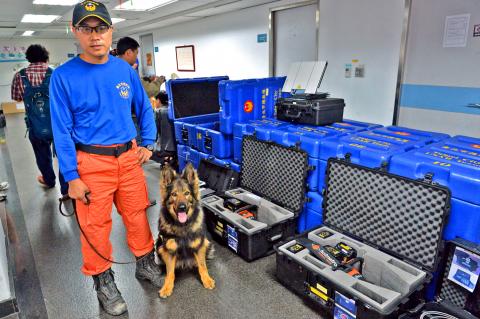
Photo: CNA
Team members have developed international experience, having participated in disaster relief after the 2004 Indonesian earthquake and tsunami, the 2008 Sichuan earthquake and the 2010 Haitian earthquake, it said.
The Red Cross Society of the Republic of China yesterday launched a fundraising campaign that aims to collect at least NT$30 million (US$966,152) for disaster relief.
The funds from the drive, which is scheduled to run until the end of June, are also earmarked to assist in reconstruction efforts in the Himalayan nation.
Red Cross Society chairperson Wang Ching-feng (王清峰) said the group contacted the Nepal Red Cross Society and the International Federation of Red Cross and Red Crescent Societies after the quake, adding that the society is ready to send supplies in accordance with the needs of local groups.
The Buddhist Compassion Relief Tzu Chi Foundation said it was setting up a relief coordination center in Nepal to aid operations and to distribute supplies.
Spokesperson Her Rey-sheng (何日生) said Tzu Chi has established communication with groups in Kathmandu.
The foundation plans to send a preliminary investigative group to Nepal “within a day or two” to better understand the needs of local relief efforts, he added.
Other religious groups, such as the Fo Guang Shan Monastery and Dharma Drum Mountain, have also expressed their intention to send humanitarian relief and medical aid to disaster-stricken regions.
Meanwhile, Presidential Office spokesperson Charles Chen (陳以信) said President Ma Ying-jeou (馬英九) has extended his sympathies to Nepal, which were conveyed through Taiwan’s representative office in New Delhi, India.
The Ministry of Foreign Affairs yesterday said that Taiwan would donate US$300,000 to aid rescue efforts.
Ministry of Foreign Affairs spokesperson Anna Kao (高安) added that Taiwan’s representative office in India assembled an emergency task force upon learning of the disaster, and would evaluate the situation to determine whether to provide further assistance.
A Ministry of National Defense source said it is unlikely that the nation would dispatch its Lockheed C-130 Hercules transport aircraft to help with relief efforts.
Coordination and permission are required before military aircraft can enter foreign countries, but none of Nepal’s neighboring countries have formal diplomatic ties with Taiwan, the source said.
Relief efforts organized by non-governmental organizations and charity groups would be able to transport larger amounts of resources — while encountering fewer hurdles in obtaining permissions to land — and therefore would be more effective, the source added.
Democratic Progressive Party Chairperson Tsai Ing-wen (蔡英文) yesterday launched a “keyboard rescue” campaign, calling on netizens to help with rescue efforts by using the Open Street Map platform to complete an online map of a region northwest of Kathmandu, which she said contains many underdeveloped villages and geographic data is desperately short.
“Over the past several years, the Internet users of Taiwan have played an important role in the real world. Let us build on this influence to help more people in need,” Tsai said on Facebook.
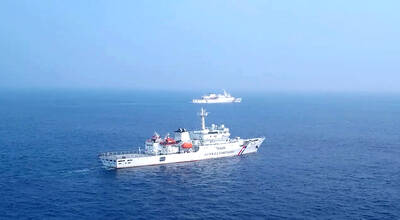
PATROL PARTNERS: The ‘Chiayi’ and the ‘Penghu’ departed for a two-day joint patrol of Palau’s exclusive economic zone, the CGA’s second diplomatic visit to the country The Coast Guard Administration (CGA) set a record for its southernmost deployment of a coast guard vessel as the vessels Chiayi and the Penghu reached Palau’s Pulo Anna Island on Saturday in a cooperative exercise between the two countries. The island, about 217 nautical miles (401km) southwest of Koror in the Palauan state of Sonsorol and 1,220 nautical miles from Taiwan’s southernmost point, Oluanpi (鵝鑾鼻), is the furthest south a CGA vessel has sailed. The two vessels are in Palau for the coast guard’s second diplomatic visit to the country. They docked at Malakal Harbor on Tuesday last week. The coast guard

The government is monitoring online rumors that a pneumonic plague outbreak has spread from Russia into China, and it might enhance quarantine measures, Premier Cho Jung-tai (卓榮泰) said yesterday. During a legislative meeting, Democratic Progressive Party Legislator Wang Ting-yu (王定宇) said that rumors had circulated that the disease had spread across several Chinese provinces. He asked Cho whether the government was prepared to prevent the disease spreading to Taiwan, given the volume of traffic between the two sides, and how concerned the government was about the alleged outbreak. The Ministry of Health and Welfare had implemented border quarantine measures after briefing the Executive
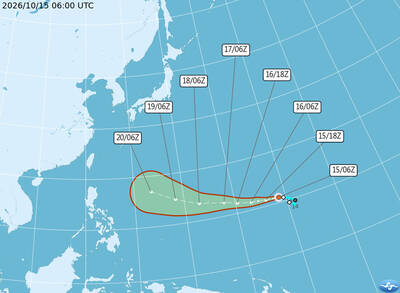
EAST OF GUAM: Tropical Storm Champi is forecast to strengthen into a typhoon, but its effect on Taiwan is uncertain due to the presence of a high-pressure system Tropical Storm Champi formed yesterday and has the potential to increase in strength, the Central Weather Administration (CWA) said yesterday. Forecasters are closely monitoring a Pacific high-pressure system that would dictate whether the storm turns north or moves toward Taiwan next week, the CWA said. The most likely scenario is that it turns northward after passing the Ryukyu Islands, CWA forecaster Cheng Chieh-jen (鄭傑仁) said. As of 8pm yesterday, Champi was east of Guam moving west-northwest at 20kph, CWA data showed. It had maximum sustained winds near the center of 72kph and gusts of up to 101kph, the data showed. If the Pacific high-pressure system
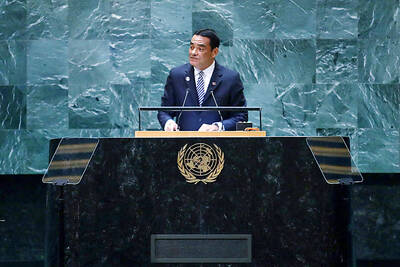
RIGHT TO DIPLOMACY: Under the UN Charter, every state has the right to conduct foreign policy free from external pressure, Belize said in a statement Belize and Paraguay on Monday condemned Beijing sanctions over their countries’ ties with Taiwan, saying China’s actions create unnecessary tensions. Earlier on Monday, Beijing announced sanctions against Paraguayan Minister of Information and Communication Technologies Gustavo Villate and Belizean Minister of Foreign Affairs Francis Fonseca. The Paraguayan Ministry of Foreign Affairs said it rejected the sanctions, writing on X that they created unnecessary friction. It added that it reaffirmed its support for Taiwan and its commitment to democratic values and principles. Villate told the Spanish-language Paraguayan daily ABC Color the sanctions were “predictable” and linked them to several cooperation projects between Taiwan and Paraguay. The projects


 RSS
RSS