


Four people were killed and four injured yesterday when a steel girder suspended over an MRT construction site in Taichung fell and crushed a car.
The female driver, Su Chia-chen (蘇家蓁), was rushed to the hospital, but was later declared dead.
The three other casualties — Hsieh Kuang-hui (謝光輝), Tu Ya-yu (杜亞有) and Liang Hsiao-kai (梁孝凱) — were construction workers.
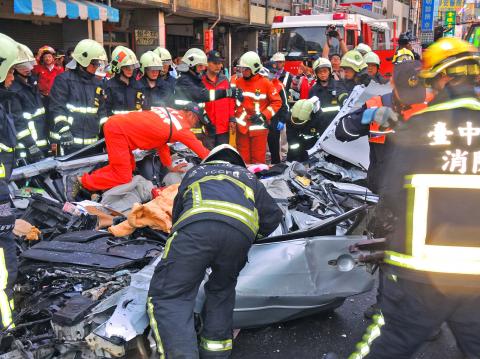
Photo: Lin Liang-sheng, Taipei Times
Injured construction workers Chen Kuan-chi (陳冠吉), Lin Chao-ching (林朝卿), Hsieh Cheng-chia (謝政家) and Chiu Chen-jung (邱振榮) were still in local hospitals at press time last night.
The accident occurred at an elevated section of the Taichung MRT’s Green Line, near the intersection of Beitun Road and Wensin Road, at about 5pm.
Traffic controls in the surrounding areas had been in place nightly for the past few days due to crane and hoist operations at the construction site, the authorities said.
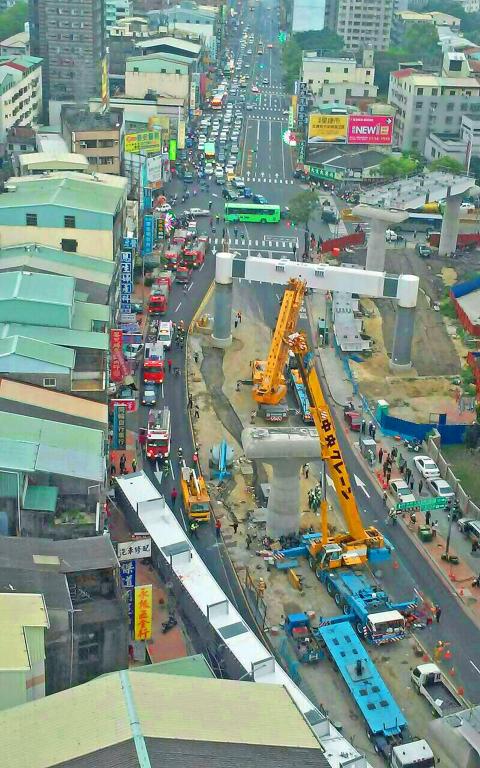
Photo: Hsu Kuo-chen, Taipei Times
However, a driver who narrowly escaped the disaster said there was no traffic control at the site at the time of the accident, adding that the girder was unbalanced and shaking, raining debris on vehicles in the street.
The girder, 43m in length and weighing 209 tonnes, fell on the car just in front of his, and he sped from the site as soon as he saw the structure falling, the driver said.
Taipei Deputy Mayor Charles Lin (林欽榮) contacted Taichung Deputy Mayor Lin Ling-shan (林陵三) and dispatched Taipei Department of Rapid Transit Systems Deputy Commissioner Fu Shih-chih (傅式治) to help the Taichung authorities respond to the accident.
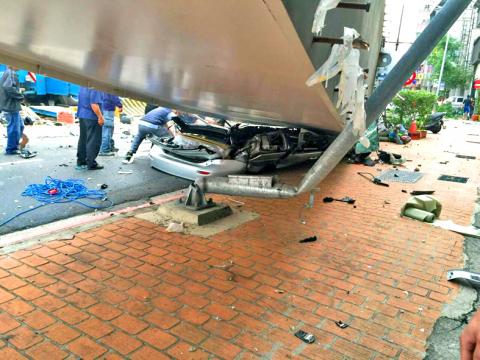
Photo: CNA
Ministry of Labor Affairs official Chu Chin-lung (朱金龍) said the accident may have occurred when a construction company was installing the girder and the tow truck released the cables on the girder before it was in place.
The swaying and the fact that it was not in the right location caused the girder to tilt to one side and fall, Chu said.
When asked whether the construction company had complied with work safety regulations and was working at the appropriate time, Chu said that under the circumstances, even placing barriers around the work place would not have helped prevent injuries, but that the timing of the hoist operation was inappropriate.
It is not appropriate to be installing girders during rush hour, Chu said, adding that he had ordered a halt to construction until the construction company submits a report on how to improve work safety conditions.
While there has been speculation that the incident happened because the contractor was rushing construction work at the request of Taichung Mayor Lin Chia-lung (林佳龍), the city government released a statement denying that the incident had anything to do with the mayor’s request to finish the MRT line earlier.
Lin said he would cut short his official visit to South Korea and return as soon as possible.
While visiting the injured at area hospitals, Deputy Taichung Mayor Chang Kuang-yao (張光瑤) apologized on behalf of the city government, adding that the city would find out who was responsible and work to prevent similar accidents.
Presidential Office spokesman Charles Chen (陳以信) said that the Presidential Office was concerned about the incident and has instructed the Executive Yuan to offer the municipal government any aid necessary.

A signaling system malfunction disrupted high-speed rail (HSR) services beginning at 8am today, with trains temporarily reduced to three northbound and three southbound trains per hour as authorities conduct inspections. The malfunction occurred on a section of track in Miaoli County during pre-operation checks early this morning, forcing northbound and southbound trains to use a single track, the HSR operator said. The regular schedule has been replaced with three hourly trains offering only nonreserved seating in each direction, stopping at every station, it said, adding that business class cars would still have reserved seating. Departures from terminal stations are scheduled at the top

Taiwan is still in the process of assessing the possibility of recruiting workers from Eswatini, the Ministry of Foreign Affairs said yesterday, adding that its goal is to help Eswatini upgrade its vocational training centers. If there are plans to recruit workers from Eswatini, safeguarding national security, protecting public health and ensuring the employment rights of Taiwanese would be prerequisites, Department of West Asian and African Affairs Director-General Yen Chia-liang (顏嘉良) told a news conference. Key considerations would also include filling labor shortages in specific industries, and fostering bilateral professional and technical exchanges, he said. Yen was asked about the progress of labor

A US uncrewed surface vessel (USV) encountered multiple Chinese warships during an autonomous transit of the Taiwan Strait, US defense company Seasats said in a statement on Wednesday. Seasats announced that a Lightfish USV had completed the first autonomous transit of the Taiwan Strait. Over five days, the USV traversed the entire length of the Strait while constantly monitoring surface vessel traffic, the company said. The Lightfish encountered multiple Chinese warships, one of which was a Chinese People’s Liberation Army Navy (PLAN) Type 056 corvette, it said. The Chinese vessels were operating “well within Taiwan’s exclusive economic zone without transmitting their identity via the

VERBOSE VESSELS: A CGA cutter and a China Coast Guard exchanged verbal barbs for more than a day in Taiwanese-controlled waters before the Chinese vessel left The Taiwanese and Chinese coast guards had a standoff near the strategically located Pratas Islands (Dongsha Islands, 東沙群島) in the north of the South China Sea, the Coast Guard Administration (CGA) said yesterday. The two sides engaged in intense radio exchanges over sovereignty claims during the 33-hour standoff. China Coast Guard vessel 3501 eventually left the restricted waters, 26.6 nautical miles (49.2km) west of the Pratas Islands, at 5pm yesterday, the CGA said. Lying approximately between southern Taiwan and Hong Kong, the Taiwan-controlled Pratas are seen by some security experts as vulnerable to Chinese attack due to their distance — more than


 RSS
RSS