


Investigation bureau agents yesterday raided the homes of two — one active and one retired — air force pilots allegedly recruited by a Chinese intelligence officer in a case described as the largest Chinese spy ring to have operated in Taiwan in recent years.
A preliminary investigation showed that a retired deputy commander of the Republic of China’s Air Force Academy’s flight training section surnamed Ke (葛) had been offered free trips to Southeast Asia by Zhen Xiaojiang (鎮小江), a Chinese intelligence officer, in exchange for confidential military information, the Taipei District Prosecutors’ Office said.
The trips took place between 2009 and 2013 before Ke’s retirement.
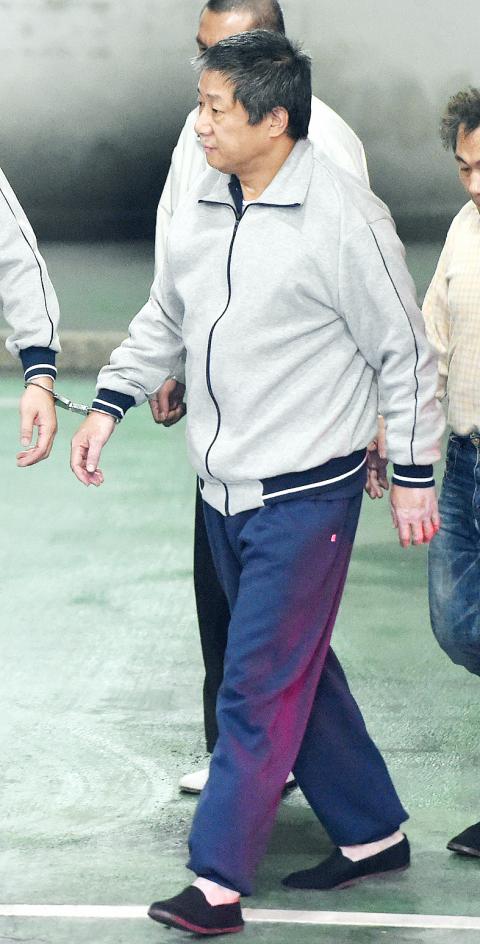
Photo: Liao Chen-huei, Taipei Times
“During that period, Ke provided confidential air force intelligence information to other Chinese intelligence officers introduced by Zhen at places outside of Taiwan and China,” prosecutors said.
Following his retirement, Ke persuaded his former colleague, a lieutenant colonel surnamed Lou (樓) who is the deputy director of the flight training section, to join the spy network set up by Zhen in Taiwan, they said.
Ke and Lou were brought in for questioning yesterday on suspicion of violating the National Security Act (國家安全法). Three witnesses were also present.
Zhen, a former People’s Liberation Army officer, was arrested in Taiwan in September last year.
He is accused of offering several retired Taiwanese military officers trips to Vietnam, Thailand, South Korea and Japan.
He also allegedly arranged many dinner meetings between the military officers and Chinese intelligence personnel outside of Taiwan, during which the latter obtained information on the Mirage 2000 aircraft, the ultra-high-frequency radar installation on Leshan (樂山) in Hsinchu County and on Taiwan’s advanced military technology and newly procured weaponry.
Zhen was indicted in January, along with five Taiwanese military officers — including former army major general Hsu Nai-chuan (許乃權), air force colonel Chou Chih-li (周自立), air force pilot Sung Chia-lu (宋嘉祿) and air force official Yang Jung-hua (楊榮華), — and Lee Huan-yu (李寰宇), a Kaohsiung nightclub operator.
The case is being tried at the Taipei District Court.
Prosecutors said Zhen is the first Chinese spy to be arrested in Taiwan in recent years, adding that his espionage ring is believed to include more than 10 Taiwanese military officers.
Ministry of National Defense spokesman Major General David Lo (羅紹和) told an impromptu press conference yesterday that the ministry would fully cooperate with prosecutors in the investigation.
He refused to comment on the probe, citing confidentiality.
“Given that the case revolving around Zhen originated from a tipoff received by the ministry’s public security division, it indicates the effectiveness of the army’s national security endeavors,” Lo said, adding that the ministry would step up its efforts to instill patriotism in soldiers.
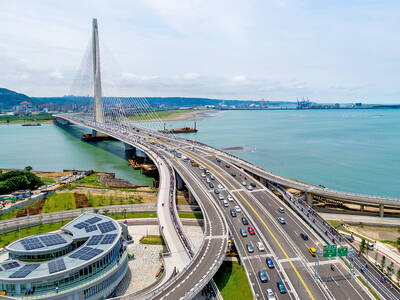
The Ministry of Transportation and Communications yesterday inaugurated the Danjiang Bridge across the Tamsui River in New Taipei City, saying that the structure would be an architectural icon and traffic artery for Taiwan. Feted as a major engineering achievement, the Danjiang Bridge is 920m long, 211m tall at the top of its pylon, and is the longest single-pylon asymmetric cable-stayed bridge in the world, the government’s Web site for the structure said. It was designed by late Iraqi-British architect Zaha Hadid. The structure, with a maximum deck of 70m, accommodates road and light rail traffic, and affords a 200m navigation channel for boats,
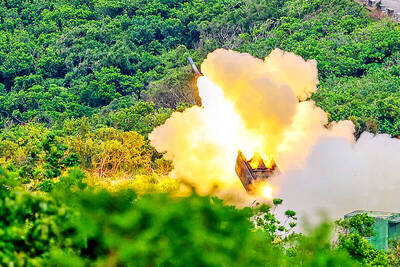
PRECISION STRIKES: The most significant reason to deploy HIMARS to outlying islands is to establish a ‘dead zone’ that the PLA would not dare enter, a source said A High Mobility Artillery Rocket System (HIMARS) would be deployed to Penghu County and Dongyin Island (東引) in Lienchiang County (Matsu) to force the Chinese military to retreat at least 100km from the coastline, a military source said yesterday. Taiwan has been procuring HIMARS and Army Tactical Missile Systems (ATACMS) from the US in batches. Once all batches have been delivered, Taiwan would possess 111 HIMARS units and 504 ATACMS, which have a range of 300km. Considering that “offense is the best defense,” the military plans to forward-deploy the systems to outlying islands such as Penghu and Dongyin so that

Taiwan Semiconductor Manufacturing Co (TSMC, 台積電), the world’s largest foundry service provider, yesterday said that global semiconductor revenue is projected to hit US$1.5 trillion in 2030, after the figure exceeds US$1 trillion this year, as artificial intelligence (AI) demand boosts consumption of token and compute power. “We are still at the beginning of the AI revolution, but we already see a significant impact across the whole semiconductor ecosystem,” TSMC deputy cochief operating officer Kevin Zhang (張曉強) said at the company’s annual technology symposium in Hsinchu City. “It is fair to say that in the past decade, smartphones and other mobile devices were

‘CLEAR MESSAGE’: The bill would set up an interagency ‘tiger team’ to review sanctions tools and other economic options to help deter any Chinese aggression toward Taiwan US Representative Young Kim has introduced a bill to deter Chinese aggression against Taiwan, calling for an interagency “tiger team” to preplan coordinated sanctions and economic measures in response to possible Chinese military or political action against Taiwan. “[Chinese President] Xi Jinping [習近平] has directed the People’s Liberation Army to be ready to invade Taiwan by 2027. China has a plan. America should have one too,” Kim said in a news release on Thursday last week. She introduced the “Deter PRC [People’s Republic of China] aggression against Taiwan act” to “ensure the US has a coordinated sanctions strategy ready should


 RSS
RSS