


China’s foreign minister yesterday defended his government’s controversial policy of reclaiming land on disputed isles in the South China Sea, which has sparked regional concern, saying Beijing was not seeking to overturn the international order.
Last year, Chinese President Xi Jinping (習近平) tried to set Southeast Asian minds at ease over the country’s ambitions, but Beijing’s reclamation work on the Spratly Islands (Nansha Islands, 南沙群島) underscores its drive to push claims in the South China Sea and reassert its rights.
China claims about 90 percent of the South China Sea, displaying its reach on official maps with a so-called “nine-dash line” that stretches deep into the maritime heart of Southeast Asia.
Taiwan, Vietnam, the Philippines, Malaysia and Brunei also have claims to parts of the potentially energy-rich waters that are crossed by key global shipping lanes.
China has already undertaken reclamation work on six other reefs it occupies in the Spratlys, expanding land mass fivefold, aerial surveillance photos show. Images last year appeared to show an airstrip and sea ports.
The work on the islands has become possibly the most visible sign of Xi’s more muscular form of diplomacy, even as he promises more than US$120 billion in funds for Africa, Southeast Asia and Central Asia.
Speaking at his annual news conference on the sidelines of the ongoing meeting of parliament, Chinese Minister of Foreign Affairs Wang Yi (王毅) said China was undertaking “necessary” construction that was not aimed at any third party.
“We are not like some countries, which have carried out ‘illegal building’ in other people’s homes, and we won’t accept unwarranted remarks about work on our own home,” he said, in apparent criticism of building by some other claimant states.
China’s stance has stoked fears in Washington, Tokyo and some Southeast Asian capitals that Beijing is increasingly trying to play by its own rules and ignore international norms, as Xi seeks a global position commensurate with China’s new economic power.
Wang said he believes that the current system needs to be updated rather than overturned, to give more say to developing countries, comparing the international order and system built around the UN to a big boat.
“Today we are in this boat, together with more than 190 other countries. So of course we don’t want to upset the boat, rather we want to work with other passengers to make sure this boat will sail forward steadily and in the right direction,” he said.

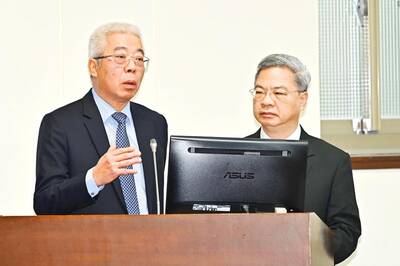
Taiwan has arranged for about 8 million barrels of crude oil, or about one-third of its monthly needs, to be shipped from the Red Sea this month to bypass the Strait of Hormuz and ease domestic supply pressures, CPC Corp, Taiwan (CPC, 台灣中油) said yesterday. The state-run oil company has worked with Middle Eastern suppliers to secure routes other than the Strait of Hormuz, through which about 20 percent of the world’s oil and liquefied natural gas typically passes, CPC chairman Fang Jeng-zen (方振仁) said at a meeting of the legislature’s Economics Committee in Taipei. Suppliers in Saudi Arabia have indicated they
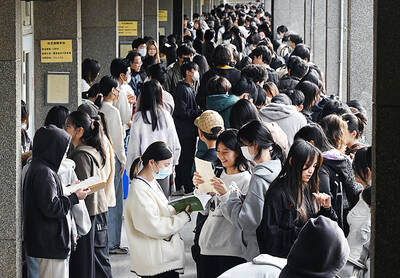
A global survey showed that 60 percent of Taiwanese had attained higher education, second only to Canada, the Ministry of the Interior said. Taiwan easily surpassed the global average of 43 percent and ranked ahead of major economies, including Japan, South Korea and the US, data from the Organisation for Economic Co-operation and Development (OECD) for 2024 showed. Taiwan has a high literacy rate, data released by the ministry showed. As of the end of last year, Taiwan had 20.617 million people aged 15 or older, accounting for 88.5 percent of the total population, with a literacy rate of 99.4 percent, the data

CCP ‘PAWN’? Beijing could use the KMT chairwoman’s visit to signal to the world that many people in Taiwan support the ‘one China’ principle, an academic said Chinese Nationalist Party (KMT) Chairwoman Cheng Li-wun (鄭麗文) yesterday arrived in China for a “peace” mission and potential meeting with Chinese President Xi Jinping (習近平), while a Taiwanese minister detailed the number of Chinese warships currently deployed around the nation. Cheng is visiting at a time of increased Chinese military pressure on Taiwan, as the opposition-dominated Legislative Yuan stalls a government plan for US$40 billion in extra defense spending. Speaking to reporters before going to the airport, Cheng said she was going on a “historic journey for peace,” but added that some people felt uneasy about her trip. “If you truly love Taiwan,

NEW LOW: The council in 2024 based predictions on a pessimistic estimate for the nation’s total fertility rate of 0.84, but last year that rate was 0.69, 17 percent lower An expected National Development Council (NDC) report expects the nation’s population to drop below 12 million by 2065, with the old-age dependency ratio to top 100 percent sooner than 2070, sources said yesterday. The council is slated to release its latest population projections in August, using an ultra-low fertility model, the sources said. The previous report projected that Taiwan’s population would fall to 14.37 million by 2070, but based on a new estimate of the total fertility rate (TFR) — the average number of children born to a woman over her lifetime — the population is expected to reach 12 million by


 RSS
RSS