


Despite drizzling weather, more than 1,000 demonstrators rallied on Jinan Road outside the Legislative Yuan in Taipei last night to support calls for reforms to the nation’s electoral policies, while also expressing their dissatisfaction toward what they say is the government’s failure to respond to demands made during the Sunflower movement.
Entitled “Blasting Jinan Road with Roars of Anger” (怒吼炸濟南) to signify participants’ outrage, the rally was launched by a coalition of civic groups, including many youth political movements that bloomed after the Sunflower movement.
Primary organizers — Taiwan March, Taiwan Inversion and the Appendectomy Project — called on the public to support three campaigns: A petition to reform the Referendum Act (公民投票法) to ensure channels for direct democracy; increased public scrutiny of candidates from political families running in the Nov. 29 nine-in-one elections; and support for a recall effort directed at three Chinese Nationalist Party (KMT) legislators on election day.
Public appearances by prominent Sunflower movement activists galvanized the crowd, including student leaders Lin Fei-fan (林飛帆) and Chen Wei-ting (陳為廷), Academia Sinica researcher Huang Kuo-chang (黃國昌) and human rights lawyer Lai Chung-chiang (賴中強).
Huang lambasted President Ma Ying-jeou’s (馬英九) recent remarks in an interview with the New York Times, in which the president voiced his support for Hong Kong’s pro-democracy movement, but condemned Taiwanese students for delaying progress in the cross-strait trade services agreement and what he said was violence.
“Only through direct democracy can the people give politicians such as Ma a lesson,” Huang said, urging supporters to support Taiwan March’s petition to reform the Referendum Act.
“When representative democracy loses its effectiveness, we need to reclaim our constitutional rights for direct democracy,” Huang said, adding that the group plans to set up stands around the nation to collect signatures on the day of the elections.
The activists demanded that the voter turnout threshold in the act be lowered. Currently, a 50 percent voter turnout is required in order for a referendum to take effect.
At one point during the rally, DJ Andy Lau (青錡) stirred up the sign-waving crowd by playing electronic music mixed with soundbites and slogans from past protests.
Several other activist musicians and bands also preformed throughout the night, including punk band Fire-EX.
Urda Yen (嚴婉玲), a member of Taiwan Inversion — a movement with the aim of raising the quality of Taiwanese politics — said local politics were often controlled by hereditary political families, and called on the public to initiate change.
“When candidates from political families who are in their 20s run for office, it’s not because they have political ideals, but merely because their families give them more political resources” Yen said, urging the public to participate in an online vote to determine the “top 10 dominant political families” in the nation.
The Appendectomy Project called on supporters to back their recall campaign against three KMT lawmakers — Lin Hung-chih (林鴻池), Wu Yu-sheng (吳育昇) and Alex Tsai (蔡正元), who also serves as KMT Taipei mayoral candidate Sean Lien’s (連勝文) campaign director.
Covered in his signature surgeon’s cap and surgical mask, the project’s representative, known as Mr Lin From Taipei (台北林先生), said the campaign hopes to initiate the first recall vote in Taiwan in 20 years, with a signature collection to be launched on Nov. 29 to coincide with nine-in-one elections.
The name “Appendectomy Project” was chosen for both the group and the recall campaign because in Mandarin Chinese, the term for blue-camp legislators, lan wei (藍委) is pronounced the same as “appendix” (闌尾).
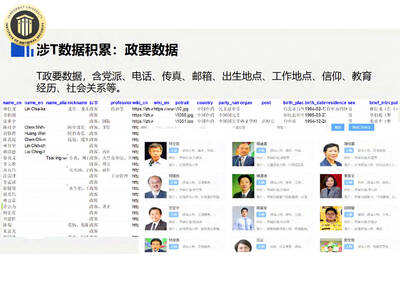
NETWORK-MAPPING PROJECT: The database contains 170 detailed files of Taiwanese politicians and about 23 million records of household registration data in Taiwan China has developed a network-mapping project targeting political figures and parties in Taiwan to monitor public opinion during elections and to craft tailored influence campaigns aimed at dividing Taiwanese society, according to documents leaked by Chinese technology firm GoLaxy (中科天璣). The documents, collected by Taipei-based Doublethink Lab, showed a database was specifically created to gather detailed information on Taiwanese political figures, including their political affiliations, job histories, birthplaces, residences, education, religion and a brief biography about them. Several notable Taiwanese politicians are in the database, including President William Lai (賴清德), former president Tsai Ing-wen (蔡英文), Minister of Foreign Affairs Lin Chia-lung (林佳龍),
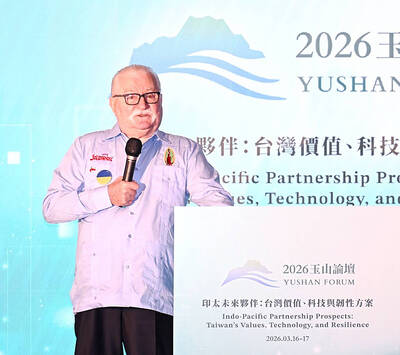
RECOGNITION: Former Fijian prime minister Mahendra Chaudhry said that Taiwan’s New Southbound Policy serves as a stabilizing force in the Indo-Pacific region Taiwan can lead the unification of the Chinese people, Nobel Peace Prize laureate and former Polish president Lech Walesa said in Taipei yesterday, adding that as the world order is changing, peaceful discussion would find good solutions, and that the use of force and coercion would always fail. Walesa made the remarks during his keynote address at a luncheon of the Yushan Forum in Taipei, titled “Indo-Pacific Partnership Prospects: Taiwan’s Values, Technology and Resilience,” organized by the Taiwan-Asia Exchange Foundation with the Ministry of Foreign Affairs. Walesa said that he had been at the forefront of a big peaceful revolution and “if
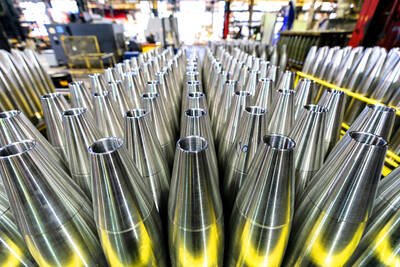
UPGRADED MISSILE: The Chungshan Institute of Science and Technology is reportedly to conduct a live-fire test of the Hsiung Feng III anti-ship missile on Thursday next week The US Army is planning to build new facilities to boost explosives production and strengthen its supply chain, a move aimed at addressing munitions shortages and supporting obligations to partners including Taiwan, Ukraine and Israel, Defense News reported. The army has issued a sources sought notice for a proposed Center of Excellence at the Blue Grass Army Depot in Kentucky, the report said. The facility would serve as a hub within the US industrial base for the production of key military explosives, including research department explosives (RDX) and high melting explosives (HMX), while also supporting research and development of next-generation materials. The proposed
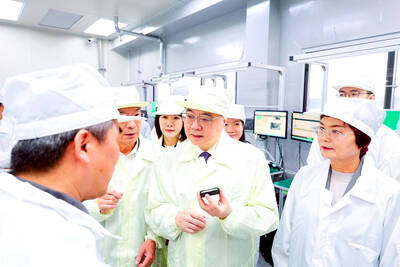
KEY INDUSTRY: The vice premier discussed a plan to create a non-red drone supply chain by next year, which has been allocated a budget of more than NT$7.2 billion The government has budgeted NT$44.2 billion (US$1.38 billion) to cultivate Taiwan’s uncrewed aerial vehicle (UAV) industry over the next five years, which would make the nation a major player in the industry’s democratic supply chain in the Asia-Pacific region, Premier Cho Jung-tai (卓榮泰) said yesterday. Cho made the remarks during a visit to the facilities of Cub Elecparts Inc (為升電裝). Democratic Progressive Party (DPP) Legislator Chen Su-yueh (陳素月) and Chinese Nationalist Party (KMT) Legislator Hsieh Yi-fong (謝依鳳) also participated in the trip. Cub Elecparts has transitioned from the automotive industry to the defense industry, which is the top priority among the nation’s


 RSS
RSS