


Democratic Progressive Party (DPP) legislators yesterday said that the Ministry of Health and Welfare has been covering up for immoral businesspersons. They cited as evidence its lack of action after receiving confirmation that Vietnam-based oil manufacturer Dai Hanh Phuc Co (大幸福公司) was exporting animal-feed-grade products to Ting Hsin Oil and Fat Industrial Co (頂新製油實業).
DPP Legislator Chen Chi-mai (陳其邁) said that as early as on Oct. 9, Taiwan’s representative office in Vietnam told the ministry that the oil exported by Dai Hanh Phuc to Taiwan was intended for use in animal fodder, but the ministry started offloading oils made by Ting Hsin only on Oct 22. Further, it waited until Friday last week to say that 110 tonnes of oil bought from Ting Hsin by oil and fat producer President Nisshin Corp (統清), a subsidiary of Uni-President Enterprises Corp (統一企業), was coconut oil intended for animal feed.
Chen said that the ministry knew that President Nisshin had bought the coconut oil from Ting Hsin, but had not announced that detail until the firm had processed the oil and sold its products to Uni-President Enterprises.
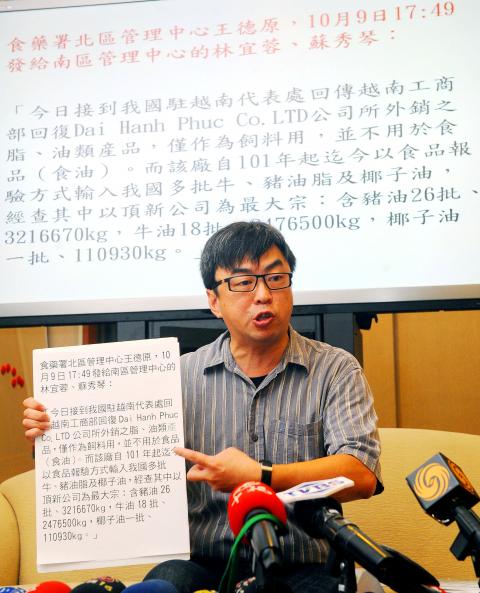
Photo: Wang Min-wei, Taipei Times
“If this is not a cover-up, then what is?” Chen said.
Referring to comments made by the ministry on Oct. 11, saying that it had not received a response from Vietnam about whether the oils were questionable, DPP Legislator Tuan Yi-kang (段宜康) said: “Why, then, did the ministry on Oct. 22 order the tallow products off the shelves as a ‘preventative’ measure?”
“If the ministry ordered companies to get rid of the products, it means the ministry feels that all products made with Dai Hanh Phuc oils are questionable. Why, then, did it take the ministry three weeks to announce that the 110 tonnes of oil bought from Ting Hsin by President Nisshin was also problematic?” Tuan said, adding that the ministry’s supposed investigation during the time period was an attempt to cover for Ting Hsin.
In response, the Food and Drug Administration (FDA) issued a press release later yesterday dismissing the allegations that it had covered up for Ting Hsin in its investigation into the latest cooking oil scandal.
“Following the discovery in early September that the lard purchased [by cooking oil manufacturer] Chang Guann Co (強冠企業) from Hong Kong-based Globalway Corp Ltd (金寶運貿易) was animal-feed-grade, the FDA immediately launched an investigation into the nature of all lard oils imported to Taiwan on Sept. 15,” the agency said.
While all imported lard from Japan and Spain were confirmed to be safe for human consumption, the agency said it received a telegram on Oct. 9 from the Taipei Economic and Cultural Office in Hanoi, Vietnam, saying that the oil products exported by Dai Hanh Phuc Co — from which Ting Hsin had purchased 3,216 tonnes of lard in the past three years — were mainly lard and fish oils intended for use as animal feed.
The agency said it then promptly ordered its regional centers and the Changhua County Health Bureau, where Ting Hsin’s factory is based, to find out what happened to oils imported from Dai Hanh Phuc Co, before barring Ting Hsin from processing and selling all cooking oils it procured from Vietnam, including lard, beef tallow and coconut oil, on Oct. 10.
“As the above telegram did not explicitly confirm the nature of the beef tallow and coconut oil purchased by Ting Hsin, and that the company also classified the oils as edible products in the custom declaration forms, the FDA only ordered the recall of its 54 lard-based products on Oct. 11,” the agency said.
Since then, the agency said it had repeatedly urged the Vietnamese office to ascertain whether the two animal oil products were fit for human use.
The agency opted to order a preventative recall of Ting Hsin’s eight beef tallow products on Oct. 22 despite not having received an answer from Vietnam, after Dai Hanh Phuc proprietor Yang Chen-yi (楊振益) reportedly confessed that he had forged the certificate for human consumption for his company’s imported oils, it said.
“The FDA did not receive the long-awaited confirmation until Oct. 27,” it said, adding that it had worked non-stop to seal and remove affected products and had never purposely stalled the investigations or covered up for anyone.
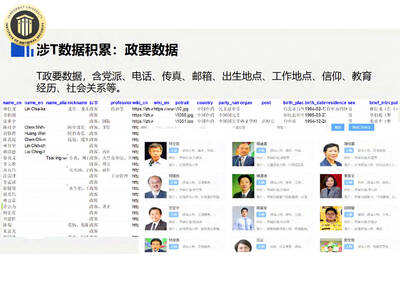
NETWORK-MAPPING PROJECT: The database contains 170 detailed files of Taiwanese politicians and about 23 million records of household registration data in Taiwan China has developed a network-mapping project targeting political figures and parties in Taiwan to monitor public opinion during elections and to craft tailored influence campaigns aimed at dividing Taiwanese society, according to documents leaked by Chinese technology firm GoLaxy (中科天璣). The documents, collected by Taipei-based Doublethink Lab, showed a database was specifically created to gather detailed information on Taiwanese political figures, including their political affiliations, job histories, birthplaces, residences, education, religion and a brief biography about them. Several notable Taiwanese politicians are in the database, including President William Lai (賴清德), former president Tsai Ing-wen (蔡英文), Minister of Foreign Affairs Lin Chia-lung (林佳龍),
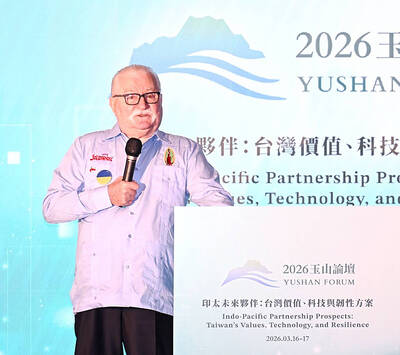
RECOGNITION: Former Fijian prime minister Mahendra Chaudhry said that Taiwan’s New Southbound Policy serves as a stabilizing force in the Indo-Pacific region Taiwan can lead the unification of the Chinese people, Nobel Peace Prize laureate and former Polish president Lech Walesa said in Taipei yesterday, adding that as the world order is changing, peaceful discussion would find good solutions, and that the use of force and coercion would always fail. Walesa made the remarks during his keynote address at a luncheon of the Yushan Forum in Taipei, titled “Indo-Pacific Partnership Prospects: Taiwan’s Values, Technology and Resilience,” organized by the Taiwan-Asia Exchange Foundation with the Ministry of Foreign Affairs. Walesa said that he had been at the forefront of a big peaceful revolution and “if
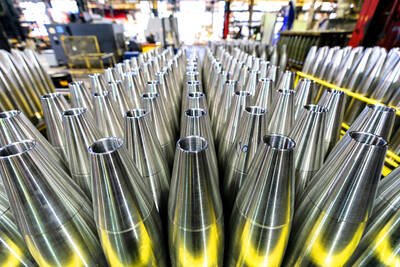
UPGRADED MISSILE: The Chungshan Institute of Science and Technology is reportedly to conduct a live-fire test of the Hsiung Feng III anti-ship missile on Thursday next week The US Army is planning to build new facilities to boost explosives production and strengthen its supply chain, a move aimed at addressing munitions shortages and supporting obligations to partners including Taiwan, Ukraine and Israel, Defense News reported. The army has issued a sources sought notice for a proposed Center of Excellence at the Blue Grass Army Depot in Kentucky, the report said. The facility would serve as a hub within the US industrial base for the production of key military explosives, including research department explosives (RDX) and high melting explosives (HMX), while also supporting research and development of next-generation materials. The proposed
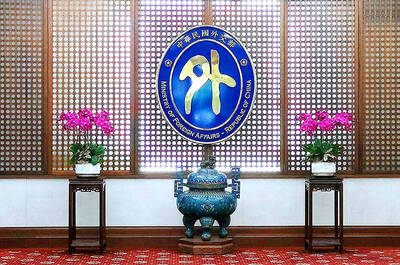
SOUTH KOREA DISPUTE: If Seoul continues to ignore its request, Taiwan would change South Korea’s designation on its arrival cards, the foreign ministry said If South Korea does not reply appropriately to a request to correct Taiwan’s name on its e-Arrival card system before March 31, the government would take corresponding measures to change how South Korea is labeled on the online Taiwan Arrival Card system, the Ministry of Foreign Affairs said yesterday. South Korea’s e-Arrival card system lists Taiwan as “China (Taiwan)” in the “point of departure” and “next destination” fields. Taipei has asked Seoul to change the wording. Since March 1, South Koreans who hold government-issued Alien Resident Certificates (ARC) have been identified as from “South Korea” rather than the “Republic of Korea,” the


 RSS
RSS