


The Executive Yuan’s Food Safety Office was officially launched yesterday.
The agency is to be supervised by newly appointed Minister of Health and Welfare Chiang Been-huang (蔣丙煌), who was sworn in yesterday, and has a prosecutor from the Taiwan High Prosecutors’ Office stationed to streamline communications with investigators on food safety.
The office is a standing body with between 20 and 25 full-time staff members, who have been transferred from the Ministry of the Interior, the Ministry of Economic Affairs, the Ministry of Health and Welfare, the Ministry of Justice and the Council of Agriculture, according to the Executive Yuan.
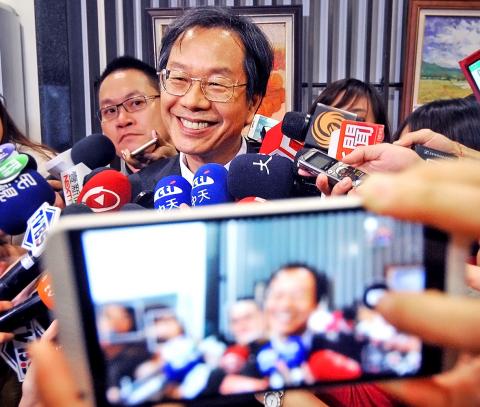
Photo: Fang Pin-chao, Taipei Times
Five people from a team tasked with building a food cloud within the Executive Yuan’s Board of Science and Technology have also been dispatched to support the new office.
Four teams — responsible for inspections and the enforcement of food safety regulations; running an information platform; management and coordination; and emergency-response and communication respectively — have been set up at the office.
Chiang is to supervise the operation of the office, while Food and Drug Administration Risk Management Director Tsai Shu-chen (蔡淑貞) has been appointed office deputy director (currently acting director), and Tsai Meng-lun (蔡孟倫), an adviser at the Executive Yuan’s Department of the Interior, Health, Welfare and Labor, is to serve as another deputy director.
“There are [various ministries and government agencies] on the front line battling food-related violations, but in the rear, you need something like a General Staff Headquarters, in charge of integration, coordination and command, and the Food Safety Office is exactly it,” Chiang said.
Prosecutor Tseng Chiun-che (曾俊哲) of the Taiwan High Prosecutors’ Office is to be the office-stationed prosecutor for the coordination of food inspections carried out by district prosecutors’ offices. Tseng was commended in 2012 for his investigation of a case involving plasticizer-tainted beverages.
“The Ministry of Health and Welfare, Council of Agriculture and many agencies are involved in the food-safety safeguarding effort, but in the end, you need the Ministry of Justice and prosecutors to conduct investigations. So if the office has [a prosecutor] stationed in it, the communication between the prosecution and investigation units and us will be smoother. And as inspection is key to [food safety], we will need their help for that as well,” Chiang said.
Later yesterday at a handover ceremony where he assumed office as health minister, Chiang pledged to restore the nation’s tarnished reputation for food and the public’s faith in the food industry.
“I have to admit that it is a tremendous challenge to take the helm of the ministry at a time when the nation has been repeatedly battered by a string of food scares, which have not only shaken people’s confidence in the nation’s food safety, but also crippled our booming food industry and damaged our international image as the paradise of delicacies,” Chiang said.
Chiang said food safety is a complex issue that requires the concerted efforts of all relevant government agencies, rather than the ministry’s alone, which is the main reason behind the Executive Yuan founding the inter-ministerial Food Safety Office yesterday.
Although food safety is undoubtedly the new minister’s top priority, he said there are many more issues that demand his attention, ranging from the Ebola epidemic in West Africa and a dengue fever outbreak in the south to the second-generation National Health Insurance system and the establishment of a sustainable long-term healthcare system.
As for some people’s doubts about his qualifications to lead the ministry, given his lack of a medical background, Chiang said: “No one in the world is born omnipotent. At least I have a great team of experts behind me.”
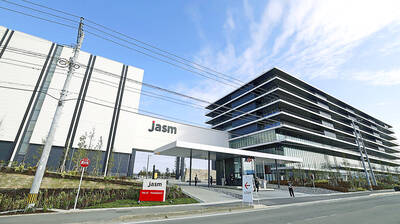
The subsidiary of Taiwan Semiconductor Manufacturing Co (TSMC, 台積電) in Kumamoto, Japan, turned a profit in the first quarter of this year, marking the first time the first fab of the unit has become profitable since mass production started at the end of 2024. According to the contract chipmaker’s financial statement released on Friday, Japan Advanced Semiconductor Manufacturing Inc (JASM), a joint venture running the fab in Kumamoto, posted NT$951 million (US$30.19 million) in profit in the January-to-March period, compared with a loss of NT$1.39 billion in the previous quarter, and a loss of NT$3.25 billion in the first quarter of
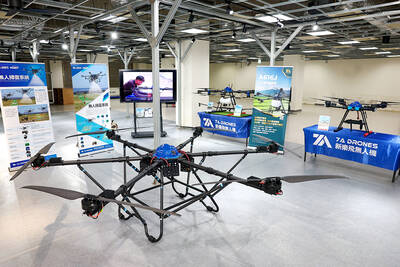
DRONE CENTRAL: Taiwan aims to become Asia’s democratic hub for drones, with most exports focused on high-quality military-grade models, an official said Taiwan’s drone industry is expected to expand significantly by 2030, producing 100,000 units per month and exporting half of them, the Ministry of Economic Affairs said yesterday. Current drone production capacity is about 15,000 units per month, but the industry can quickly scale up as demand increases, Industrial Development Administration Director-General Chiou Chyou-huey (邱求慧) told a news conference in Taipei. Taiwan’s drone output grew 2.5-fold last year to NT$12.9 billion (US$408.3 million) under a government program to develop the uncrewed vehicle sector, he said. The Executive Yuan in October last year approved plans to invest NT$44.2 billion into domestic production of uncrewed aerial
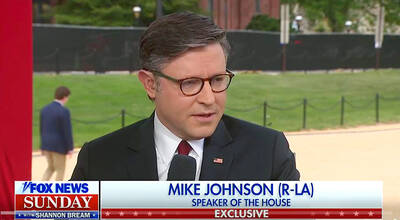
RESOLUTE BACKING: Two Republican senators are planning to introduce legislation that would impose immediate sanctions on China if it attempts to invade Taiwan US House of Representatives Speaker Mike Johnson on Sunday reaffirmed US congressional support for Taiwan, saying the US and “all freedom-loving people” have a stake in preventing China from seizing Taiwan by force. Johnson made the remarks in an interview with Fox News Sunday on US President Donald Trump’s summit with Chinese President Xi Jinping (習近平) last week. In an interview that aired on Friday on Fox News, just as Trump wrapped up a high-stakes visit to China, he said he has yet to green-light a new US$14 billion arms package to Taiwan and that it “depends on China.” “It’s a very good
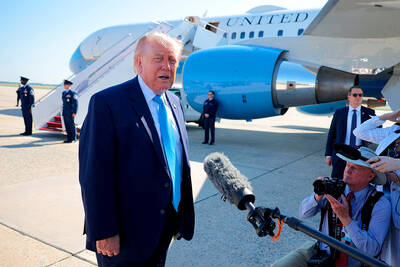
US President Donald Trump yesterday said he would speak to President William Lai (賴清德) as his administration considers whether to move ahead with a US$14 billion weapons sale to Taiwan — a potential arms deal that has drawn criticism from China. “Well, I’ll speak to him. I speak to everybody,” Trump told reporters yesterday when asked if he had any plans to call his counterpart, although he did not offer a time frame for when such a conversation could take place. Trump previously said he would speak to the person “that’s running Taiwan,” without specifying who he meant. “We have that situation very


 RSS
RSS