


Premier Jiang Yi-huah (江宜樺) is “the most evil man of banality,” prominent Taiwanese literature academic Yang Tsui (楊翠) said yesterday, amid calls for his resignation from the public and legislators across party lines who accused the premier of bad management of the tainted cooking oil scandal, as well as the damage it has done to exports and the reputation of Taiwanese food.
Yang, whose grandfather is Yang Kui (楊逵), a leading Taiwanese writer best known for the books The Newspaper Boy (送報伕) and The Indomitable Rose (壓不扁的玫瑰花), also accused Jiang of acting heavy-handedly toward student protesters, but appearing unhesitant to give perks to the most prominent oil scandal accused, senior Ting Hsin International Group (頂新集團) executive Wei Ying-chun (魏應充).
Yang Tsui, an associate professor at National Dung Hwa University, said on Facebook yesterday that the prosecutors and the police were “caring and gentle” while searching Wei’s luxury apartment earlier this week, and did not even dare to go into his kitchen. Wei was also not handcuffed when he was taken from a prosecutors’ inquiry session to the court, as is regular practice.
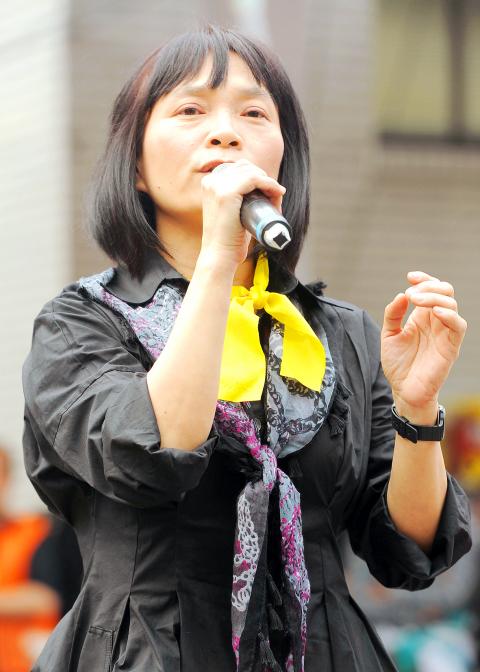
Photo: Wang Min-wei, Taipei Times
Compared with the “gentleness” reserved for Wei, she said, the students in the Sunflower movement who stormed the Executive Yuan were pitilessly handled and arrested, with their wrists scraped by handcuffs. The police even used cable ties to confine students’ movement, “tying [their wrists] dead tight,” said Yang Tsui, who is the mother of one of the Sunflower movement leaders, Dennis Wei (魏揚).
The Chinese Nationalist Party (KMT) government offered a legal basis to justify the opposite treatments of Wei Ying-chun and the students, which Yang Tsui furiously called the “KMT’s arbitrary use, non-use and interpretation of the law.”
A wave of boycotts has hit Ting Hsin’s products and the workers at its subsidiary, Wei Chuan Foods Corp (味全), have voiced concerns over their livelihood, she said, but Jiang has done nothing to safeguard the workers’ rights and has been nonchalant about animosity between consumers and Wei Chuan’s workers.
“Shouldn’t you be demanding compensation from the corporation for the workers? Why are you letting the situation degenerate into a state where the workers’ rights are pitted against consumers’ rights?” Yang Tsui asked the premier.
The government had also allowed a private jet belonging to the Wei (魏) family — Ting Hsin International Group’s founder-owners — to fly to China without hindrance.
“Can you be 100 percent sure that there is no relevant evidence whatsoever on the jet?” Yang Tsui asked.
“What policies in the world has this ‘Executive’ Yuan ‘executed?’” she added.
The phrase “administrating according to the law” that has been repeatedly used by the KMT government now sounds extremely grating, Yang Tsui said.
“The phrase was used when the government strong-armed small families into a deplorable state, such as in a case of land expropriation in [Miaoli County’s] Dapu [Borough, 大埔], but it has also been used to allow the wealthy [accused] to have more time to destroy evidence and hide their assets. The KMT simply has the final say on everything,” she said.
Despite Jiang’s claim that he “abhors evils as deadly foes,” as far as he is concerned, “the students who stand against him are the most evil, while the KMT-supporting Ting Hsin is not,” Yang Tsui said.
He is either the most hypocritical villain or the “most evil man of banality,” she said.
Meanwhile, a number of civic groups were discussing a plan to stage a large-scale demonstration to protest the string of food safety scandals that have occurred under the watch of President Ma Ying-jeou’s (馬英九) administration and what they described as the government’s negligence in reining in businesspeople moving freely across the Taiwan Strait, such as the Wei family.
Taiwan Association of University Professors president Lu Chung-chin (呂忠津) said the Ma administration has been cozying up to China since Ma was elected in 2008, adding that Ting Hsin was allowed to set up its business in Taiwan shortly after Ma came into office.
The recent scandals over food security show that the government is too lenient and protective of these businesspeople who move freely between Taiwan and China, Lu said, calling on Ma and Jiang to take responsibility.
Saying that the public’s ongoing boycott of Ting Hsin products would only solve the problem on the surface, Alliance of Referendum for Taiwan convener Tsay Ting-kuei (蔡丁貴) said that the Ma administration’s cozying up to corporations lay at the root of all the issues.
Additional reporting by Lee Hsin-fang
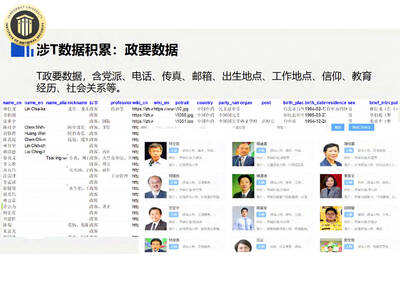
NETWORK-MAPPING PROJECT: The database contains 170 detailed files of Taiwanese politicians and about 23 million records of household registration data in Taiwan China has developed a network-mapping project targeting political figures and parties in Taiwan to monitor public opinion during elections and to craft tailored influence campaigns aimed at dividing Taiwanese society, according to documents leaked by Chinese technology firm GoLaxy (中科天璣). The documents, collected by Taipei-based Doublethink Lab, showed a database was specifically created to gather detailed information on Taiwanese political figures, including their political affiliations, job histories, birthplaces, residences, education, religion and a brief biography about them. Several notable Taiwanese politicians are in the database, including President William Lai (賴清德), former president Tsai Ing-wen (蔡英文), Minister of Foreign Affairs Lin Chia-lung (林佳龍),
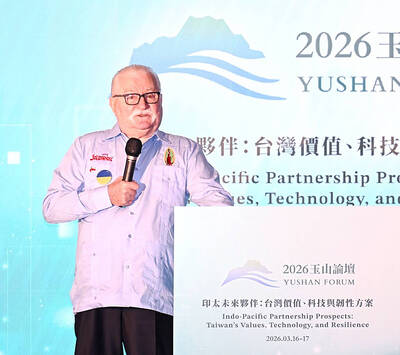
RECOGNITION: Former Fijian prime minister Mahendra Chaudhry said that Taiwan’s New Southbound Policy serves as a stabilizing force in the Indo-Pacific region Taiwan can lead the unification of the Chinese people, Nobel Peace Prize laureate and former Polish president Lech Walesa said in Taipei yesterday, adding that as the world order is changing, peaceful discussion would find good solutions, and that the use of force and coercion would always fail. Walesa made the remarks during his keynote address at a luncheon of the Yushan Forum in Taipei, titled “Indo-Pacific Partnership Prospects: Taiwan’s Values, Technology and Resilience,” organized by the Taiwan-Asia Exchange Foundation with the Ministry of Foreign Affairs. Walesa said that he had been at the forefront of a big peaceful revolution and “if
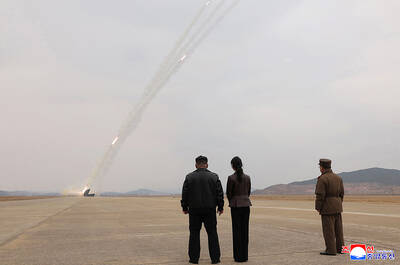
North Korea tested nuclear-capable rocket launchers, state media reported yesterday, a day after Seoul detected the launch of about 10 ballistic missiles. The test comes after South Korean and US forces launched their springtime military drills, due to run until Thursday. North Korean leader Kim Jong-un on Saturday oversaw the testing of the multiple rocket launcher system (MRLS), the Korean Central News Agency (KCNA) said. The test involved 12 600mm-caliber ultra-precision multiple rocket launchers and two artillery companies, it said. Kim said the drill gave Pyongyang’s enemies, within the 420km striking range, a sense of “uneasiness” and “a deep understanding

North Korea yesterday fired about 10 ballistic missiles to the sea toward Japan, the South Korean Joint Chiefs of Staff (JCS) said, days after Pyongyang warned of “terrible consequences” over ongoing South Korea-US military drills. Pyongyang recently dashed hopes of a diplomatic thaw with Seoul, Washington’s security ally, describing its latest peace efforts as a “clumsy, deceptive farce.” Seoul’s military detected “around 10 ballistic missiles launched from the Sunan area in North Korea toward the East Sea [Sea of Japan] at around 1:20pm,” JCS said in a statement, referring to South Korea’s name for the body of water. The missiles


 RSS
RSS