


The Taiwan High Prosecutors’ Office at 6pm yesterday instructed the Taipei District Prosecutors’ Office to issue an order to seize the Taipei assets registered in the name of senior Ting Hsin International Group (頂新集團) executive Wei Ying-chun (魏應充) in connection with his involvement in last year’s Chang Chi Foodstuff Factory Co (大統長基食品公司) cooking oil scandal.
According to officials, the assets include 14 real-estate units, including units in The Palace (帝寶) luxury apartment complex, shares in seven companies and savings in eight financial accounts to an estimated total value of several billion New Taiwan dollars.
Chang Chi Foodstuff was founded in October last year and its chairman, Kao Cheng-li (高振利), was subsequently sentenced after it was found that the firm pawned cheaper oils off as more expensive ones.
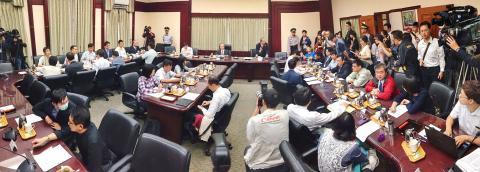
Photo: CNA
The Ting Hsin group’s flagship Wei Chuan Foods Corp (味全食品工業) brand was found to have sold the adulterated oil products for several years.
After an investigation, prosecutors determined that Ting Hsin Oil and Fat Industrial Co (頂新製油實業), which Wei previously led, was selling its adulterated oils to Wei Chuan, which he also led, on a contract basis.
Earlier yesterday, the Taiwan High Prosecutors’ Office convened a meeting with prosecutors from 12 cities and counties, including Keelung, Taipei, New Taipei City, Taoyuan, Greater Taichung, Greater Tainan, Greater Kaohsiung and Pingtung County, who are investigating cases involving tainted oil and other adulterated food products.
An agreement was reached at the meeting to investigate the cases “promptly, on solid footing,” and that suspects are to be brought in wherever the evidence leads, officials said.
After integrating information and establishing the scope of the probe, prosecutors said former Ting Hsin Oil and Fat Industrial Co and Cheng I Food Co chairman Wei Ying-chun (魏應充) is to be summoned for questioning.
Meanwhile, Ministry of Justice Investigation Bureau Director-General Wang Chung-yi (汪忠一) yesterday said his agency was not sure of the whereabouts of the four Wei (魏) brothers, the principal owners and senior executives of Ting Hsin International.
Wang made the remarks in response to Democratic Progressive Party (DPP) Legislator Chen Ming-wen’s (陳明文) queries during a hearing at the legislature’s Foreign Affairs and National Defense Committee.
Chen inquired as to the Wei brothers’ whereabouts and whether they are still in Taiwan.
Wang said his bureau had not been monitoring the brothers’ whereabouts.
“The food scandal and related cases are taken up by district prosecutors. Our bureau only provides support into the investigation,” Wang said.
Meanwhile, in response to DPP Legislator Tsai Huang-liang’s (蔡煌瑯) queries as to whether prosecutors could seize two of Ting Hsin’s private jets that flew to Shanghai and Beijing on Tuesday through cross-strait judicial cooperation, Vice Justice Minister Tsai Pi-yu (蔡碧玉) said that a Taiwan-China agreement on fighting crime will help prevent Ting Hsin International from removing its assets.
Under the Cross-Strait Joint Fight Against Crime and Mutual Legal Assistance Agreement signed in 2009, prosecutors can request that Ting Hsin’s assets be seized if they are moved to China, Tsai Pi-yu said.
She said prosecutors understand the significance and urgency of the investigation into the Ting Hsin group and will collect evidence and take the necessary legal action.
Fears have arisen that the conglomerate could move its assets to China to avoid having them frozen in Taiwan pending investigation into irregularities at their cooking oil plants.
Additional reporting by Chou Ssu-yu
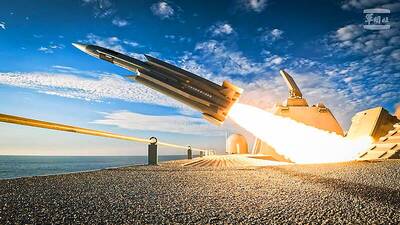
DETERRENCE: With 1,000 indigenous Hsiung Feng II and III missiles and 400 Harpoon missiles, the nation would boast the highest anti-ship missile density in the world With Taiwan wrapping up mass production of Hsiung Feng II and III missiles by December and an influx of Harpoon missiles from the US, Taiwan would have the highest density of anti-ship missiles in the world, a source said yesterday. Taiwan is to wrap up mass production of the indigenous anti-ship missiles by the end of year, as the Chungshan Institute of Science and Technology has been meeting production targets ahead of schedule, a defense official with knowledge of the matter said. Combined with the 400 Harpoon anti-ship missiles Taiwan expects to receive from the US by 2028, the nation would have

North Korea yesterday fired about 10 ballistic missiles to the sea toward Japan, the South Korean Joint Chiefs of Staff (JCS) said, days after Pyongyang warned of “terrible consequences” over ongoing South Korea-US military drills. Pyongyang recently dashed hopes of a diplomatic thaw with Seoul, Washington’s security ally, describing its latest peace efforts as a “clumsy, deceptive farce.” Seoul’s military detected “around 10 ballistic missiles launched from the Sunan area in North Korea toward the East Sea [Sea of Japan] at around 1:20pm,” JCS said in a statement, referring to South Korea’s name for the body of water. The missiles

‘UNWAVERING FRIENDSHIP’: A representative of a Japanese group that co-organized a memorial, said he hopes Japanese never forget Taiwan’s kindness President William Lai (賴清德) yesterday marked the 15th anniversary of the Tohoku earthquake and tsunami, urging continued cooperation between Taiwan and Japan on disaster prevention and humanitarian assistance. Lai wrote on social media that Taiwan and Japan have always helped each other in the aftermath of major disasters. The magnitude 9 earthquake struck northeastern Japan on March 11, 2011, triggering a massive tsunami that claimed more than 19,000 lives, according to data from Japanese authorities. Following the disaster, Taiwan donated more than US$240 million in aid, making it one of the largest contributors of financial assistance to Japan. In addition to cash donations and
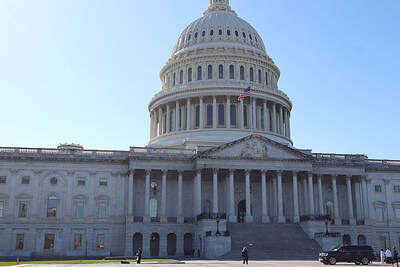
MORE OPTIONS: The bill seeks to ‘harden a critical weak point’ in the Indo-Pacific region by finding ways to diversify and protect Taiwan’s energy infrastructure US Representative Pat Harrigan yesterday introduced the Taiwan Energy Security and Anti-Embargo Act of 2026, saying it would ensure “Taiwan isn’t left vulnerable to supply shocks, coercion by the Chinese Communist Party [CCP], or external geopolitical turmoil.” “Energy is leverage,” Harrigan, a Republican, was quoted as saying in a statement from his office. “Beijing knows exactly where Taiwan is weakest — and global events today, from strikes in the Middle East to threats at chokepoints like the Strait of Hormuz, underscore that energy vulnerability is national security vulnerability.” The bill would authorize the creation of a joint Taiwan-US energy security center to


 RSS
RSS