


Democratic Progressive Party Chairperson Tsai Ing-wen (蔡英文) yesterday said President Ma Ying-jeou (馬英九) forgot that Taiwanese are the “true masters of the nation,” adding that this is why there was not much of a festive atmosphere for Double Ten National Day yesterday.
“There is no atmosphere of festivity and celebration. In recent years, the nation has not been as prosperous as Ma described in his speech,” Tsai said in a statement. “The president has violated the Constitution to serve his own interests and those of the Chinese Nationalist Party [KMT], leaving the government incapable of solving people’s problems and the economy, and leading the nation into chaos.”
“The KMT has forgotten that the people are the masters of the nation,” Tsai said.
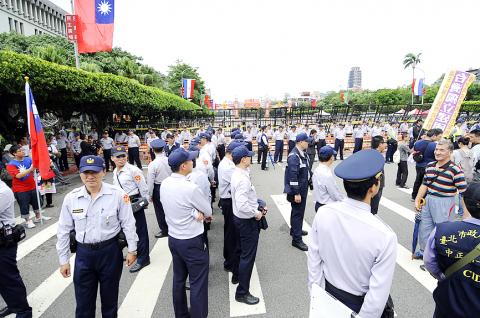
Photo: Chen Chih-chu, Taipei Times
She said that if National Day has to be celebrated, the best way would be “for all people to live happily, and to allow people to live in a society that has freedom and democracy.”
“If the nation’s birthday is indeed worth celebrating, then let us all stand united under the democratic system, together solve any problems that we might encounter, find a good direction for the nation’s future and go through challenges together,” Tsai said.
Separately yesterday, in response to Ma’s speech, Academia Sinica deputy research fellow Huang Kuo-chang (黃國昌), who is involved with the Sunflower movement, panned remarks Ma made saying that Taiwan should serve as a model of democratization for China, Hong Kong and Macau.
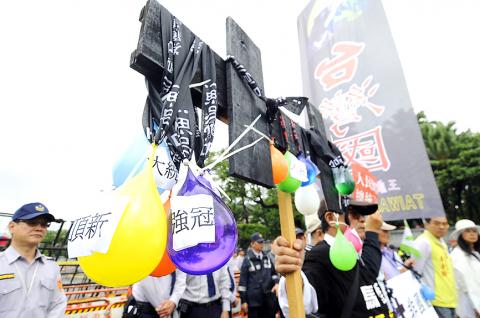
Photo: Chen Chih-chu, Taipei Times
Huang said that while no one, except Beijing, would oppose democratization in China, Hong Kong and Macau, it is ironic when such words come from Ma.
“In the Taiwanese struggle for democracy, Ma not only had zero contribution, but often stood on the opposite side,” Huang said. “He reserved no effort to defend the authoritarian regime and opposed direct elections for president.”
Huang said that since Ma took office in 2008, he has made many moves to compromise the nation’s democracy, including restricting freedom of expression when then-chairman of China’s Association for Relations Across the Taiwan Straits Chen Yunlin (陳雲林) visited Taiwan in 2008; causing last year’s September strife by accusing Legislative Speaker Wang Jin-pyng (王金平) of unduly using his influence; and trying to force the legislature to pass the cross-strait service trade agreement.
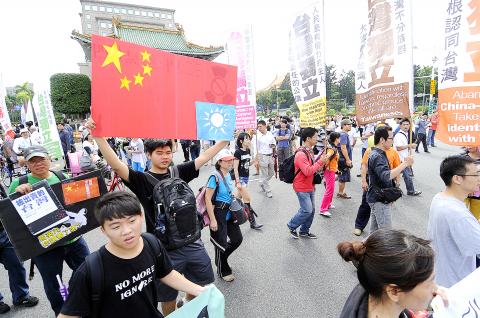
Photo: Chen Chih-chu, Taipei Times
“How could Ma be so shameless as to say he is proud of Taiwan’s democracy?” Huang said. “It is ironic and pretentious for him to call on China to democratize, as he often caters to China at the expense of Taiwan’s democracy and the rule of law, while Hong Kongers are bravely fighting against the Chinese Communist Party for democracy and freedom.”
He said that it might be too severe to say that people should be ashamed of Ma, but Taiwanese should definitely “beware of Ma” for the good of the nation’s future.
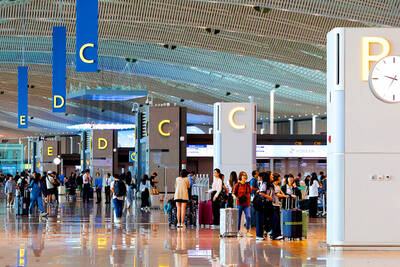
South Korea has adjusted its electronic arrival card system to no longer list Taiwan as a part of China, a move that the Ministry of Foreign Affairs said would help facilitate exchanges between the two sides. South Korea previously listed “Taiwan” as “Taiwan (China)” in the drop-down menus of its online arrival card system, where people had to fill out where they came from and their next destination. The ministry had requested South Korea make a revision and said it would change South Korea’s name on Taiwan’s online immigration system from “Republic of Korea” to “Korea (South),” should the issue not be
The Legislative Yuan’s Finance Committee yesterday approved proposed amendments to the Amusement Tax Act (娛樂稅法) that would abolish taxes on films, cultural activities and competitive sporting events, retaining the fee only for dance halls and golf courses. The proposed changes would set the maximum tax rate for dance halls and golf courses at 50 and 20 percent respectively, with local governments authorized to suspend the levies. Article 2 of the act says that “amusement tax shall be levied on tickets sold or fees charged by amusement places, facilities or activities” in six categories: “Cinema; professional singing, story-telling, dancing, circus, magic show, acrobatics

Tainan, Taipei and New Taipei City recorded the highest fines nationwide for illegal accommodations in the first quarter of this year, with fines issued in the three cities each exceeding NT$7 million (US$220,639), Tourism Administration data showed. Among them, Taipei had the highest number of illegal short-term rental units, with 410. There were 3,280 legally registered hotels nationwide in the first quarter, down by 14 properties, or 0.43 percent, from a year earlier, likely indicating operators exiting the market, the agency said. However, the number of unregistered properties rose to 1,174, including 314 illegal hotels and 860 illegal short-term rental
INFLATION UP? The IMF said CPI would increase to 1.5 percent this year, while the DGBAS projected it would rise to 1.68 percent, with GDP per capita of US$44,181 The IMF projected Taiwan’s real GDP would grow 5.2 percent this year, up from its 2.1 percent outlook in January, despite fears of global economic disruptions sparked by the US-Iran conflict. Taiwan’s consumer price index (CPI) is projected to increase to 1.5 percent, while unemployment would be 3.4 percent, roughly in line with estimates for Asia as a whole, the international body wrote in its Global Economic Outlook Report published in the US on Monday. The figures are comparatively better than the IMF outlook for the rest of the world, which pegged real GDP growth at 3.1 percent, down from 3.3 percent


 RSS
RSS