


Tensions in Hong Kong soared yesterday after police were seen unloading boxes of tear gas and rubber bullets close to the territory’s besieged government headquarters as the authorities urged pro-democracy demonstrators to disperse “as soon as possible.”
Protesters have shut down central areas of the territory with a mass sit-in, including outside the Legislative Council building, and had given Hong Kong Chief Executive Leung Chun-ying (梁振英) until midnight last night to step down, or face escalated action.
China backed the territory’s embattled leader, saying it was behind Leung “firmly and unshakably” and pledged support for the police as protesters prepared for a fifth night on the barricades.
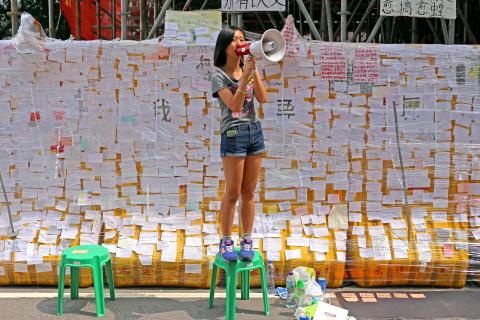
Photo: AFP
Days of peaceful demonstrations have seen tens of thousands of people take over Hong Kong’s usually traffic-heavy streets as they demand Beijing grant fully free elections in the semi-autonomous territory.
Last month, China said Hong Kongers would be able to vote for their next leader in 2017, but only those vetted by a loyalist committee would be allowed to stand — something demonstrators have dismissed as a “fake democracy.”
Hong Kong authorities said yesterday they wanted the streets cleared around the government headquarters, with more than 3,000 civil servants expected to return to the headquarters after a two-day public holiday.
In a statement, officials called on protesters “not to block the access there and to disperse peacefully as soon as possible.”
The late afternoon resupply by police officers caused widespread alarm among protesters as their leaders issued fresh calls for people to swell their ranks.
Pictures shared widely on social media and television showed one barrel with the words “round, 38mm rubber baton multi” written on it. Another had “1.5 in CS” emblazoned on it, a possible reference to CS gas.
The Chinese Communist Party has shown no sign of bowing to protesters’ twin demands. An editorial in party mouthpiece the People’s Daily yesterday warned against chaos in the territory, adding that Beijing supported “the police of the special territory in handling these illegal protests according to the law.”
The demonstrators consider Leung a Beijing stooge and protest leaders wanted yesterday’s ultimatum to be met.
“We will consider having different operating actions in future days, including occupying other places, like important government offices,” said Agnes Chow (周庭) of the student movement Scholarism.
Analysts say it is unlikely that Leung will step down, in what would be a massive loss of face for the establishment.
“If Beijing forces him to resign, they will be seen to be buckling under pressure from the protesters. They might give out signals that he has been sidelined, but the likelihood of his immediate dismissal... is not very high,” said Willy Lam (林和立), Chinese University of Hong Kong professor.
However, Lam added that the longer the protests affect Hong Kong, the more pressure Chinese President Xi Jinping (習近平) would be under to act.
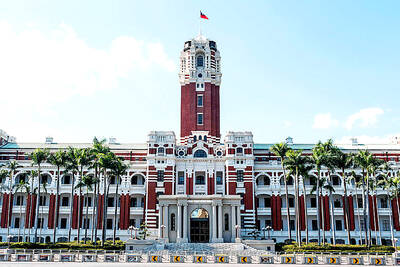
SECURITY: Taipei presses the US for arms supplies, saying the arms sales are not only a reflection of the US security commitment to Taiwan but also serve as a mutual deterrent against regional threats Taiwan is committed to preserving the cross-strait “status quo” and contributing to regional peace and stability, the Presidential Office said yesterday. “It is an undeniable fact that the Republic of China is a sovereign and independent democratic nation,” Presidential Office spokeswoman Karen Kuo (郭雅慧) reiterated, adding that Beijing has no right to claim sovereignty over Taiwan. The statements came after US President Donald Trump warned against Taiwanese independence. Trump wrapped up a state visit to Beijing on Friday, during which Chinese President Xi Jinping (習近平) had pressed him not to support Taiwan. Taiwan depends heavily on US security backing to deter China from carrying
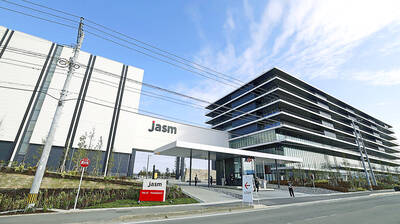
The subsidiary of Taiwan Semiconductor Manufacturing Co (TSMC, 台積電) in Kumamoto, Japan, turned a profit in the first quarter of this year, marking the first time the first fab of the unit has become profitable since mass production started at the end of 2024. According to the contract chipmaker’s financial statement released on Friday, Japan Advanced Semiconductor Manufacturing Inc (JASM), a joint venture running the fab in Kumamoto, posted NT$951 million (US$30.19 million) in profit in the January-to-March period, compared with a loss of NT$1.39 billion in the previous quarter, and a loss of NT$3.25 billion in the first quarter of
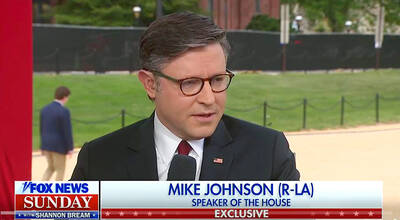
RESOLUTE BACKING: Two Republican senators are planning to introduce legislation that would impose immediate sanctions on China if it attempts to invade Taiwan US House of Representatives Speaker Mike Johnson on Sunday reaffirmed US congressional support for Taiwan, saying the US and “all freedom-loving people” have a stake in preventing China from seizing Taiwan by force. Johnson made the remarks in an interview with Fox News Sunday on US President Donald Trump’s summit with Chinese President Xi Jinping (習近平) last week. In an interview that aired on Friday on Fox News, just as Trump wrapped up a high-stakes visit to China, he said he has yet to green-light a new US$14 billion arms package to Taiwan and that it “depends on China.” “It’s a very good
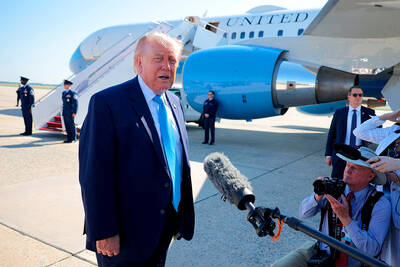
US President Donald Trump yesterday said he would speak to President William Lai (賴清德) as his administration considers whether to move ahead with a US$14 billion weapons sale to Taiwan — a potential arms deal that has drawn criticism from China. “Well, I’ll speak to him. I speak to everybody,” Trump told reporters yesterday when asked if he had any plans to call his counterpart, although he did not offer a time frame for when such a conversation could take place. Trump previously said he would speak to the person “that’s running Taiwan,” without specifying who he meant. “We have that situation very


 RSS
RSS