

Dozens of civic groups yesterday took to the streets of Taipei to vent their frustration over what they said was the government not taking responsibility for its handling of the tainted lard oil scandal, calling on Premier Jiang Yi-huah (江宜樺) to step down.
Chanting slogans such as “Waste oil hits, food safety ruined,” representatives of the Homemakers United Foundation, the Homemakers Union Consumers Coop, the National Alliance of Parents Organizations, the Taiwan Yucheng Victims’ Support Organization and other groups staged a protest in front of the Executive Yuan yesterday morning.
“Although the Executive Yuan has held several emergency meetings to seek ways to handle the snowballing tainted lard oil scare, it has yet to disclose the issues discussed or any consensus reached during the meetings, nor has it given a time line for when the scandal will be brought under control or what emergency measures it will implement to tackle a food scare that has had a widespread impact,” Homemakers United Foundation chairman Chiang Miao-ying (江妙瑩) said.
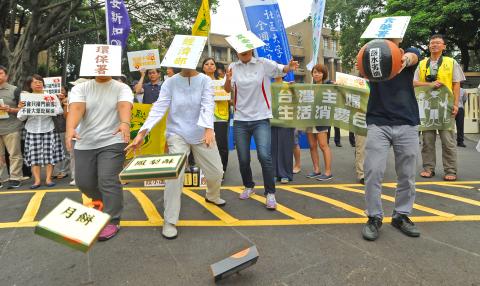
Photo: Liu Hsin-de, Taipei Times
Chiang also accused government agencies of shirking their responsibility during the scandal and failing to join forces to work out ways to improve the nation’s regulations on the sources of ingredients used in food, especially the Food and Drug Administration, the Council of Agriculture, the Ministry of Economic Affairs and the Environmental Protection Administration.
“The seemingly endless string of food scares in recent years has completely exposed the ineffectiveness of the government’s efforts to safeguard food safety,” Chiang said.
Chiang also criticized Jiang.
“If you cannot do your job, please step down. We will find someone else who can,” Chiang said.
Homemakers Union Consumers Coop chairman Hsu Hsiu-chiao (許秀嬌) said the group has spent years of effort trying to educate consumers to monitor what they eat by reading the ingredient labels, but its endeavors have repeatedly been nullified by food scares.
“Usually, government agencies do nothing to regulate food manufacturers and rely solely on ‘self-monitoring.’ When problems surface, they evade responsibility and have no desire to address them,” Hsu said.
Taiwan Yucheng Victims’ Support Organization standing director Lo Shih-hsiang (羅士翔) said the government’s indifference toward food safety is evidenced by its apparent attempts to downplay the potential health impacts of consuming recycled waste oil.
“The victims of PCB [polychlorinated biphenyl] poisoning have for years been forced to live with the painful trauma left by a food scare [in 1979], yet their suffering and predicament seem insufficient to awaken the government to the importance of food safety,” Lo said.
The 1979 scandal involved rice bran oil laced with PCB — a group of industrial chemicals that can cause long-term skin problems if consumed in large amounts — that affected more than 2,000 people across the nation.
National Alliance of Parents Organizations supervisor Huang Tsung-chih (黃聰智) said the tainted lard oil scandal has unnerved many parents nationwide, who fret that the government’s inability to monitor the quality of raw materials could leave their children vulnerable to more contaminated food.
Tsai Meng-lun (蔡孟倫), an adviser at the Executive Yuan’s Department of the Interior, Health, Welfare and Labor, received the petition from the groups.
The groups also issued three demands: that the Executive Yuan immediately hold inter-ministerial food safety conferences to seek ways to make the control of food materials at the source more stringent; that the government establish a mechanism to allow the public to help monitor food safety risks; and that a law on dietary education be implemented as soon as possible.

PATROL PARTNERS: The ‘Chiayi’ and the ‘Penghu’ departed for a two-day joint patrol of Palau’s exclusive economic zone, the CGA’s second diplomatic visit to the country The Coast Guard Administration (CGA) set a record for its southernmost deployment of a coast guard vessel as the vessels Chiayi and the Penghu reached Palau’s Pulo Anna Island on Saturday in a cooperative exercise between the two countries. The island, about 217 nautical miles (401km) southwest of Koror in the Palauan state of Sonsorol and 1,220 nautical miles from Taiwan’s southernmost point, Oluanpi (鵝鑾鼻), is the furthest south a CGA vessel has sailed. The two vessels are in Palau for the coast guard’s second diplomatic visit to the country. They docked at Malakal Harbor on Tuesday last week. The coast guard

The government is monitoring online rumors that a pneumonic plague outbreak has spread from Russia into China, and it might enhance quarantine measures, Premier Cho Jung-tai (卓榮泰) said yesterday. During a legislative meeting, Democratic Progressive Party Legislator Wang Ting-yu (王定宇) said that rumors had circulated that the disease had spread across several Chinese provinces. He asked Cho whether the government was prepared to prevent the disease spreading to Taiwan, given the volume of traffic between the two sides, and how concerned the government was about the alleged outbreak. The Ministry of Health and Welfare had implemented border quarantine measures after briefing the Executive
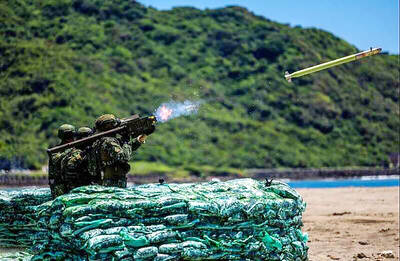
BATCH 1: The military has plans to assign the weapons to the army to defend Taiwan proper, as well as outlying islands and the navy for the Marine Corps, the official said Taiwan is to receive 500 Stinger missiles and 178 launchers from the US by the end of the year, the first batch under a planned two-stage acquisition totaling 2,621 missiles and 763 launchers, a defense official said yesterday on condition of anonymity. The portable missiles would play a vital role in the nation’s air defense capabilities, the source said. The army plans to deploy 2,235 missiles and 657 launchers to defend Taiwan proper and outlying islands, they said, citing military documents. The navy is allotted 295 missiles and 85 launchers to arm the Marine Corps and some surface vessels that lack air defense
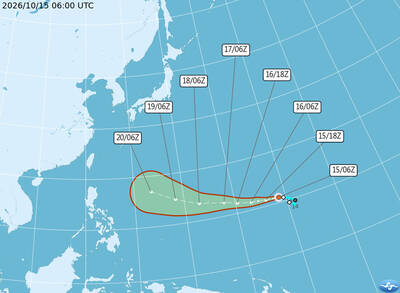
EAST OF GUAM: Tropical Storm Champi is forecast to strengthen into a typhoon, but its effect on Taiwan is uncertain due to the presence of a high-pressure system Tropical Storm Champi formed yesterday and has the potential to increase in strength, the Central Weather Administration (CWA) said yesterday. Forecasters are closely monitoring a Pacific high-pressure system that would dictate whether the storm turns north or moves toward Taiwan next week, the CWA said. The most likely scenario is that it turns northward after passing the Ryukyu Islands, CWA forecaster Cheng Chieh-jen (鄭傑仁) said. As of 8pm yesterday, Champi was east of Guam moving west-northwest at 20kph, CWA data showed. It had maximum sustained winds near the center of 72kph and gusts of up to 101kph, the data showed. If the Pacific high-pressure system


 RSS
RSS