


Charged with leaking state secrets, former Mainland Affairs Council deputy minister Chang Hsien-yao (張顯耀) yesterday appeared at the Taipei District Prosecutors’ Office without having received a notice of subpoena from the prosecutors.
“I am here to bring the truth to light,” he said upon his arrival at 10:30am. “All the rumors [alleging] that I have leaked state secrets [to China], divulged where [Taiwan’s] bottom lines were during [cross-strait] negotiations, and given documents classified as secrets to [Chinese officials] are absolutely not true.”
Chang was Taiwan’s second-highest ranked negotiator with China, and concurrently served as vice chairman and secretary-general of the Straits Exchange Foundation, before the Executive Yuan announced on Aug. 16 that he resigned from his posts.
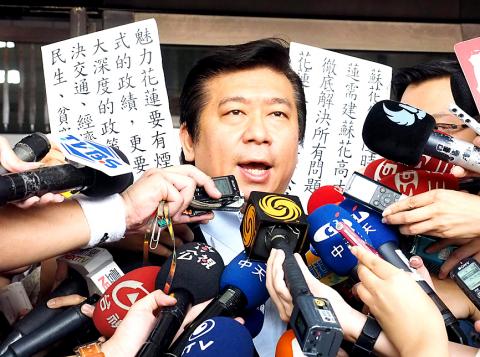
Photo: EPA
Following a string of allegations, mostly made by unnamed sources in media reports after Chang said in a statement on Aug. 17 that he was forced to resign, the prosecutors’ office accepted a request by the Ministry of Justice’s Investigation Bureau on Friday last week to look into the charges laid against him.
In front of cameras, Chang yesterday remained tight-lipped over what he said were possible issues he has attended to that led to the accusations, saying that he could not tell the public what he had told the prosecutors because they were state secrets.
Asked whether the government’s failed attempts to schedule a meeting between President Ma Ying-jeou (馬英九) and Chinese President Xi Jinping (習近平) had anything to do with his downfall, Chang said he he was not aware of that, but might have “offended someone” when he handled the issue.
“As far as whom I might have offended, the answer is obvious,” Chang said.
A report carried in the Chinese-language Apple Daily newspaper yesterday said that Chang has attributed his ouster to his role in handling the proposed Ma-Xi meeting, based on a handwritten note that Chang held at a press conference on Thursday last week, which was photographed by the newspaper’s photojournalists.
Chang did not read that part of the note at the press conference where he accused Ma of being “hijacked” by a handful of people and being deceived into believing the allegations against him. He also refrained from describing what the issues involved could be at the conference.
Chang advised civil servants to take “necessary precautions” to avoid “ending up like him.”
Chang also offered an apology to civil servants, saying that he felt sadness and regret over the repercussions following what happened to him over the previous week.
“It has sparked fear among civil servants. Everyone is now anxious and cannot relax at their jobs,” he said while leaving the prosecutors’ office after being questioned.
Civil servants could be investigated under the suspicion of leaking secrets if they follow orders from their superiors in handling external negotiations when the orders are not written in a signed and sealed government document, Chang said.
Chang said that civil servants had better not deviate from scripted remarks written on a signed and sealed government document when they engage in negotiations with foreign powers, that they must have government documents securely delivered to their negotiation partners via DHL or other logistics services, such as post offices, instead of personally handing documents to their counterparts, and they must record any telephone calls they make.
“[Doing so] is to avoid facing trials for leaking secrets,” Chang said.
After Chang’s interrogation, Taipei District Prosecutors’ Office spokesman Huang Mou-hsin (黃謀信) said later yesterday that the office has listed him as a defendant and restricted him to his place of residence.
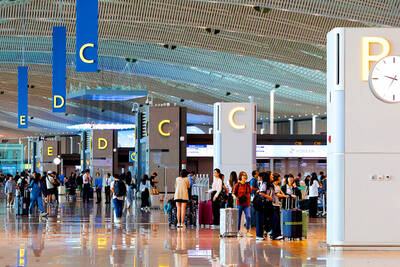
South Korea has adjusted its electronic arrival card system to no longer list Taiwan as a part of China, a move that the Ministry of Foreign Affairs said would help facilitate exchanges between the two sides. South Korea previously listed “Taiwan” as “Taiwan (China)” in the drop-down menus of its online arrival card system, where people had to fill out where they came from and their next destination. The ministry had requested South Korea make a revision and said it would change South Korea’s name on Taiwan’s online immigration system from “Republic of Korea” to “Korea (South),” should the issue not be

Tainan, Taipei and New Taipei City recorded the highest fines nationwide for illegal accommodations in the first quarter of this year, with fines issued in the three cities each exceeding NT$7 million (US$220,639), Tourism Administration data showed. Among them, Taipei had the highest number of illegal short-term rental units, with 410. There were 3,280 legally registered hotels nationwide in the first quarter, down by 14 properties, or 0.43 percent, from a year earlier, likely indicating operators exiting the market, the agency said. However, the number of unregistered properties rose to 1,174, including 314 illegal hotels and 860 illegal short-term rental
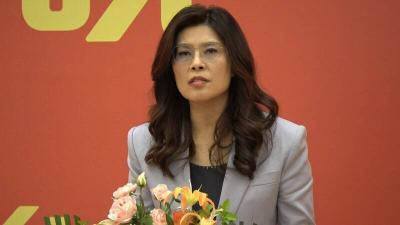
Both sides of the Taiwan Strait share a political foundation based on the “1992 consensus” and opposition to Taiwanese independence, Chinese Nationalist Party (KMT) Chairwoman Cheng Li-wun (鄭麗文) today said during her meeting with Chinese President Xi Jinping (習近平). Both sides of the Strait should plan and build institutionalized and sustainable mechanisms for dialogue and cooperation based on that foundation to make peaceful development across the Strait irreversible, she said. Peace is a shared moral value across the Strait, and both sides should move beyond political confrontation to seek institutionalized solutions to prevent war, she said. Mutually beneficial cross-strait relations are what the
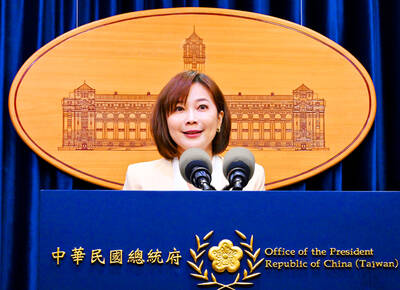
ECONOMIC COERCION: Such actions are often inconsistently applied, sometimes resumed, and sometimes just halted, the Presidential Office spokeswoman said The government backs healthy and orderly cross-strait exchanges, but such arrangements should not be made with political conditions attached and never be used as leverage for political maneuvering or partisan agendas, Presidential Office spokeswoman Karen Kuo (郭雅慧) said yesterday. Kuo made the remarks after China earlier in the day announced 10 new “incentive measures” for Taiwan, following a landmark meeting between Chinese President Xi Jinping (習近平) and Chinese Nationalist Party (KMT) Chairwoman Cheng Li-wun (鄭麗文) in Beijing on Friday. The measures, unveiled by China’s Xinhua news agency, include plans to resume individual travel by residents of Shanghai and China’s Fujian


 RSS
RSS